HappyHorse 1.0 vs Seedance 2.0: Which AI Video Model Wins in 2026?
HappyHorse 1.0 leads on benchmarks. Seedance 2.0 leads on documentation, multimodal inputs, and reference-driven control. On Artificial Analysis Video Arena (April 2026), HappyHorse beats Seedance in three of four categories, with Seedance taking only Image-to-Video with audio (1182 vs 1167 Elo). For most creators, the right answer is not "pick one" but "route the shot to the model that fits it.
Alibaba's stealth #1 model went public. HappyHorse 1.0 (快乐小马) appeared anonymously on the Artificial Analysis leaderboard on April 7, 2026. Alibaba confirmed authorship April 10. The fal API launched April 26. With an aggregate score of 1381 Elo, it holds a 107-point lead over every other ranked model — the widest gap any single release has opened since Veo 3 shipped.
Seedance 2.0, ByteDance's February 2026 release, briefly held the throne. It is still the most flexible AI video model in production: 12-file multimodal inputs, the @ reference system, native audio with phoneme-level lip-sync in 8+ languages, 2K output. Seedance built the workflow vocabulary the rest of the field is copying.
This is the honest head-to-head. Real Elo numbers, real architecture differences, a per-use-case routing map. No "revolutionary" puffery on either side.
At a Glance: Specs and Leaderboard Position
| Spec | HappyHorse 1.0 | Seedance 2.0 |
|---|---|---|
| Maker | Alibaba ATH-AI | ByteDance |
| Released | April 26, 2026 (fal API) | February 2026 |
| Architecture | Single-stream 40-layer Transformer (~15B params) | Dual-branch multimodal joint generation |
| Native audio | Yes — single forward pass | Yes — dual-branch sync |
| Lip-sync languages | 7 (EN, ZH, YUE, JA, KO, DE, FR) | 8+ (broader coverage) |
| Output resolution | 1080p HD native | 2K (2048p) native |
| Max clip length | 12s lite / 15s paid | 4–15s, extendable |
| Generation speed | ~10s avg (~38s for 1080p / H100) | ~30–40% slower on equivalent prompts |
| Input modalities | Text + image | Text, up to 9 images, 3 videos, 3 audio (12 files total) |
| Reference control | Standard text + image | @camera, @action, @effect, @style |
| Video extension | Not yet supported | Yes — extend without regen |
| Aggregate Elo (Apr 2026) | 1381 (#1) | — |
The shape of the comparison is already clear. HappyHorse is the leaner, faster, leaderboard-winning model with the simpler input surface. Seedance is the heavier, more flexible, more workflow-friendly model that loses on raw quality scores but wins on what you can pipe into it.
The Benchmark Deep-Dive: Four Categories, Three Wins for HappyHorse
The Artificial Analysis Video Arena runs blind side-by-side comparisons with public Elo scoring. As of April 2026, here are the per-category numbers for these two models:
| Category | HappyHorse 1.0 (Elo) | Seedance 2.0 (Elo) | Winner |
|---|---|---|---|
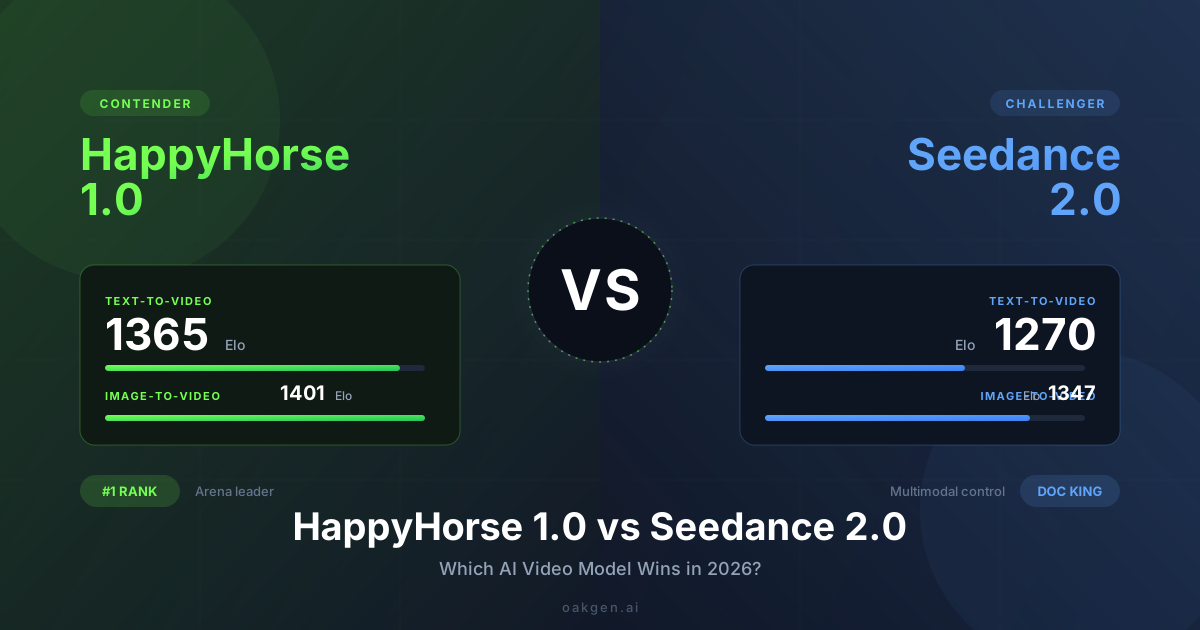
| Text-to-Video (no audio) | 1365 | 1270 | HappyHorse +95 |
| Image-to-Video (no audio) | 1401 | 1347 | HappyHorse +54 |
| Text-to-Video (with audio) | 1230 | 1221 | HappyHorse +9 |
| Image-to-Video (with audio) | 1167 | 1182 | Seedance +15 |
Three observations the headline number hides.
The T2V gap is the largest. A 95-point Elo spread on T2V (1365 vs 1270) is a serious blind-test margin. For pure text-prompted clips with no reference image, HappyHorse is the stronger model.
The audio-on categories are nearly tied. With native audio on, the gap narrows to 9 points on T2V+audio and flips 15 points to Seedance on I2V+audio. Both are inside the noise floor for any single render.
Seedance wins one category — and it's the one most creators care about. Image-to-Video with audio is the modal workflow for product demos, character spots, and reference-driven UGC. Seedance leading by 15 points there is meaningful. If your pipeline starts with a hero still and ends with a clip that talks, Seedance's I2V+audio score is a real argument for it.
Architecture: Single-Pass vs Joint Generation
This is where the two models diverge most. The output behaviors flow from these design choices.
HappyHorse 1.0: Single-stream 40-layer Transformer
HappyHorse generates video and audio in one forward pass through a single ~15B-parameter Transformer. No cross-attention bridge between separate models, no second model bolted on for sound. The same attention layers that compute pixel motion compute the audio waveform alongside it.
Consequences: ~10s typical generation (~38s for 1080p on H100), roughly 30–40% faster than Seedance on matched prompts. Audio-video timing locks naturally — footsteps land on impact frames, lip movement matches phoneme onsets without a separate sync step. The streams cannot drift because they are not produced by separate models. The trade is control: you cannot keep the video and regenerate only the audio. Every render is a full render.
Seedance 2.0: Dual-branch joint generation with multimodal fusion
Seedance processes video and audio along parallel branches and fuses them. The architecture is designed from the ground up to accept many input types at once — image, video, audio, and text references in the same prompt with semantic understanding across them.
Consequences: 30–40% longer generation time on matched prompts. Native 2K (vs HappyHorse's 1080p). Far richer input control — covered in the next section. Video extension without regen: render 5 seconds, review, extend to 15 seconds with continuity preserved. HappyHorse has no equivalent yet.
Neither architecture is "better" in the abstract. Single-pass wins when you want fast, coherent text-to-video. Dual-branch joint generation wins when your starting material is not a blank text prompt.
Input Modalities: This Is Where Seedance Still Owns the Workflow
HappyHorse accepts text and image. That is the entire input surface — write a prompt, optionally attach a starting frame, generate.
Seedance 2.0 accepts up to 12 files in a single request: 9 images, 3 video clips (15s max each), 3 audio files (15s max each). On top of any video input, the @ reference system extracts specific attributes:
@camera— replicate camera movement (dolly, tracking, push-in, reveal)@action— copy choreography, gait, gesture, body motion@effect— transfer transitions, color shifts, speed ramps@style— match grading, palette, aesthetic
This is structured extraction, not style transfer. Upload a 4-second tracking shot tagged @camera, supply an entirely different subject in your text prompt and image, and Seedance applies that exact camera behavior to your new content.
For workflows that start with reference material — brand footage, a director's shot list, an editor's reference reel — there is no comparable feature on HappyHorse in April 2026. For workflows that start with a text prompt and a hero still, HappyHorse's text + image is enough, and you get the leaderboard-leading output and ~30–40% faster renders as the trade.
HappyHorse just dropped. The prompt library, community examples, and best-practice guides that exist for Seedance after three months in production do not exist for HappyHorse yet. If you need a starting prompt for a specific shot type today, you'll find five worked examples on Seedance for every one on HappyHorse. That gap will close, but it is real on April 29, 2026.
When HappyHorse 1.0 Wins
Pure text-to-video. The 95-point T2V Elo gap is the largest spread in any category. If your input is a text prompt and you want the highest-quality output the public leaderboard knows about, HappyHorse is the call.
Speed-critical batch work. ~10s typical generation vs Seedance's 30–40% longer renders. Across a 50-clip batch, that compounds. For ad-creative iteration where you re-roll until you ship, time saved compounds further.
Multilingual lip-sync. Seven languages built in: English, Mandarin, Cantonese, Japanese, Korean, German, French. Seedance has broader nominal coverage (8+), but HappyHorse's Mandarin/Cantonese pairing is the strongest current model on that pair specifically — unsurprising given Alibaba's training data access.
Image-to-video without audio. 1401 vs 1347 (54-point gap). HappyHorse is the better pick for animating a hero still into silent motion — B-roll, atmospheric inserts, music-bed cuts where you layer audio in post.
Single-pass a/v coherence. When audio and video have to lock tightly — a hammer hitting a nail, a clap on the beat, a footstep on impact — HappyHorse's single forward pass produces tighter sync than dual-branch generation on average. The streams cannot drift because they share the same attention layers.
When Seedance 2.0 Wins
The honest section. Seedance is not the leaderboard winner anymore, but it wins on dimensions the leaderboard does not measure.
Reference-driven shots. The @ system is unique. If you have reference footage and want a specific camera move or action choreography on new content, Seedance is the only model that does this natively. HappyHorse has no equivalent.
Multi-reference workflows. A product image, a brand video for camera, and an audio track for beat matching — into a single generation. Seedance handles 12 files. HappyHorse handles text plus one image.
Image-to-video with audio. The one Elo category Seedance still owns: 1182 vs 1167. For talking-head spots, character animation with sound, and product demos with synced audio, Seedance is the better-scoring model in blind tests.
Higher native resolution. 2K vs 1080p. For deliverables headed to 4K, Seedance starts closer to target.
Video extension without regen. Render 5s, review, extend to 15s with continuity preserved. HappyHorse does not support this yet.
Documented prompt library. Three months of production usage means the Seedance vocabulary is mapped. The HappyHorse one is not yet.
Beat-matched music videos. Upload an audio track and Seedance times visual cuts to it. HappyHorse generates audio with video but does not accept audio as input.
If any of those are core to your workflow, the leaderboard ranking does not matter. Seedance is the model.
Generate HappyHorse 1.0 Videos Now
Practical Routing: Which Model for Which Shot
A simple decision tree that matches the benchmarks and the architectural strengths. Not sure which to try first? Ask Oakgen's AI assistant — describe your project and it will suggest the right model and settings.
| Shot type | Pick | Why |
|---|---|---|
| Pure T2V hero shot, no audio | HappyHorse 1.0 | +95 Elo on T2V, faster render, leaderboard #1 |
| I2V silent B-roll | HappyHorse 1.0 | +54 Elo on I2V (no audio), ~10s gen |
| Talking-head UGC ad with synced audio | Seedance 2.0 | +15 Elo on I2V+audio, broader lip-sync |
| Product demo from reference camera move | Seedance 2.0 | @camera on a reference video; HappyHorse can't |
| Multilingual ad in EN/ZH/JA/KO/DE/FR | HappyHorse 1.0 | Native 7-language lip-sync, single-pass sync |
| Music video with beat-matched cuts | Seedance 2.0 | Audio input + beat alignment |
| 50-clip overnight batch | HappyHorse 1.0 | 30–40% faster compounds across the batch |
| 4K-target deliverable | Seedance 2.0 | 2K native vs 1080p — closer to target before upscale |
| Animation series with recurring character | Seedance 2.0 | Multi-reference image inputs, video extension |
| Tightly-synced foley (hammer/clap/impact) | HappyHorse 1.0 | Single-pass a/v locks tighter on average |
| First draft of a stitched 6-shot reel | Seedance 2.0 | Video extension and reference reuse across shots |
The bottom row of the table matters more than the top. Most production work routes shots to multiple models in the same project.
Honest Limitations on Both Sides
Things HappyHorse is not best at, even with the #1 ranking:
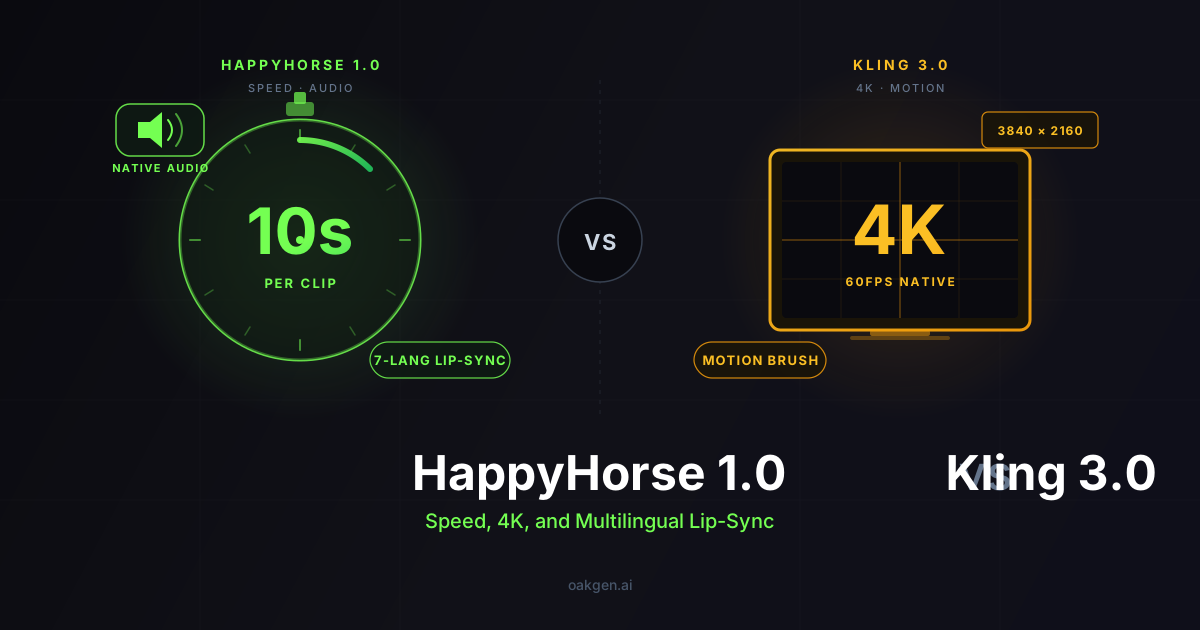
- 1080p ceiling. Kling 3.0 generates native 4K; HappyHorse does not.
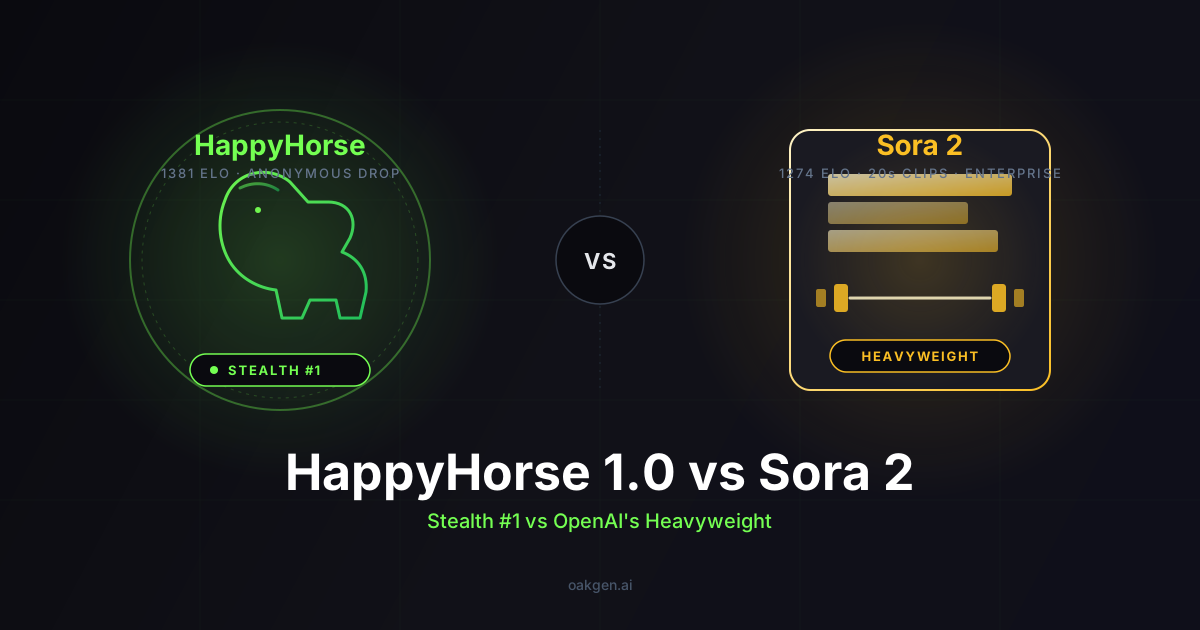
- Sora 2 supports 20-second single clips; HappyHorse caps at 15s (paid tier).
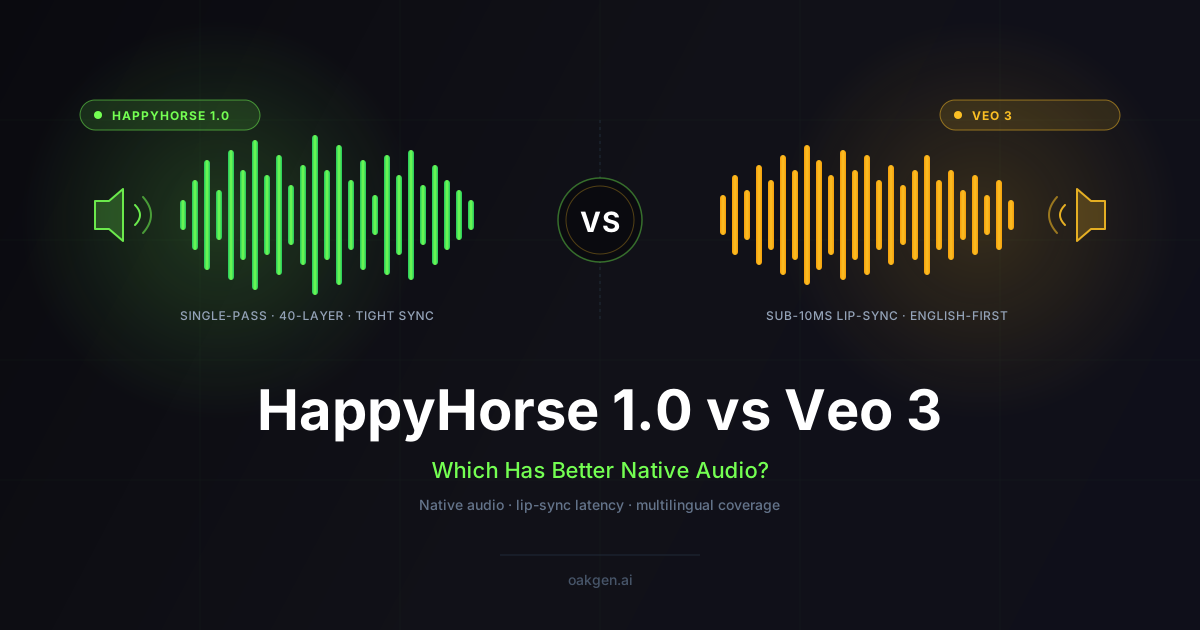
- Veo 3 still has tighter sub-10ms lip-sync latency for spoken English dialogue.
- Documentation is thin. The community prompt library will catch up over the next 60 days.
- No video, audio, or motion reference inputs.
Things Seedance is not best at, even with the workflow lead:
- Aggregate Elo. HappyHorse leads in three of four arena categories.
- Speed. ~30–40% slower on matched prompts.
- Single-pass a/v coherence. Dual-branch generation can produce subtle audio drift that single-pass does not.
On Oakgen, You Don't Have to Choose
Both models live in the AI video generator's model picker. Same credit pool, same workspace, same auth. Universal credits — 1 USD = 260 credits, no platform margin, third-party cost 1:1. No separate Seedance subscription, no separate HappyHorse subscription.
A representative 4-shot reel session:
- Hero opener (T2V cinematic): HappyHorse 1.0 — leaderboard-leading T2V.
- Product close-up (I2V with synced audio): Seedance 2.0 — better I2V+audio score.
- Camera-matched B-roll insert: Seedance 2.0 with
@cameraon a reference clip. - Multilingual end-card with lip-synced VO: HappyHorse 1.0 — single-pass sync across 7 languages.
The right answer for most production work in April 2026 is "HappyHorse for raw quality, Seedance for reference control, route per shot."
Earn 25% recurring on every referral.
Share Oakgen, get paid every month they stay.
Conclusion: The 107-Point Margin Is Not the Whole Story
HappyHorse 1.0 wins the leaderboard. Its aggregate Elo of 1381 sits 107 points clear of the field — a margin no single model release has matched since Veo 3. Across three of four arena categories — T2V, I2V, T2V+audio — HappyHorse outscores Seedance 2.0 by margins ranging from 9 to 95 Elo points.
Seedance 2.0 wins on dimensions the leaderboard does not measure: the @ reference system, the 12-file multimodal input surface, video extension without regen, 2K native output, and the I2V+audio category where it leads by 15 points.
HappyHorse is the new default for pure T2V and silent I2V work. Seedance remains the default for reference-driven, multi-input, and audio-synced production. Both are on Oakgen on the same credit pool. If you only test one this week, test HappyHorse — it's the news. If you ship one workflow this month, you'll probably ship it on both.
Frequently Asked Questions
Is HappyHorse 1.0 better than Seedance 2.0?
On raw output quality, yes — HappyHorse leads in three of four Artificial Analysis arena categories (T2V, I2V, T2V+audio). But Seedance wins on workflow flexibility: multi-file inputs, the @ reference system, video extension, and 2K native resolution. Neither model dominates every use case. The best choice depends on whether your project starts from a text prompt (HappyHorse) or from reference material (Seedance).
Can I use both HappyHorse and Seedance on Oakgen?
Yes. Both models are available in the same AI video generator model picker. They draw from the same credit pool — no separate subscriptions, no separate accounts. You can route individual shots to whichever model fits, within the same project. See pricing for per-model credit costs.
Which model has better native audio-video sync?
HappyHorse produces audio and video in a single forward pass through one Transformer, so the two streams cannot drift apart. Seedance uses a dual-branch architecture that fuses audio and video separately, which can introduce subtle timing drift on occasion. For foley-heavy clips (impacts, claps, footsteps), HappyHorse's single-pass approach typically locks tighter. For dialogue-driven clips with lip-sync, both models perform well, and Seedance covers more languages (8+ vs 7).
What is Seedance 2.0's @ reference system and does HappyHorse have it?
The @ reference system lets you tag an uploaded video clip with a semantic label — @camera, @action, @effect, or @style — and Seedance extracts that specific attribute to apply to your new generation. For example, upload a tracking shot tagged @camera and Seedance replicates that exact camera move on entirely different content. HappyHorse 1.0 has no equivalent as of April 2026. For a full walkthrough, see the Seedance 2.0 complete guide.
How much do HappyHorse and Seedance cost on Oakgen?
Oakgen uses universal credits at a flat conversion of 1 USD = 260 credits with zero platform margin — you pay the third-party provider cost 1:1. HappyHorse renders faster (~10s typical), so per-clip credit spend is comparable despite different architectures. Check the pricing page for exact credit costs per model, resolution, and clip length.
Which model should I pick for product demo videos?
If your demo starts with a product photo and needs synced voiceover or sound effects, Seedance 2.0 is the stronger pick — it leads HappyHorse by 15 Elo on I2V+audio, and the @camera tag lets you match a reference camera move. If your demo is text-prompted with no reference footage, HappyHorse delivers higher-quality output faster. For complex demos mixing both styles, use both models in the same Oakgen workspace and ask the AI assistant for model recommendations per shot.
What to read next
- HappyHorse 1.0 Review: Alibaba's #1 AI Video Model Tested on Oakgen — the full single-model review with hands-on prompt tests and shot-by-shot output assessment.
- HappyHorse 1.0 vs Veo 3: Which Has Better Native Audio in 2026? — the audio-focused head-to-head, including dialogue lip-sync latency and language coverage.
- Best AI Video Model with Native Audio in 2026 (Tested) — the broader native-audio roundup across HappyHorse, Seedance, Veo, and Kling.
- Seedance 2.0: Complete Guide to ByteDance's Multi-Modal AI Video Model — everything about Seedance's architecture, the @ reference system, and multimodal inputs in one place.
- Best AI Video Generators in 2026: Every Model Ranked — the full leaderboard breakdown covering HappyHorse, Seedance, Veo 3, Kling 3.0, Sora 2, and more.