HappyHorse 1.0 vs Veo 3: Which Has Better Native Audio in 2026?
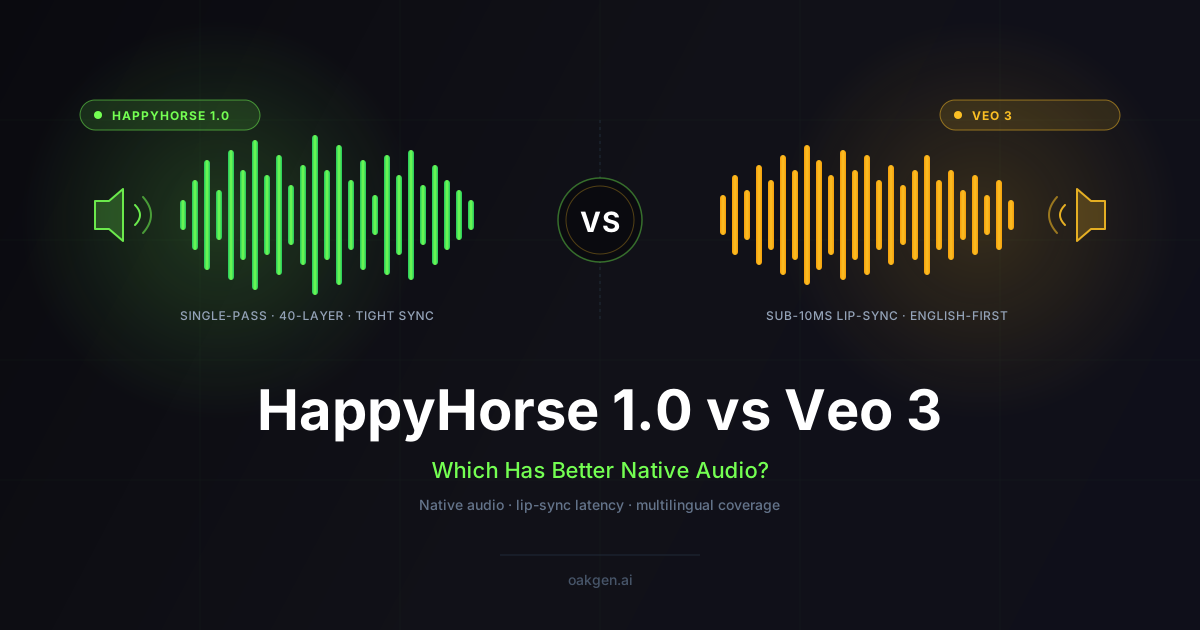
Both ship native audio. The architectures are not the same. HappyHorse 1.0 from Alibaba generates audio and video in a single forward pass on a unified Transformer stack with no cross-attention bridge between the two modalities. Veo 3 from Google DeepMind keeps a tighter dialogue lip-sync pipeline tuned for spoken English at sub-10ms latency. The verdict in 2026 is split: Veo wins English explainer and broadcast dialogue work, HappyHorse wins multilingual lip-sync and the Artificial Analysis leaderboard ranking. If you ship in Mandarin, Cantonese, or Japanese, the choice is already made.
The interesting thing about the April 2026 video model landscape is that "native audio" stopped being a differentiator and started being a category. Veo 3 set the bar in 2025 with its first-pass dialogue generation. A year later, HappyHorse 1.0 stealth-launched on the Artificial Analysis Video Arena on April 7, claimed the #1 aggregate slot by a decisive 107-point Elo gap, and shipped on the fal API on April 26 with native audio in 7 languages. Both models now generate sound and picture together. The question is which architecture wins which shot.
This piece walks the spec sheet, the architecture difference, and the per-language coverage — then lays out which of the two earns its credits on which kind of work. If you want to explore the broader text-to-video landscape or learn about native audio video generation in general, we have deeper guides on those as well.
The Native Audio Spec Comparison
Both models output audio as part of the same generation. Neither bolts on a separate TTS pass. Beyond that surface match, the architectures and the language coverage diverge. Here is the head-to-head:
| Spec | HappyHorse 1.0 | Veo 3 |
|---|---|---|
| Maker | Alibaba ATH-AI | Google DeepMind |
| Architecture | Unified multi-modal Transformer (~15B params, 40 layers) | Cross-attention dialogue model |
| Audio + video synthesis | One forward pass, no cross-attention | Tightly coupled, separate dialogue track |
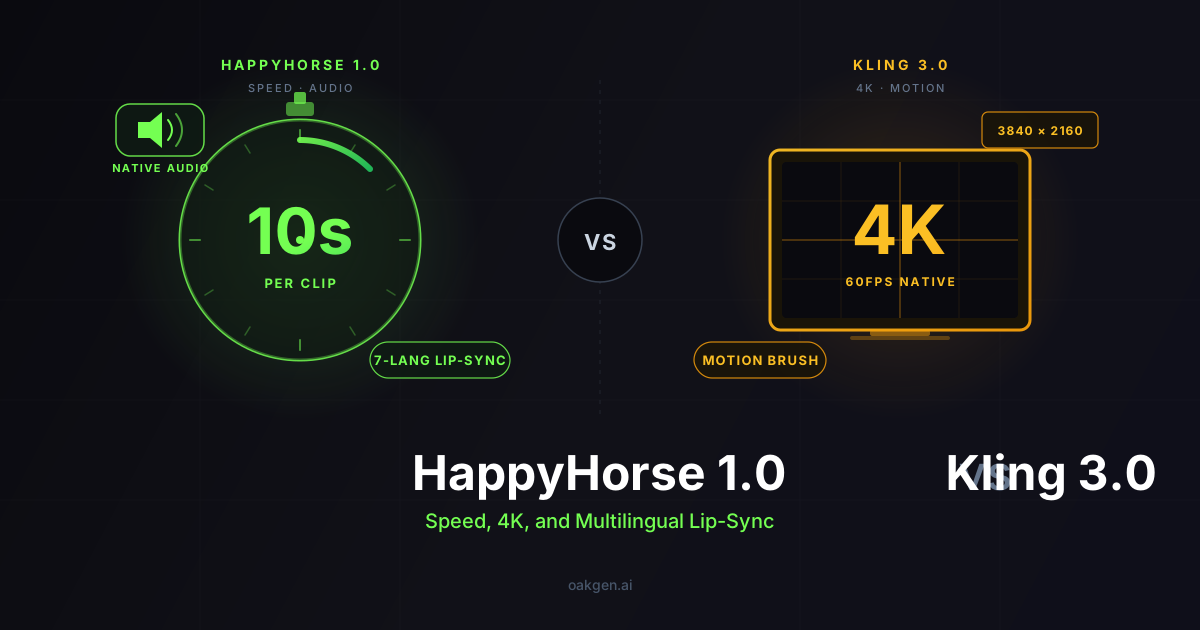
| Native resolution | 1080p HD | Up to 4K (24fps) |
| Generation speed (avg) | ~10s typical, ~38s for 1080p on H100 | Slower on equivalent prompts |
| Lip-sync latency (English) | Acceptable | Sub-10ms (best in class) |
| Lip-sync languages | 7 (English, Mandarin, Cantonese, Japanese, Korean, German, French) | 30+ (variable quality) |
| Mandarin/Cantonese lip-sync quality | Top-quality (native-team trained) | Weaker than English |
| Max clip length | 12s Lite, 15s paid | 8-10s typical |
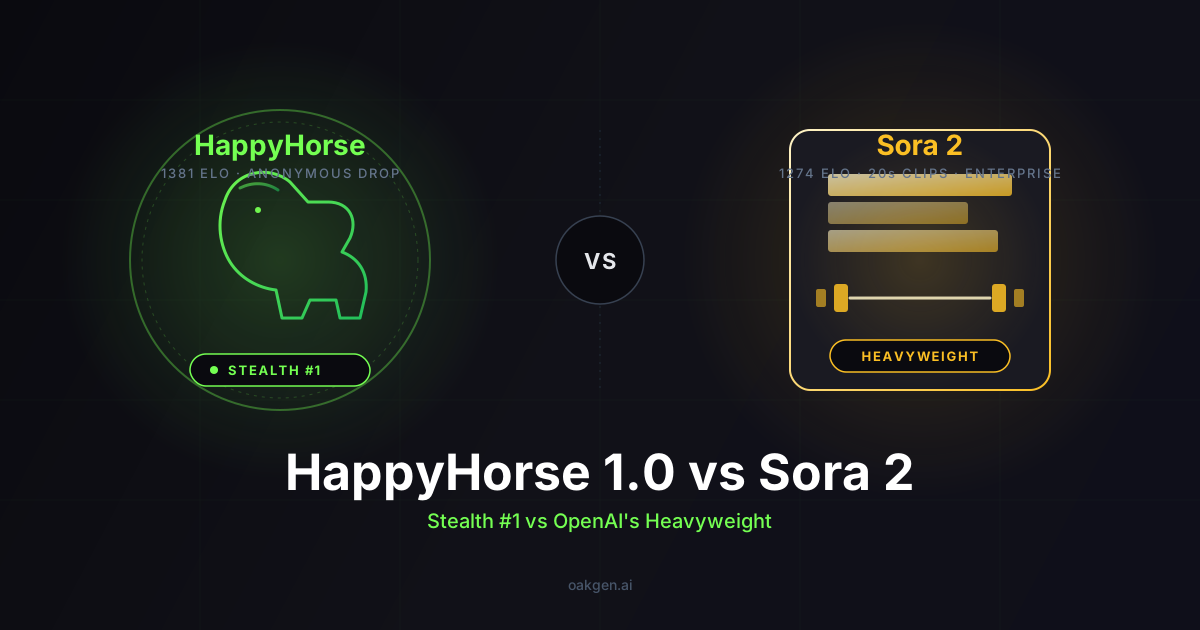
| Aggregate Elo (Artificial Analysis) | 1381 (#1, +107 over runner-up) | Lower |
| Input modalities | Text, image | Text, image, two-frame steering |
| Best at | Multilingual dialogue, leaderboard scenes | English dialogue, cinematic explainers |
The numbers carry two stories. On English-only shots with tight lip-sync demands, Veo's sub-10ms pipeline is still the cleanest you can get. On every other axis where multilingual reach or single-pass synthesis matters, HappyHorse pulls ahead. Both observations can be true at the same time.
Architecture: Single-Pass vs Coupled Dialogue Model
The technical difference between these two models matters more than most spec sheets show.
HappyHorse 1.0 is built on a roughly 15-billion-parameter Transformer stacked 40 layers deep, but the key design decision is not the scale — it is the fusion strategy. Audio tokens and video tokens share the same attention layers end to end. There is no auxiliary cross-attention module stitching two separate encoders together, no late-stage waveform merger, no dialogue-specific branch. Frames and audio emerge from one unified forward pass. That architectural bet has downstream consequences: mouth shapes, ambient sound, environmental reverb, and spoken dialogue all live inside the same temporal representation. When a generated character pauses mid-sentence, the room tone pauses with them. When they shout, the reverb in the room scales. This single-stream design is a large part of why HappyHorse dominates the Artificial Analysis aggregate ranking and why its multilingual lip-sync holds across 7 languages without a per-language audio retraining step.
Veo 3 takes a different path. The model couples a dialogue-tuned audio pipeline tightly with the video stream and runs an aggressive lip-sync alignment pass that hits sub-10ms latency on spoken English. The result on a single-character English explainer is genuinely the best in the field — Veo can land a 6-second on-camera read where HappyHorse occasionally drifts on a hard consonant. The trade-off is that the dialogue pipeline is tuned hardest for English. On Mandarin, Cantonese, Japanese, and several other tonal or non-Indo-European languages, the alignment quality degrades.
Practical read: if you imagine the audio as a separate stream the model has to align with the video, you get something close to Veo. If you imagine the audio as part of the same temporal cloth the video is woven from, you get something close to HappyHorse.
Language Coverage: Veo's 30+ vs HappyHorse's 7 (and Why It's Closer Than It Looks)
The headline language number favors Veo. Google publishes 30+ supported languages for Veo 3 audio. HappyHorse confirmed 7. On a count, that is more than a 4x gap. On quality, the gap inverts in three of HappyHorse's languages.
HappyHorse's 7 languages: English, Mandarin, Cantonese, Japanese, Korean, German, French. The model was trained at Alibaba ATH-AI, which means the Mandarin and Cantonese pipelines went through the same engineering rigor as English at most Western labs. The Mandarin lip-sync, in particular, holds tone shape on the four lexical tones in a way that English-tuned models do not — Mandarin mouth movement on a falling-rising tone (ma3) is visibly different from a high-level tone (ma1), and HappyHorse picks up that distinction. Cantonese, with its 6-9 tones depending on how you count, gets similar treatment. Japanese mora-timing — the slight beat structure that distinguishes "Tokyo" from "Tookyoo" — lands cleanly.
Veo 3's coverage is broader but uneven. English is exceptional. Spanish, French, German, and Portuguese are strong. Mandarin is acceptable but visibly weaker than HappyHorse — mouth shapes drift on tones, and a side-by-side test on the same prompt typically reads "dubbed" on Veo and "native" on HappyHorse. Cantonese is in the supported list but in practice generates lip movement that does not track the tone glides. Several other languages in the 30+ count are technically supported but ship at noticeably reduced quality.
The honest framing: Veo's count is bigger, HappyHorse's coverage is deeper where it claims it. If you ship in English, German, French, or one of Veo's strong tier, Veo's count advantage is real. If you ship in Mandarin, Cantonese, Japanese, or Korean, HappyHorse's 7-language list is the better sheet on quality. If you need voiceover or narration in languages neither model covers natively, you can always generate the dialogue separately using Oakgen's AI Audio Generator with ElevenLabs TTS and composite it in post.
Sample Prompt: A Side-by-Side English Dialogue Read
The easiest way to feel the difference is the same prompt run on both. Here is a 6-second talking-head explainer:
A woman in her early thirties sits at a wooden desk in front of a
bookshelf. Soft afternoon light. She looks directly at the camera and
says, in clear American English: "We tested both models on the same
prompt today, and the results genuinely surprised us." Natural
breathing, no music, slight room tone. 1080p, 6 seconds.
On Veo 3, the lip movement is locked to the audio in a way that reads broadcast. Plosives ("tested," "prompt") land on the right frame. The slight breath before "genuinely" is visible in her shoulders. There is no perceptible drift across the full 6 seconds. This is the work Veo was built for.
On HappyHorse 1.0, the result is very close. Lip-sync holds for the full clip. The room tone is right. The shoulders carry the breath. On a hard consonant cluster, you can occasionally see a single frame where mouth shape sits a beat off audio — call it 30-50ms drift on one of the harder words. Most viewers will not see it. A broadcast editor will.
Now run the same scene in Mandarin:
Same setup. She says, in Mandarin Chinese: "我们今天测试了这两个模型,
结果让我们感到惊讶。" (Wǒmen jīntiān cèshì le zhè liǎng gè móxíng,
jiéguǒ ràng wǒmen gǎndào jīngyà.) Natural breathing, no music.
On HappyHorse, the four-tone shape on each character lands. The mouth opens differently for jīntiān (high-level then falling) than for cèshì (falling then falling). On Veo, the mouth movement averages across the tones and the shot reads dubbed. This is the case where HappyHorse takes the credit.
When HappyHorse 1.0 Wins
Three cases where HappyHorse is the right call in 2026:
- Multilingual content for global launches. If your video ships in English plus Mandarin, Cantonese, Japanese, Korean, German, or French, HappyHorse's lip-sync is the most consistent across the whole set. One model, one prompt structure, seven languages that hold quality.
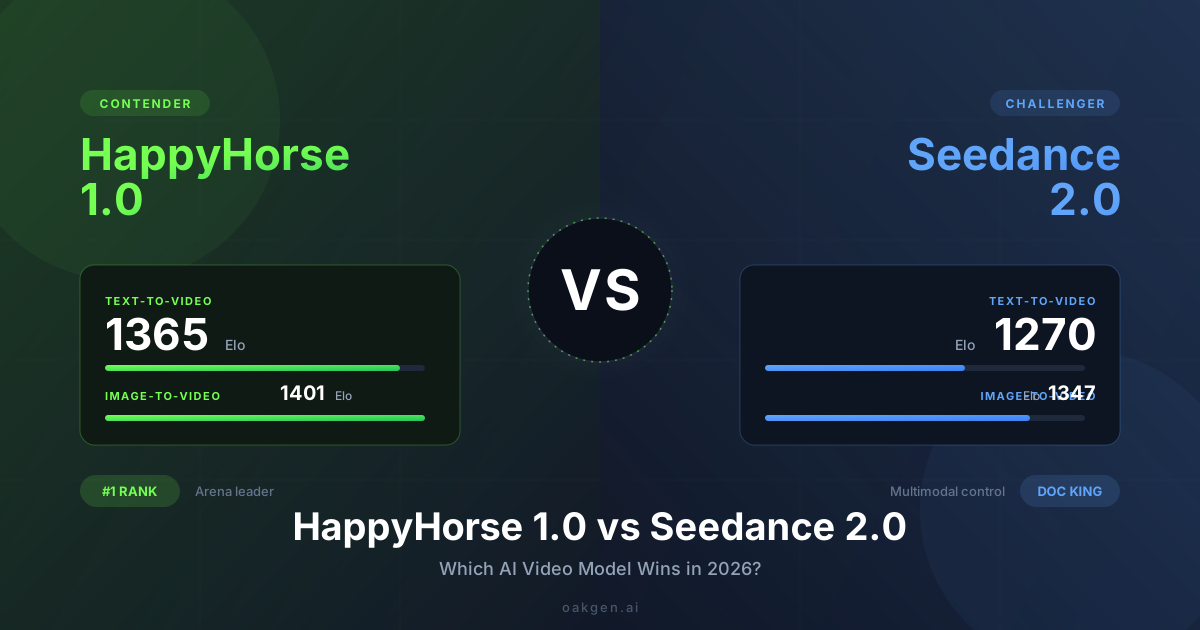
- Aggregate scene quality on the leaderboard. HappyHorse holds the #1 spot on Artificial Analysis Video Arena at 1381 Elo, outpacing the next-closest model by over a hundred points on the aggregate ranking. On Text-to-Video without audio it leads with 1365 Elo. On Image-to-Video without audio it leads with 1401. The single-pass architecture is winning blind comparisons across most categories.
- Speed-to-shot for batch creator work. ~10s typical generation on HappyHorse, with native 1080p and 12-15s clip length. For shipping volume on social — 30 variants of an ad concept, 20 atmospheric clips for a music video — HappyHorse's speed and price-per-second tilts the math. Pair your video clips with AI-generated background tracks from Oakgen's Music Generator or create matching visuals with the Image Generator to build a full content package without leaving one platform.
Generate HappyHorse 1.0 Videos Now
When Veo 3 Wins
The honest section. Veo 3 is the right call in three real scenarios:
- Sub-10ms English dialogue lip-sync for broadcast. If you ship a talking-head explainer in English and a broadcast editor will scrub the timeline frame by frame, Veo's lip-sync is still the cleanest in the field. The plosive landing, the breath beats, the micro-pauses — all locked to the audio in a way HappyHorse's single-pass design occasionally drifts on by 30-50ms. For one-character English-language explainer content shipping to a polished editorial standard, Veo earns the premium.
- Google-grade safety review and commercial coverage. Veo 3 ships with Google DeepMind's content safety stack and a clearer commercial-use license footprint for enterprise customers. Brands shipping to broadcast TV, regulated industries, or markets with strict deepfake disclosure rules find Veo's review pipeline simpler to audit than a Chinese-lab model. This is a procurement story, not an output-quality story, but it decides real workflows.
- Broader language count even when quality varies. If your work needs Italian, Portuguese, Hindi, Arabic, Indonesian, or Vietnamese — languages outside HappyHorse's 7 — Veo is the only one of these two that even attempts the language. The output may not match HappyHorse's quality bar in its top tier, but acceptable Veo audio in a long-tail language beats no HappyHorse audio at all.
If your shot list is "talking-head English explainer for an enterprise brand on broadcast," Veo wins. The price difference is invisible in the final cut. Choose by the shot, not the headline ranking.
On Oakgen You Can Run Both
The practical answer for most teams is a mixed-model render plan. English broadcast dialogue routes to Veo 3. Mandarin, Cantonese, Japanese, or Korean dialogue routes to HappyHorse. Atmospheric and B-roll work routes to whichever has credits left. Both models are live on Oakgen in the same model picker, and both draw from the same credit pool — no separate API keys, no separate billing, no provider-specific rate limit to manage.
For credit math: HappyHorse runs at the third-party cost passed through 1:1 (Oakgen's CREDIT_RATIO is 260 credits per USD with no platform margin), so the on-Oakgen credit cost matches what you would pay direct on fal. Check the full breakdown on our pricing page to see exactly how many credits each model and resolution costs. The bundled image, audio, and music models in the same credit pool — FLUX Pro 1.1, GPT-Image-2, Suno, ElevenLabs — are what makes the unified-pool approach cheaper end-to-end than running each provider separately. A full game trailer or product launch video typically pulls from at least three of those modalities.
If you need help scripting complex multi-model workflows or want prompt suggestions tailored to your project, try Oakgen's Agent Chat — it can walk you through model selection, prompt tuning, and credit budgeting in a conversational interface.
Earn 25% recurring on every referral.
Share Oakgen, get paid every month they stay.
Verdict
Both models ship native audio. The architectures and the language coverage are different in ways that matter for specific shots. Veo 3 holds the lead on sub-10ms English dialogue lip-sync, broadcast polish, and language count. HappyHorse 1.0 holds the lead on the Artificial Analysis aggregate ranking — it sits at #1 with a 1381 Elo score, a comfortable triple-digit margin over the field — along with its unified audio-video synthesis architecture and quality of multilingual lip-sync in Mandarin, Cantonese, Japanese, Korean, German, and French. If you ship one language and that language is English, Veo is the cleaner pick on dialogue-heavy shots. If you ship a global content slate or work in any of HappyHorse's 7 supported languages, HappyHorse is the model that holds quality across the set.
The right answer for most production teams is to run both. Route by shot, not by headline. The mixed-model render plan typically saves 30% or more versus committing every shot to one model and accepting the wrong tool on half the work.
Frequently Asked Questions
Is HappyHorse 1.0 better than Veo 3 for English dialogue?
No. Veo 3 remains the stronger model for English-only dialogue work, particularly when broadcast-grade lip-sync precision matters. Its sub-10ms alignment on spoken English is the best available. HappyHorse is competitive — most casual viewers will not notice the 30-50ms drift on hard consonants — but if a broadcast editor is scrubbing frame by frame, Veo is the safer pick for English talking-head content.
Which model is cheaper per video second?
HappyHorse 1.0 is generally cheaper per second of output. It generates faster (~10s typical vs Veo's longer queue times on equivalent prompts) and supports longer clips (up to 15s vs Veo's 8-10s typical). On Oakgen, both models draw from the same credit pool at third-party cost passed through 1:1 with no platform margin. Visit the pricing page for exact per-model credit costs at each resolution tier.
Can I use both models on the same platform?
Yes. Both HappyHorse 1.0 and Veo 3.1 are available in the same model picker on Oakgen's AI Video Generator. They share the same credit balance, the same project workspace, and the same download pipeline. You can route English broadcast shots to Veo and multilingual or atmospheric shots to HappyHorse without switching tools or managing separate API keys.
Does HappyHorse support lip-sync in languages Veo doesn't?
Both models technically cover HappyHorse's 7 languages. The difference is quality, not availability. HappyHorse's Mandarin, Cantonese, and Japanese lip-sync is trained by native-language teams and tracks tonal mouth shapes that Veo's broader pipeline smooths over. Cantonese on Veo is listed as supported but in practice produces lip movement that does not follow the tone glides. So HappyHorse does not support languages Veo lacks — it supports the same languages at visibly higher quality for tonal and mora-timed languages.
Which model has better 4K output?
Veo 3 supports native 4K output at 24fps. HappyHorse 1.0 generates at 1080p natively. If 4K resolution is a hard requirement for your deliverable, Veo is the only choice between these two. For most social, web, and mobile use cases, HappyHorse's 1080p output is sufficient, and upscaling from 1080p to 4K in post produces acceptable results for non-broadcast delivery.
Is HappyHorse 1.0 open source?
No. HappyHorse 1.0 is a proprietary model from Alibaba ATH-AI. It is available through API providers (fal, Replicate, WaveSpeed) and through platforms like Oakgen, but the model weights are not publicly released. Veo 3 is similarly proprietary — accessible via Google's API and select platforms, with no open-source weights.
What to Read Next
- HappyHorse 1.0 vs Seedance 2.0: Which AI Video Model Wins in 2026? — the leaderboard #1 vs the previous-best, with Image-to-Video audio numbers where Seedance still leads narrowly.
- Multilingual AI Video for Global Marketing: Lip-Sync in 7 Languages — the deep dive on HappyHorse's 7-language coverage and prompt patterns for each language.
- Best AI Video Model with Native Audio in 2026 (Tested) — the full field of native-audio video models tested side-by-side, including HappyHorse, Veo, and Seedance.
- Veo 3 Prompting Guide — how to write prompts that get the most out of Veo 3's dialogue pipeline, camera controls, and audio generation.
- Veo 3.1 Review: 4K Native Audio — our full review of Veo 3.1's 4K upgrade and what it means for broadcast workflows.