OpenArt has carved out a distinctive position in the AI creative market. While most platforms race to integrate the newest models, OpenArt has gone deep on character-driven content: its Character Builder locks identity across generations, Worlds creates persistent spatial environments for recurring scenes, and its Kling 2.6 Motion Control, Wan 2.5, Hedra lip-sync, and OmniHuman integrations make it the strongest all-in-one platform for AI influencers, animated series, and branded character work.
That focus is also its limit. OpenArt does not generate music, does not offer chat-based ideation, and its pricing (Pro at ~$56/month) runs above multi-modal alternatives that cover more ground. For creators whose work is not character-centric -- or who need the full content stack of image, video, voice, music, and chat -- OpenArt leaves real gaps.
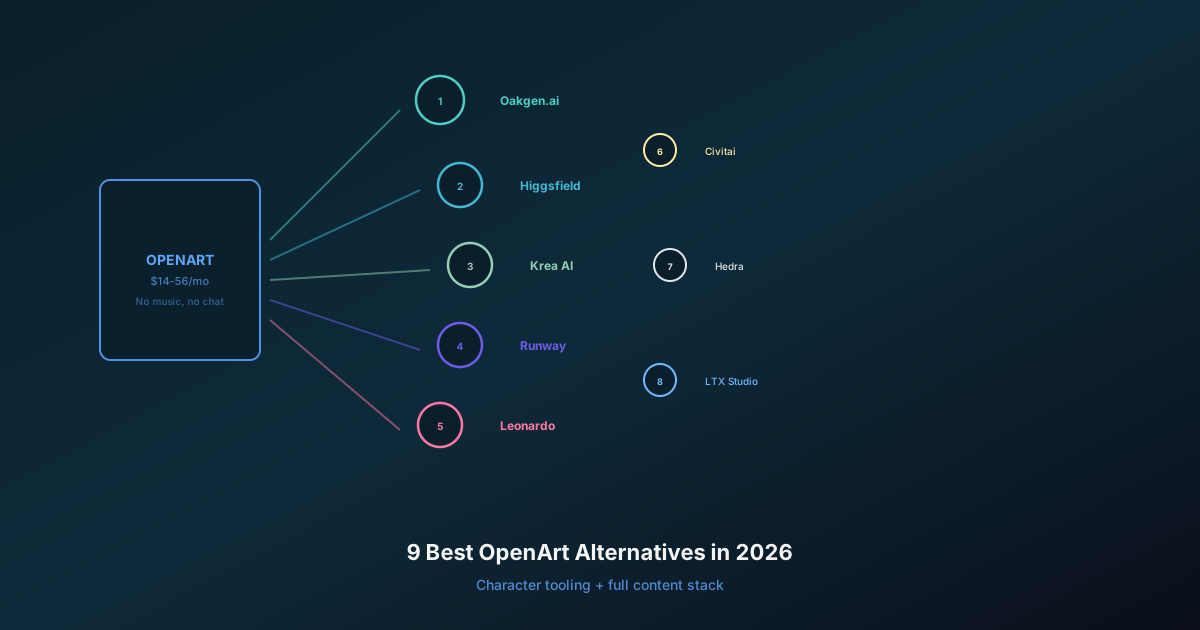
This guide ranks the 9 best OpenArt alternatives in 2026 based on character and reference consistency, model library breadth, multi-modal support, and per-generation cost.
OpenArt's Character Builder, Worlds, and lip-sync pipeline are legitimately the best in the consumer AI market for recurring-character content. If that is your primary use case, no single alternative fully replicates it. What the alternatives below offer is broader multi-modal coverage, often at lower cost, with character consistency features that are good enough for most non-series workflows.
Why Creators Are Looking Beyond OpenArt
OpenArt solves a real problem -- character consistency in AI content -- but several gaps push users to look elsewhere:
No music generation. Creators making AI videos for YouTube, TikTok, or any platform with background audio need music somewhere in their stack. OpenArt does not generate music. You are paying OpenArt for image and video, then paying Suno or Udio for music, then paying an LLM for chat-based scripting. That is three subscriptions when one could cover it.
No chat-based ideation. Script writing, caption generation, prompt engineering, and narrative planning all benefit from LLM integration in the same session. OpenArt does not include chat. Oakgen combines Agent Chat (Auto, Max, and Pro Max) with creative generation tools under one credit balance.
Pricing scales steeply. OpenArt's Pro plan at $56/month positions above most multi-modal alternatives. For heavy users, the math often favors switching.
Strong but not exhaustive video model library. OpenArt covers ~15 video models (Kling 2.6, Wan 2.5, Veo 3, Sora 2, Hailuo). Higgsfield covers 50+. Oakgen covers Kling, Seedance, Vidu, Hailuo, and more. If your work depends on running the newest model the day it drops, OpenArt sometimes lags.
Character-centric UX adds friction for non-character work. The Character Builder, Worlds, and lip-sync focus means the interface assumes you are building recurring content. For one-off illustration, product photography, or standalone concept work, the overhead is unnecessary.
What Makes a Good OpenArt Alternative
A real OpenArt replacement should compete on the dimensions OpenArt chose to own while closing its gaps:
- Character and reference consistency -- Character locking, multi-reference generation, identity preservation
- Video motion control -- Kling-class motion transfer, reference-to-video, lip-sync
- Full multi-modal stack -- Image + video + audio + music + chat in one credit balance
- Model library breadth -- Access to the newest premium models
- IP and commercial safety -- Confidence that outputs are safe for commercial use
- Per-generation economics -- Cheaper than $56/month for equivalent capability
With those criteria established, here are the 9 best options.
The 9 Best OpenArt Alternatives, Ranked
1. Oakgen.ai (Our Pick)
Best for: Creators who need image, video, audio, music, and chat in one credit balance
Oakgen closes OpenArt's biggest gaps -- music, chat, broader price flexibility -- while preserving most of what makes OpenArt strong. For character work, Oakgen's image models via Image Arena include strong identity-preserving options (Nano Banana Pro, FLUX 2 Pro with reference weights, GPT Image 2), and its video stack covers Kling motion control, Vidu Q2 Pro reference-to-video, and Seedance 2 multi-shot storyboarding -- all the character-consistency capabilities OpenArt wraps with its own UI.
Where Oakgen clearly exceeds OpenArt: music generation (Lyria 3 Pro and Eleven Music in the same credit balance), chat (Oakgen Auto, Max and Pro Max), starting price ($9/month Basic vs $56/month Pro), and unused credits that carry forward while your subscription is active.
- Image models: GPT Image 2, Nano Banana Pro, FLUX 2, and more via Image Arena
- Video models: Kling V3 Pro and O3, Seedance 2.0 and 2.5, Vidu Q3, Hailuo 2.3 Pro (image-to-video), and more
- Audio: Full TTS, voice cloning (ElevenLabs, MiniMax Speech HD)
- Music: Lyria 3 Pro + Eleven Music
- Chat: Claude, GPT, Gemini, DeepSeek, Grok
- Character consistency: Vidu Q2 Pro reference-to-video + GPT Image 2 reference mode + FLUX 2 Pro Edit
- Pricing: Paid plans from $9/month (no free signup credits); unused credits carry forward while your subscription is active
For creators whose work extends beyond recurring characters -- or who want music and chat in the same subscription -- Oakgen is a stronger bundle.
2. Higgsfield AI
Best for: Premium curated video model access with Sora 2
Higgsfield takes the opposite approach from OpenArt's character focus. It is video-only, but maximally curated: Sora 2, Kling 2.6, Seedance, and 50+ others in one polished interface. If OpenArt's video model list felt limiting, Higgsfield is the maximalist answer.
Credits expire in 90 days, which is a real drawback. See our Higgsfield alternatives guide for full analysis.
- Strength: 50+ curated video models, Sora 2 access
- Weakness: Video only, no character builder, 90-day credit expiration
- Pricing: From $29/month plus top-ups
- On Oakgen: Kling, Seedance, and several other Higgsfield-curated model families (not Sora or Veo)
3. Krea AI
Best for: Real-time creative iteration and visual-first workflows
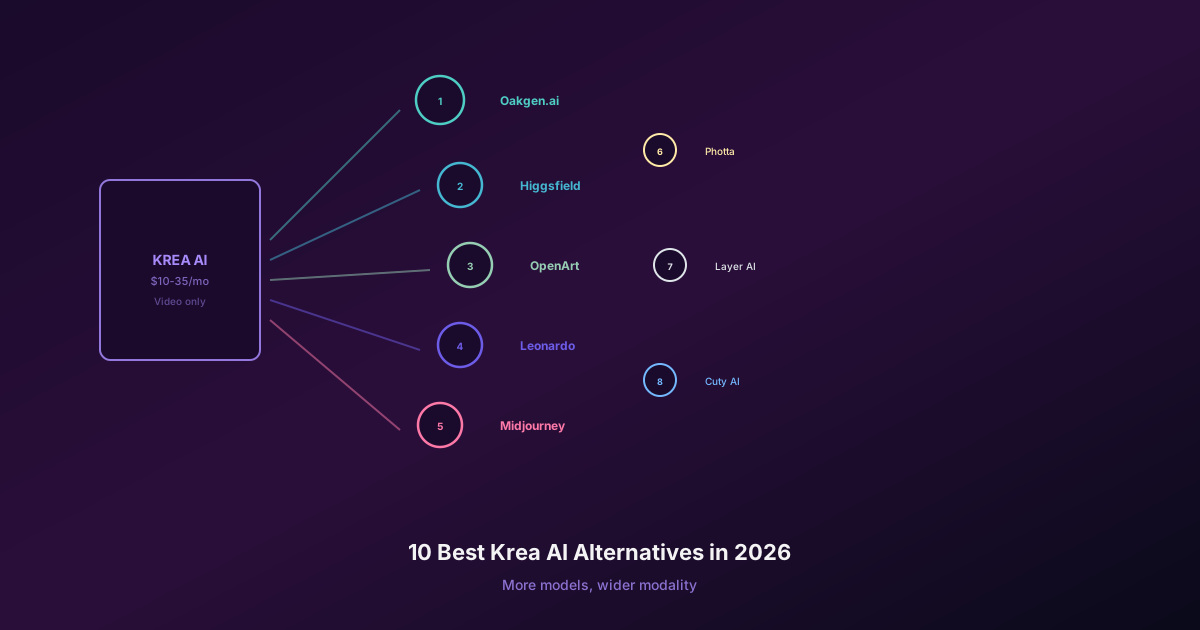
Krea optimizes for exploratory iteration rather than produced output. Its realtime image model updates as you type, Node Agent automates visual workflows, and its FLUX.1 Krea open-weights model is technically distinctive. For designers and concept artists who think visually and iterate fast, Krea is a closer philosophical match to OpenArt's canvas approach than most alternatives.
- Strength: Real-time generation, node-based workflows, FLUX-tuned models
- Weakness: No music, weaker character consistency features, $35/month Pro
- Pricing: Free tier; Pro from $10-35/month
- On Oakgen: No (direct competitor). See Krea alternatives.
4. Runway
Best for: Professional video editing pipeline
Runway remains the professional video tool with polished timeline, motion brush, and Adobe integrations. It does not match OpenArt's character-driven workflow, but for teams whose primary need is "cinematic AI video inside a professional editing environment," Runway's Gen-4.5 and workspace feel more like a production tool than OpenArt's character-first UI.
- Strength: Motion brush, professional UI, Adobe integrations
- Weakness: Single-model lock-in, no character builder or music
- Pricing: $12-76/month
- On Oakgen: Runway Gen 4 Turbo image-to-video, plus Kling and Seedance
5. Leonardo AI
Best for: Production-scale brand-consistent image generation
Leonardo AI is the strongest alternative for commercial image production at volume. Its batch processing, reference-to-image workflows, and brand consistency tools target agencies and in-house marketing teams generating 100+ variations of a campaign asset. OpenArt's Character Builder locks one character across scenes; Leonardo locks a brand's visual identity across hundreds of outputs.
- Strength: Batch generation, brand consistency, Leonardo-tuned models
- Weakness: Weaker video story, no music or chat
- Pricing: Free tier; paid from $12-60/month
- On Oakgen: Leonardo-class output via FLUX 2 Pro and GPT Image 2
6. Civitai
Best for: Open-source model library and community LoRAs
Civitai is not a direct functional alternative -- it is an open-source ecosystem for Stable Diffusion, FLUX, and derived models. For creators who want character consistency through custom LoRAs (Low-Rank Adaptation fine-tunes), Civitai's community library dwarfs OpenArt's preset options. The tradeoff is technical overhead: you manage your own generation environment.
- Strength: Massive open-source LoRA and model library, community-driven
- Weakness: Requires technical setup; no unified UI
- Pricing: Free; Buzz credits for generation
- On Oakgen: Stable Diffusion-family models integrated natively
7. Hedra
Best for: Talking-head and lip-synced character video
Hedra has become the dedicated tool for AI talking-head content -- the same capability OpenArt wraps through its Hedra integration. Going direct to Hedra gives you deeper control, more voice options, and lower per-generation cost than accessing it through OpenArt.
- Strength: Best-in-class lip-sync and talking-head generation
- Weakness: Narrow scope outside lip-synced character work
- Pricing: Pay-as-you-go and subscription tiers
- On Oakgen: Talking Photo feature offers similar capability
8. LTX Studio
Best for: End-to-end AI video production
LTX Studio positions as a full-production platform: script, storyboard, scene generation, character consistency, and export in one workflow. For creators making longer-form narrative content with recurring characters, LTX's structural approach overlaps directly with what OpenArt does -- with stronger scripting and weaker community model variety.
- Strength: Script-to-video pipeline, scene composition, character continuity
- Weakness: Steeper learning curve; no music or chat
- Pricing: Free tier; paid from $15-125/month
- On Oakgen: No
9. Magic Hour
Best for: Fast multi-format AI content for social creators
Magic Hour offers image and video generation optimized for social media throughput. Over 3 million users including teams at Meta, NBA, and Shopify use it for fast, consistent output. It does not have OpenArt's character builder depth, but for creators who value speed over structure, Magic Hour's conversion funnel is much smoother.
- Strength: Fast generation, social-optimized presets, large user base
- Weakness: Less character-builder depth
- Pricing: Free tier; paid plans available
- On Oakgen: Fast options include Hailuo 2.3 Fast Pro and Runway Gen 4 Turbo (both image-to-video)
Full Comparison
| Platform | Character Builder | Music | Chat | Video Models | Starting Price |
|---|---|---|---|---|---|
| Oakgen.ai | Reference + Vidu + FLUX 2 Edit | Lyria 3 Pro + Eleven Music | 3 chat tiers | Multiple | $9/mo |
| OpenArt | Yes (native) | No | No | ~15 | $14-56/mo |
| Higgsfield | Limited | No | Chat feature | 50+ | $29/mo |
| Krea AI | Via reference | No | No | ~3 | $10-35/mo |
| Runway | Via reference | No | No | 1 family | $12-76/mo |
| Leonardo AI | Brand consistency | No | No | Limited | $12/mo |
| Civitai | Via custom LoRA | No | No | Community | Free |
| Hedra | Lip-sync focus | No | No | Talking head | Pay-as-you-go |
| LTX Studio | Yes (native) | No | No | 5+ | $15/mo |
| Magic Hour | Limited | No | No | Multi-format | Freemium |
OpenArt's Strengths: What You Might Miss
OpenArt has built something distinctive. Worth acknowledging:
Character Builder is best-in-class. No other consumer AI platform makes locking character identity this approachable. If your content depends on a recurring character -- AI influencer, branded mascot, series protagonist -- OpenArt's character workflow saves real time.
Worlds is a genuine innovation. Persistent spatial environments are a research-grade feature shipped as a consumer product. Creators building immersive content benefit in ways that standard generation does not replicate.
IP Safety Check builds commercial confidence. The built-in check against known copyrighted material is a real differentiator for brand work where IP liability matters.
The Kling 2.6 Motion Control + OmniHuman + Hedra stack. Integrating these three pipelines under one UI is genuinely hard, and OpenArt's execution is clean.
Curated quality over quantity. Where Higgsfield chases model count, OpenArt curates. That matters to creators who value "the right model surfaced" over "every model available."
The question is whether these strengths outweigh the missing music, chat, and higher price ceiling for your workflow. For recurring-character series, OpenArt is often the right answer. For broader multi-modal work, an alternative usually wins.
Some creators use OpenArt specifically for character-driven scenes and Oakgen for everything else (music, chat, image arena, video variety). The two plans combined still typically cost less than OpenArt Pro plus ElevenLabs plus Suno plus ChatGPT Plus. If Character Builder is non-negotiable, this is worth considering.
Which OpenArt Alternative Is Right for You?
The right replacement depends on what draws you to OpenArt:
- Full multi-modal creation stack -- Oakgen.ai covers image, video, audio, music, and chat in one credit balance from $9/month.
- Maximum curated video model breadth -- Higgsfield for 50+ premium video models.
- Real-time visual iteration -- Krea AI for exploratory image work.
- Professional video editing -- Runway for motion brush and Adobe integration.
- Brand-consistent commercial images at volume -- Leonardo AI for batch production.
- Open-source custom LoRAs -- Civitai for deep character customization.
- Dedicated lip-sync and talking heads -- Hedra or Oakgen's Talking Photo.
- Script-to-video narrative production -- LTX Studio for longer-form content.
- Fast social-optimized output -- Magic Hour for throughput.
Multi-model workflows consistently outperform single-platform lock-in. If you are also evaluating related alternatives, see our guides on Runway alternatives, Higgsfield alternatives, Krea alternatives, and the best AI image generators of 2026.
More Than Character Builder -- One Full Stack
Image, video, audio, music, and chat in one credit balance. Character consistency, motion control, and many models from $9/month.