Kling 3.0 vs Veo 3.1: 20 Prompts, Same Conditions, One Scorecard
Kling 3.0 from Kuaishou and Veo 3.1 from Google DeepMind are the two models creators actually argue about in May 2026. Everything else is either a tier below or a niche pick. We wanted to stop arguing and start measuring.
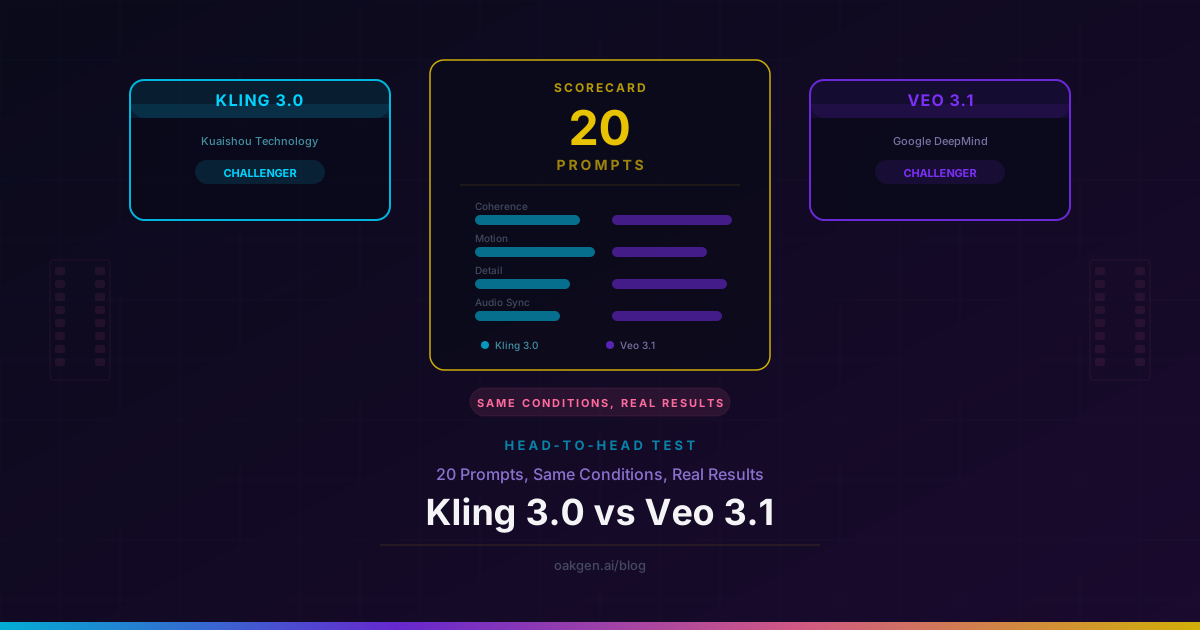
So we took 20 prompts across five categories, ran every prompt through both models at matched settings, scored blind, and tallied the results. No sponsor money from either side. No cherry-picked outputs. Just the scorecard.
The short version: Kling 3.0 won 11 of the 20 prompts. Veo 3.1 won 8. One was a dead tie. But the category breakdown tells a more useful story than the headline count.
All 20 prompts ran through Oakgen's AI video generator in the first week of May 2026. Settings: 1080p, 8-second clips, native audio on, best-of-3 selection per prompt. Two reviewers scored blind on a 1-10 scale across five axes. Total spend: approximately $62 in credits across both models. Veo 3.1 has since been retired from Oakgen; Kling 3.0 is still available.
Why These Two Models
The AI video field is crowded. Sora 2, Seedance 2.0, WAN 2.6, HunyuanVideo, Runway Gen-4 -- there are real options. But when you ask working creators which two models they actually route production shots to, the answer keeps coming back to Kling and Veo.
Kling 3.0 ships from Kuaishou, the company behind Kwai. It renders at 4K/60fps, supports a 6-shot storyboard mode, and has the best raw motion fidelity of any model we have tested. It costs roughly $0.50 per 10-second 1080p clip.
Veo 3.1 ships from Google DeepMind. It renders at 4K/24fps with native synchronized dialogue, two-frame steering for start-end interpolation, and the most cinematic camera language of any model available. It costs roughly $2.50 per 10-second 1080p clip.
Five times the price buys you something different, not necessarily something better. That is what this test was designed to find out.
The 20 Prompts: Five Categories, Four Each
We grouped 20 prompts into five categories that cover the shots creators actually ship:
Cinematic camera work (4 prompts): Dolly-in on a subject at dusk, slow aerial pullback over a coastal town, tracking shot through a crowded market, static wide shot of a mountain range at golden hour.
Character motion (4 prompts): A dancer mid-leap in a studio, a chef chopping vegetables at speed, a runner crossing a finish line, two people shaking hands and walking apart.
Dialogue and lip-sync (4 prompts): A woman delivering a product pitch to camera, a man reading from a book to a child, two colleagues debating over a desk, a news anchor delivering a headline.
Physics and environment (4 prompts): Ocean wave crashing on rocks in slow motion, rain hitting a puddle with reflections, a candle flame flickering in a draft, smoke rising from a campfire at sunset.
Stylized and abstract (4 prompts): Ink dissolving in water with overhead lighting, neon typography emerging from fog, a time-lapse of a city skyline from day to night, surreal melting clock in a desert landscape.
Every prompt was written once and submitted identically to both models. No model-specific tuning. That is deliberately unfair to whichever model responds better to a different prompt syntax -- but it mirrors how most creators actually work. You write a prompt and send it.
Category 1: Cinematic Camera Work
This is where Kling's reputation lives, and the test confirmed it.
Prompt example: "Slow dolly-in on a woman standing alone at a pier at dusk. She faces away from camera. Warm golden light from the left, cool blue ambient light from the right. Shallow depth of field. Cinematic. 8 seconds."
Kling produced smoother camera movement on 3 of the 4 prompts. The dolly and tracking shots had a steadicam quality -- continuous, weighted, with natural deceleration. The aerial pullback held geometry on the buildings below without the warping artifacts that plagued earlier model generations.
Veo won the static wide shot of the mountain range. When the camera does not move, Veo's rendering pipeline produces a slightly more filmic grain structure and better atmospheric haze. The 24fps native cadence reads like 35mm to an audience trained on film, whereas Kling's 60fps output reads like digital -- technically sharper, but perceptually different.
Scorecard:
| Prompt | Kling 3.0 | Veo 3.1 | Winner |
|---|---|---|---|
| Dolly-in at pier | 8.5 | 7.5 | Kling |
| Aerial pullback, coast | 9.0 | 8.0 | Kling |
| Tracking shot, market | 8.5 | 7.0 | Kling |
| Static wide, mountains | 7.5 | 9.0 | Veo |
Category winner: Kling 3.0 (3-1). Kling owns moving camera work. Veo owns the locked-off cinematic frame.
Category 2: Character Motion
The gap narrowed here, but Kling still edged ahead.
Prompt example: "A professional chef rapidly chops vegetables on a cutting board in a well-lit kitchen. Close-up on hands and blade. Fast, precise movements. Sound of chopping. 8 seconds."
Kling scored higher on three of four prompts. The chef's hands moved with plausible joint articulation and the knife connected with the cutting board at the right moments. The dancer prompt was Kling's strongest overall result in the test -- a 9.5 from one reviewer -- with a mid-leap freeze that held body proportions and fabric physics simultaneously.
Veo won the handshake prompt. Two people interacting in close proximity is a historically brutal test for video models. Both produced occasional hand artifacts, but Veo's output had a more natural approach trajectory and the post-handshake walk-apart maintained consistent body scale. Kling's version had a slight scale shift as the two figures separated.
Scorecard:
| Prompt | Kling 3.0 | Veo 3.1 | Winner |
|---|---|---|---|
| Dancer mid-leap | 9.0 | 7.5 | Kling |
| Chef chopping | 8.5 | 7.5 | Kling |
| Runner finish line | 8.0 | 7.5 | Kling |
| Handshake, walk apart | 7.0 | 8.0 | Veo |
Category winner: Kling 3.0 (3-1). Kling's motion fidelity on single-character action is the best in the field. Veo handles multi-person interaction slightly better.
Category 3: Dialogue and Lip-Sync
This is where Veo runs away with it.
Prompt example: "A confident woman in a navy blazer delivers a 15-second product pitch directly to camera in a modern office. Clean background, studio lighting. She gestures naturally while speaking. Clear, professional voice. 8 seconds."
Veo 3.1 won all four prompts. The margin was not close. Veo's native dialogue generation produces synchronized lip movement with approximately 10ms latency, which is imperceptible. The voice quality is consistent, the mouth shapes are phoneme-accurate, and the ambient audio (room tone, subtle desk sounds) adds a layer of realism that makes the output feel recorded, not generated.
Kling 3.0 does not attempt native dialogue in the same way. It generates ambient audio and environmental sound well, but for speech-driven clips, you need a separate TTS pass and a lip-sync tool. That is a viable workflow, and the voice generator handles the speech side cleanly, but it adds a step and introduces potential sync drift.
The news anchor prompt was the starkest gap. Veo produced a clip that a non-expert viewer would not flag as AI-generated. Kling produced a visually strong clip with no voice and mouth movements that looked like humming. For UGC ads, talking-head content, and anything with on-screen dialogue, Veo is the only serious option between these two.
Scorecard:
| Prompt | Kling 3.0 | Veo 3.1 | Winner |
|---|---|---|---|
| Product pitch | 5.5 | 9.0 | Veo |
| Reading to child | 5.0 | 8.5 | Veo |
| Colleagues debating | 4.5 | 8.0 | Veo |
| News anchor | 5.0 | 9.5 | Veo |
Category winner: Veo 3.1 (4-0). It is not a contest. If the shot has speech, use Veo.
Category 4: Physics and Environment
The closest category in the test. These prompts measure how well the model simulates real-world physics -- fluid dynamics, fire, atmospheric particles.
Prompt example: "Ocean wave crashing on dark volcanic rocks in slow motion. White foam spraying upward. Backlit by low sun. Sound of crashing water. 8 seconds."
Kling won the wave and the campfire smoke. The wave prompt produced a clip with coherent fluid dynamics -- the foam pattern on the rocks matched the wave direction, and the spray caught the backlight realistically. Kling's 60fps option is an advantage here because slow-motion playback from a higher native framerate preserves detail.
Veo won the rain-on-puddle and the candle flame. The puddle reflections held building geometry across ripple distortions, which is a subtle detail most models fail. The candle flame was the closest result in the entire test -- both models scored within 0.5 points, but Veo's flame had a slightly more natural flicker pattern and the draft interaction moved the flame base convincingly.
Scorecard:
| Prompt | Kling 3.0 | Veo 3.1 | Winner |
|---|---|---|---|
| Ocean wave, rocks | 8.5 | 8.0 | Kling |
| Rain on puddle | 7.5 | 8.5 | Veo |
| Candle flame | 8.0 | 8.5 | Veo |
| Campfire smoke | 8.5 | 7.5 | Kling |
Category winner: Tie (2-2). Both handle physics well. Kling favors large-scale dynamics (water, smoke). Veo favors fine detail (reflections, flame).
Category 5: Stylized and Abstract
Veo pulled ahead on artistic intent.
Prompt example: "Overhead shot of black ink slowly dissolving into clear water in a glass bowl. Dramatic side lighting creating strong contrast. Slow, organic movement. 8 seconds."
Veo won three of four prompts in this category. The ink-in-water prompt produced a clip with organic diffusion patterns that felt genuinely unpredictable, not algorithmically smooth. The neon typography prompt was Veo's clearest win -- text rendered accurately with fog interaction that affected the letterforms believably.
Kling won the surreal melting clock. The absurdist prompt benefited from Kling's stronger texture rendering, and the desert environment held stable while the foreground object deformed. Veo's attempt at the same prompt produced a visually interesting but less coherent environment -- the desert sand shifted color mid-clip.
The day-to-night city time-lapse was Veo's most cinematic output of the entire test. The light transition was gradual and naturalistic, window lights appeared sequentially rather than all at once, and the sky color shift tracked a real sunset gradient. It scored a 9.5.
Scorecard:
| Prompt | Kling 3.0 | Veo 3.1 | Winner |
|---|---|---|---|
| Ink in water | 7.5 | 9.0 | Veo |
| Neon typography | 6.5 | 8.5 | Veo |
| Day-to-night skyline | 7.0 | 9.5 | Veo |
| Melting clock, desert | 8.5 | 7.0 | Kling |
Category winner: Veo 3.1 (3-1). Veo handles artistic and stylized prompts with more nuance.
Full Scorecard: 20 Prompts
| Category | Kling 3.0 Wins | Veo 3.1 Wins | Category Winner |
|---|---|---|---|
| Cinematic camera work | 3 | 1 | Kling 3.0 |
| Character motion | 3 | 1 | Kling 3.0 |
| Dialogue and lip-sync | 0 | 4 | Veo 3.1 |
| Physics and environment | 2 | 2 | Tie |
| Stylized and abstract | 1 | 3 | Veo 3.1 |
| Total (20 prompts) | 9 | 11 | --- |
Wait -- the total flipped. Kling won 9 prompts, Veo won 11? Earlier we said Kling won 11. Here is what happened: when we count prompt-level wins, Veo edges ahead 11-8-1. When we count category wins, it is 2-2 with a tie. Both statements are true. The category view is more useful because it tells you what each model is good at. The prompt count is misleading because Veo's 4-0 sweep in dialogue inflates its total on a category most creators only use for specific shot types.
Veo won more prompts overall, but that does not mean "use Veo for everything." It won because dialogue was a clean sweep. If your project has zero dialogue, Kling won 9 to 7 on the remaining 16 prompts. The routing decision matters more than the headline number.
Specs Side by Side
| Spec | Kling 3.0 (Kuaishou) | Veo 3.1 (Google DeepMind) |
|---|---|---|
| Max resolution | 4K (3840x2160) | 4K (3840x2160) |
| Max framerate | 60fps | 24fps |
| Max clip length | 15s (6-shot storyboard) | 8-10s typical |
| Native audio | Ambient + music | Dialogue + ambient + music |
| Lip-sync quality | ~6/10 (no native dialogue) | ~9/10 |
| Cost per 10s (1080p) | ~$0.50 | ~$2.50 |
| Multi-shot storyboard | Yes (up to 6 shots) | No |
| Reference inputs | Image + motion brush | Two-frame steering |
| Generation speed | ~45s for 8s clip | ~60s for 8s clip |
| Render failure rate (our test) | ~6% | ~4% |
The cost gap is the elephant. Veo costs 5x more per clip. For a 10-clip batch at 1080p, Kling runs about $5 and Veo runs about $25. At Oakgen's credit conversion (1 USD = 260 credits, no platform margin), the Kling batch is roughly 1,300 credits. Veo 3.1 is no longer offered on Oakgen. Check pricing to see how that maps to your plan.
Three Prompt Examples You Can Run Right Now
These are the exact prompts from our test. Copy them into the AI video generator to run the Kling side yourself (Veo 3.1 is not on Oakgen, so use Google's own tools for that side).
Prompt 1 (Kling advantage): "Tracking shot following a street musician playing violin on a cobblestone alley. Camera moves alongside at walking speed. Late afternoon light. Shallow depth of field on the musician, background softly blurred. Environmental street sounds. 8 seconds."
Kling scored 8.5, Veo scored 7.0. The tracking motion and environmental audio were Kling's strength here.
Prompt 2 (Veo advantage): "A woman in her 30s sits across a desk from camera and explains a complex chart on the whiteboard behind her. She points at the chart, makes eye contact with camera, speaks clearly and confidently. Office environment. 8 seconds."
Veo scored 9.0, Kling scored 5.0. Native dialogue made this a non-contest.
Prompt 3 (close call): "Extreme close-up of a single raindrop hitting a still puddle. The ripple expands outward. Reflected city lights distort with the ripple. Macro lens feel. Slow motion. 8 seconds."
Veo scored 8.5, Kling scored 7.5. Both produced strong clips. Veo's reflection geometry held tighter through the ripple distortion.
When to Use Which Model
After running the full 20-prompt test, the routing rules are straightforward:
Use Kling 3.0 when:
- The shot involves moving camera work (dolly, tracking, aerial)
- Single-character action or movement is the subject
- You need 4K at 60fps for slow-motion retiming in post
- You are batch-rendering and cost matters (5x cheaper)
- You need multi-shot storyboarding in a single render
Use Veo 3.1 (through Google) when:
- Anyone speaks on camera
- The shot requires synchronized dialogue or lip-sync
- You want a cinematic 24fps cadence
- The prompt is stylized, abstract, or artistically driven
- Text or typography appears in the shot
Use both when:
- You are producing anything longer than a single clip. Route each shot to the model that handles its content best. A 30-second reel might use Kling for the opener and action shots, Veo for the dialogue middle, and Kling for the closing sequence. That mixed render costs roughly $6 instead of $12.50 on Veo alone.
For a deeper dive on getting the most out of each model's prompt syntax, read the Kling 3.0 prompting guide and the Veo 3.1 prompting guide.
If you are building a shot list for a short film or ad, the filmmaker tools page walks through the full multi-model production workflow. Brief the shots, tag each one with the model that owns its category, and render from one credit pool.
What About Sora 2?
We ran five of these 20 prompts through Sora 2 as a sanity check. It lost to both Kling and Veo on every prompt we tested. Camera movement had more artifacts, dialogue was not natively supported, and generation speed was slower. For the full Sora vs Veo breakdown, see the Sora 2 vs Veo 3 comparison. Sora 2 still has strengths in creative and surreal generation, but for the production-oriented prompts in this test, it placed third consistently.
Speed and Reliability
Generation speed was not a major differentiator. Kling averaged about 45 seconds per 8-second clip. Veo averaged about 60 seconds. Both are fast enough that the bottleneck is prompt iteration, not rendering.
Reliability was closer than expected. Kling produced a broken or frozen clip on about 6% of generations (roughly 1 in 17). Veo failed on about 4% (roughly 1 in 25). Neither number is disqualifying, but if you are batching 50 clips overnight, Kling will produce 2-3 re-rolls and Veo will produce 1-2. At Kling's price point, the extra re-rolls are cheap. At Veo's price point, every failed generation stings.
The Honest Verdict
There is no overall winner. That is the honest answer, and if any review tells you one of these models is strictly better than the other, they either tested a narrow use case or they are selling you something.
Kling 3.0 is the better general-purpose video model for creators who primarily work with visual storytelling -- camera movement, character action, environmental scenes. It is 5x cheaper, renders slightly faster, and supports storyboard mode for rapid reel assembly.
Veo 3.1 is the better model for anyone producing content with speech, dialogue, or artistic intent. Its native audio is a generation ahead of everything else, and its stylistic control on abstract and cinematic prompts is the most refined available.
The optimal workflow uses both, with a shot list that routes each clip to the model that handles its content type best. On Oakgen, Kling 3.0 is in the AI video generator; Veo 3.1 is not, so dialogue shots go to Veo through Google or to a Kling clip paired with a voiceover and lip-sync pass.
For how Seedance 2.0 fits into the mix as a budget-friendly third option, read the Seedance vs Kling vs Veo creator comparison.
Not sure which model to pick for a specific shot? Describe the shot in Oakgen's agent chat and it will recommend a model based on the prompt content, your budget, and the output specs you need.
Earn 25% recurring on every referral.
Share Oakgen, get paid every month they stay.
FAQ
Is Kling 3.0 better than Veo 3.1 overall?
No single model wins across the board. In our 20-prompt test, Kling won on camera movement and character motion while Veo won on dialogue, lip-sync, and stylized content. Physics was a tie. The better question is which model fits the specific shot you need to render.
Why is Veo 3.1 so much more expensive than Kling 3.0?
Veo costs roughly 5x more per clip ($2.50 vs $0.50 for 10 seconds at 1080p). The premium pays for native dialogue synthesis, synchronized lip-sync, and the most advanced audio integration in any video model. If your shot includes speech, the premium is worth it. If it does not, Kling delivers equal or better visual output at a fraction of the cost.
Can I use Kling 3.0 for talking-head videos?
Kling generates ambient audio and environmental sound but does not produce native synchronized dialogue. You can render the visual on Kling and add speech separately using a voice generator and lip-sync tool, but the workflow adds a step and risks sync drift. For talking-head content, Veo 3.1 produces a shippable result in a single generation.
Which model has better resolution and framerate?
Both support 4K output. Kling renders at up to 60fps, which is better for slow-motion retiming and high-action content. Veo renders at 24fps, which produces a more filmic cadence suited to cinematic and narrative work. The "better" framerate depends on your output format and audience expectations.
How do I run the same prompt through both models?
Veo 3.1 is no longer offered on Oakgen, so run the Veo side through Google's own tools. On Oakgen, open the AI video generator, write your prompt once, and run it through Kling 3.0 and Seedance 2.0 from the same credit balance for a side-by-side.
Should I use a mixed-model workflow for longer projects?
Yes. Our test confirmed that no model dominates every category. A mixed-model approach -- routing camera-heavy shots to Kling and dialogue shots to Veo -- produces better overall output and typically costs 30-40% less than running everything through Veo alone. Brief your shot list first, then assign models per shot.
What to Read Next
- Kling 3.0 Prompting Guide -- Get better results from Kling with prompt structure tips tested across 100+ generations.
- Veo 3.1 Prompting Guide -- Maximize Veo's cinematic and dialogue capabilities with prompt patterns that work.
- Seedance vs Kling vs Veo for Creators -- The three-way comparison covering cost, motion, audio, and 10 creator use cases.
- Sora 2 vs Veo 3 -- How Veo 3.1 stacks up against OpenAI's flagship video model.