HappyHorse 1.0 vs Kling 3.0: Speed, Quality, and Multilingual Lip-Sync
HappyHorse 1.0 sits at #1 on the Artificial Analysis Video Arena leaderboard with a 107-point Elo margin and ships native audio plus 7-language lip-sync in a single forward pass. Kling 3.0 still holds the only practical path to native 4K AI video and ships motion-transfer reference inputs no other model in this lane matches. Pick HappyHorse for talking-head work, multilingual ads, and speed. Pick Kling for billboard-grade resolution and reference-driven motion control. On Oakgen, both share one credit pool, so the choice is per-shot, not per-subscription.
The two models came to the 2026 fight from opposite directions. Kling 3.0 from Kuaishou iterated in public for almost two years and built a mature ecosystem around motion brush, multi-shot storyboards, and the only consumer-accessible 4K/60fps pipeline. HappyHorse 1.0 from Alibaba's ATH-AI Innovation Division ghosted the Artificial Analysis leaderboard in early April under a stealth name, climbed to #1 on April 7, was officially confirmed on April 10, hit fal on April 26, and went live on Oakgen on April 29. Two stories, two strengths, one head-to-head decision for anyone shipping AI video this quarter.
Verdict First: HappyHorse for Audio and Lip-Sync, Kling for 4K and Motion Transfer
HappyHorse 1.0 wins overall for the workflows most creators ship in 2026. It tops the Artificial Analysis Video Arena at 1381 aggregate Elo — a gap wide enough that it wins roughly 65% of blind head-to-head matchups against any other model in the arena. A 5- to 8-second 1080p clip renders in about 10 seconds, audio included, because the entire pipeline runs through a single 40-layer Transformer rather than chaining separate video and sound models. Lip-sync ships natively in 7 languages at a quality bar high enough for paid ad placements. If your output target is 9:16 social, 16:9 web hero, talking-head UGC, or any multilingual creator pipeline, HappyHorse is the default. For a deeper look at crafting prompts that get the most out of this model, the Kling 3.0 prompting guide covers the Kling side, while HappyHorse prompt patterns are documented in the HappyHorse 1.0 review.
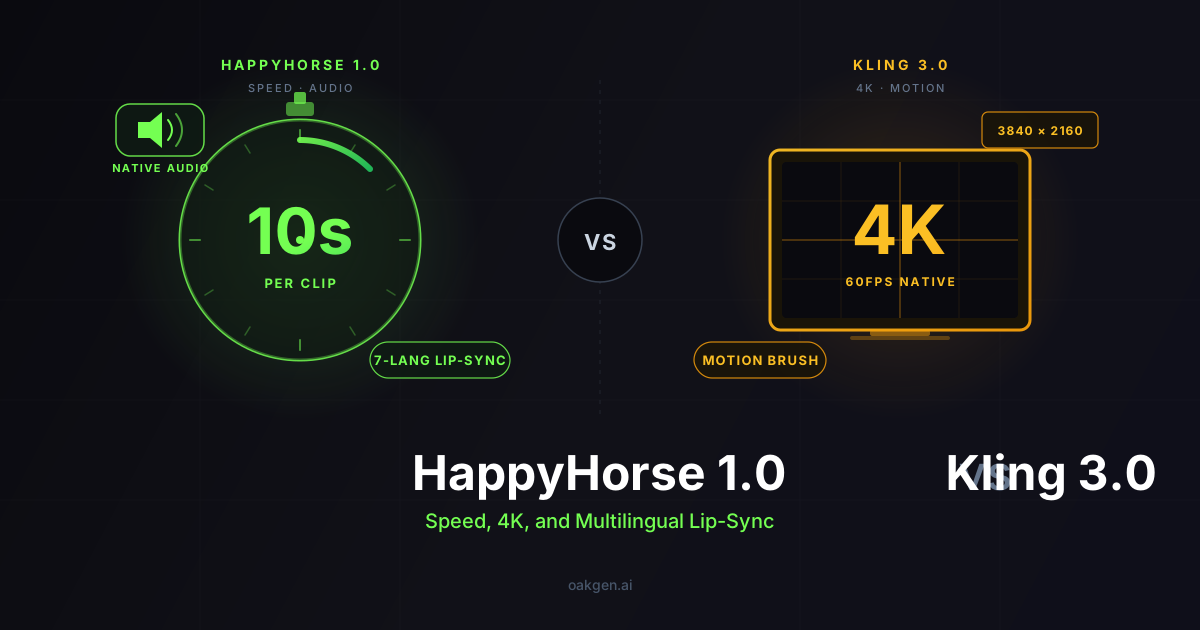
Kling 3.0 stays the right pick for two specific jobs. First, native 4K output: HappyHorse caps at 1080p HD; Kling renders at 4K and 60fps, the only on-ramp to billboard or cinema-grade master files without an upscaler in the loop. Second, motion-transfer and reference-driven shot direction: Kling's motion-brush plus reference-video inputs let you specify motion frame-by-frame in ways HappyHorse's text-and-image input pair does not. You can explore the full Kling 3.0 Pro model page for detailed specs and parameter options.
Most production decks need both at different stages. The argument below is about routing, not replacement.
ComparisonTable: The Spec Sheet at a Glance
| Feature | HappyHorse 1.0 | Kling 3.0 |
|---|---|---|
| Maker | Alibaba ATH-AI | Kuaishou |
| Architecture | Single-stream 40-layer Transformer, ~15B params | Multi-stage diffusion + motion module |
| Max output resolution | 1080p HD | 4K (native, 60fps) |
| Max clip length | 12s lite / 15s paid | 15s (6-shot storyboard) |
| Generation speed | ~10s avg, ~38s for 1080p on H100 | ~60-90s typical at 1080p |
| Native audio | Yes — single forward pass | No — silent video, requires external TTS |
| Lip-sync languages | 7 (EN, ZH, YUE, JA, KO, DE, FR) | Broader coverage but no synchronized lip-sync built in |
| Motion-transfer / reference video | Image + text only | Yes — motion brush + reference video |
| Aggregate Elo (Artificial Analysis) | 1381 (#1, +107 over #2) | Lower (not top-3 in April 2026) |
| Ecosystem maturity | Days old, thin docs | ~2 years, mature prompt library |
| On Oakgen | Yes — fal-first | Yes — same credit pool |
Two numbers do most of the work in that table. HappyHorse generates roughly 6x to 9x faster than Kling at matched resolution. Kling renders at 4x the pixel count when you need it. Everything else is downstream of those two facts.
Resolution and Length: 4K Belongs to Kling, 1080p Belongs to HappyHorse
Resolution is the cleanest split. HappyHorse 1.0 outputs 1080p HD natively. That is the ceiling — no native 4K mode, no 1440p toggle, no upscaler shipped inside the model. If your delivery surface is web, social, mobile, or any standard streaming target, 1080p is appropriate. If your delivery surface is a cinema screen, a billboard, a 4K OLED brand-installation display, or a slow-motion retiming workflow, HappyHorse will make you upscale in post, which is a real cost in time and quality.
Kling 3.0 ships native 4K at 60fps. It is the only consumer-accessible AI video model in April 2026 with that combination. Native 4K matters for two reasons. An upscaler hallucinates detail; native 4K renders detail, and the difference reads on a large screen. Second, 60fps gives slow-motion headroom: render at 60fps, conform to 24fps, and you have a 2.5x slow ramp without external interpolation.
Length lands closer. HappyHorse caps at 12 seconds on the Lite tier and 15 seconds on paid. Kling caps at 15 seconds and adds a 6-shot storyboard mode that stitches multiple shots into a cohesive 15-second sequence in one render. For a single uninterrupted shot, they are tied. For a multi-cut reel inside one render, Kling wins.
Practical rule: if your master file ever gets pulled at 4K, render that shot on Kling. Everything else, render on HappyHorse for the speed and audio.
Audio Architecture: Single-Pass vs Bolt-On TTS
This is the most underrated split between the two models, and the one that quietly decides routing for most ad and UGC creators.
HappyHorse 1.0 generates audio and video simultaneously in a single forward pass through its unified Transformer stack. There is no separate audio model bolted onto the side, no cross-attention bridge synchronizing two independent streams, and no post-hoc TTS step layered on after the visual frames are done. Lip movements, ambient sound, music bed, and dialogue are all co-generated with the visual output. Because audio and video share the same latent space and the same decoding pass, sync is architectural rather than reconstructed — lip movements do not drift, and ambient sound matches on-screen action without an editor stitching tracks. The text-to-video feature page covers the full input-output flow if you want the specifics.
Kling 3.0 produces silent video. To get sound on a Kling clip, you generate the visual first, then add audio via an external TTS pipeline (ElevenLabs, MiniMax Speech HD, or any equivalent voice generator) and align in an editor or via a lip-sync wrapper. The pipeline works for non-dialogue work, but it adds two steps, two tools, and a sync error budget. For shipping volume on talking-head ads, those steps cost real time per render. Worth noting: Kling 3.0's roadmap lists audio, but as of April 2026 the production model ships silent.
The cost shows up in pipeline math. A talking-head UGC ad on HappyHorse: one render, audio included, ~30 seconds end-to-end. The same ad on Kling: one Kling render, one ElevenLabs call, one lip-sync wrapper, one editor pass — typically 4 to 6 minutes. For batch volume, that compounds.
Multilingual Lip-Sync: Quality Over Coverage
HappyHorse 1.0 supports synchronized lip-sync in 7 languages: English, Mandarin, Cantonese, Japanese, Korean, German, and French. The phoneme-to-viseme mapping has been trained against native speakers in each language, not approximated from English mouth shapes.
Kling 3.0 has broader language coverage in its TTS-adjacent products, but the core video model does not synthesize synchronized lip-sync. Lip-sync on Kling requires a downstream wrapper, and quality depends on the wrapper. Wrappers tend to do well on English and Mandarin and degrade on tonal languages and languages with complex consonant clusters (German, in particular).
For a multilingual ad campaign, this is a real choice. If your campaign covers the 7 HappyHorse languages, render every variant on HappyHorse and the lip-sync stays consistent across the set. If your campaign covers 30 languages, neither model alone is enough — HappyHorse handles the 7 cleanly and you fall back to a separate dub-and-sync pipeline for the long tail. The full playbook lives in the multilingual AI video lip-sync 2026 breakdown.
For non-dialogue work (atmospheric, abstract, product, B-roll), the lip-sync question does not apply and routing falls back to resolution, length, and motion control.
When Kling 3.0 Wins
Honest section. Kling beats HappyHorse on three real workflows in April 2026.
4K output for billboards, OOH, and large-screen. HappyHorse caps at 1080p. If your shot ever ships at 4K, Kling is the only practical native option. Upscaling 1080p to 4K is fine for 4K social uploads (the platform compresses anyway) and web heroes that auto-downsample. Wrong for cinema screens, billboard installations, and high-end brand films with 4K finishing in the budget.
Motion-transfer and reference-driven shots. Kling's motion brush lets you paint motion vectors onto a reference image and supply a reference video clip that drives the motion in your generated shot. HappyHorse accepts text and image only, no motion-transfer input. For animation, character action where you want a specific gait, or any shot matching the motion of an existing reference clip, Kling has the tool and HappyHorse does not.
Mature ecosystem and prompt library. Kling 3.0 has been in the wild since 2025 with iterative releases — well-tested prompt patterns, motion-brush playbooks, storyboard templates. HappyHorse dropped publicly on April 26 and went live on Oakgen on April 29. The documentation is thin. A two-week-old model at #1 leaderboard is a real win, but it does not replace two years of community-tested prompt knowledge. For high-stakes shots that need predictable output on the first render, Kling's maturity is a genuine asset. The Kling 3.0 prompting guide is the best starting point for learning Kling's prompt conventions.
If your shot list includes any of those three, route those shots to Kling, route everything else to HappyHorse.
Generate HappyHorse 1.0 Videos Now
When HappyHorse 1.0 Wins
The other side of the split. HappyHorse takes most routing decisions for shipping volume in 2026.
Native audio in a single pass. No external TTS, no lip-sync wrapper, no editor sync pass. For talking-head UGC, multilingual ads, podcast-style avatar work, or any shot where mouth and dialogue need to lock, HappyHorse is the only model here that does it inside the render. Time savings compound to hours per week at volume.
Multilingual lip-sync at quality. 7 languages with native speaker-trained mouth shapes. For a campaign that needs English, Mandarin, Japanese, and German variants in lockstep, render four variants on HappyHorse and the lip-sync holds. The same campaign on Kling requires four Kling renders plus four wrapper passes, and the German variant tends to read off.
Speed. ~10 seconds average per clip, with 1080p renders landing near 38 seconds on a single H100. Kling typically lands in the 60 to 90 second range at 1080p and longer at 4K. For prompt-iteration loops, the 6x to 9x gap is the difference between a 5-minute and a 30-minute session.
Dominant blind-evaluation performance. The Artificial Analysis Video Arena runs blind A/B matchups across hundreds of evaluators. HappyHorse 1.0 holds the top position at 1381 Elo, clearing the second-place model by 107 points — a margin that translates to winning roughly two out of every three anonymous comparisons. That gap spans both text-to-video and image-to-video categories. Per-category numbers live in the HappyHorse 1.0 review.
For 9:16 reels, 16:9 web heroes, talking-head UGC, multilingual ad batches, and any workflow where 1080p is the delivery target, HappyHorse is the routing default.
On Oakgen, Both Live in One Credit Pool
The comparison stops being about model choice the moment both models share a credit pool. On Oakgen, HappyHorse 1.0 and Kling 3.0 are both available inside the AI video generator, priced from the same balance, picked from the same model selector, with no separate API keys or subscriptions. The credit pool also covers the other 30+ video models (Seedance 2.0, Veo 3.1, Kling v3 Pro), 35+ image models for keyframes, and the music and audio stacks (Suno, Lyria 2, ElevenLabs, MiniMax Speech HD). Check the pricing page for exact credit costs per model and to compare plans side by side.
The routing pattern that ships fastest: brief the shot list, mark which shots need 4K or motion-transfer (Kling), mark which shots need audio or multilingual lip-sync (HappyHorse), render everything from one balance. A 1,000-credit free balance covers roughly four to six side-by-side comparison renders across both models — enough to validate the routing decision for a real campaign before any plan upgrade. Plans start at $9/month.
If you want help building your shot list or experimenting with prompts interactively, the Agent Chat can walk you through model selection, suggest prompt structures for each model, and estimate credit costs before you hit generate.
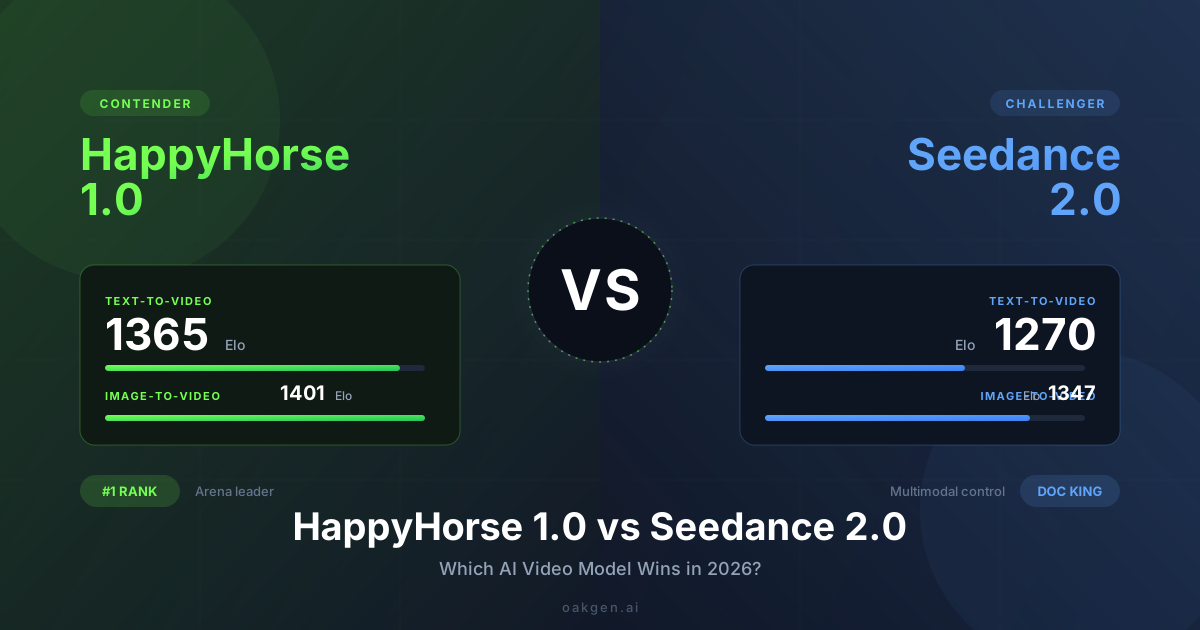
For the second comparison most creators run, the HappyHorse vs Seedance 2.0 head-to-head covers the closer fight: Seedance leads narrowly on image-to-video with audio (1182 vs 1167), HappyHorse leads everywhere else.
Earn 25% recurring on every referral.
Share Oakgen, get paid every month they stay.
Conclusion: Pick Per Shot, Not Per Model
There is no single winner between HappyHorse 1.0 and Kling 3.0 for serious creator work in 2026. There is a per-shot routing decision. HappyHorse takes 1080p talking-head, multilingual, and speed-sensitive work, which is most of what gets shipped. Kling takes 4K hero shots, motion-transfer-driven animation, and any output that ships above 1080p. Both belong in a 2026 stack. Both live in one credit pool on Oakgen. The decision after this article is which 3 to 5 shots in your next campaign route to which model, not which subscription to cancel.
If you're testing the routing for the first time, render the same prompt on both models inside Oakgen's AI Video Generator, watch the speed difference, watch the audio difference, and decide on outputs you generated rather than specs on a page.
Frequently Asked Questions
Is HappyHorse 1.0 better than Kling 3.0 overall? For most creator workflows shipping in 2026 — social video, UGC ads, talking-head content, multilingual campaigns — HappyHorse wins. It holds the #1 spot on the Artificial Analysis Video Arena with a 107-point Elo lead, renders 6x to 9x faster at matched resolution, and ships native audio plus 7-language lip-sync in a single pass. Kling remains the stronger choice specifically for native 4K output and motion-transfer/reference-driven shots.
Can I use both HappyHorse and Kling 3.0 without separate subscriptions?
Does Kling 3.0 support audio or lip-sync? Not natively, as of April 2026. Kling 3.0 outputs silent video. To add audio, you run a separate TTS pipeline (such as ElevenLabs or MiniMax Speech HD) and align the tracks in post. Kling's roadmap mentions audio, but the production model does not include it yet.
How does HappyHorse generate audio and video at the same time? HappyHorse uses a unified Transformer architecture — a single 40-layer model with approximately 15 billion parameters — that decodes audio and visual frames in the same forward pass. Because both modalities share one latent space, lip-sync and ambient sound stay locked to the video without a separate alignment step. The text-to-video feature overview explains the full pipeline.
Which model should I pick for TikTok ads or Instagram Reels? HappyHorse, in almost every case. These platforms cap at 1080p, so Kling's 4K advantage does not apply. HappyHorse's native audio eliminates the TTS-then-sync step, its speed lets you iterate on prompts in minutes instead of hours, and its lip-sync quality holds for paid ad placements. If you need help scripting or prompt-tuning your ad, the Agent Chat can walk you through the process.
What languages does HappyHorse lip-sync support? Seven: English, Mandarin Chinese, Cantonese, Japanese, Korean, German, and French. Each language was trained against native speaker phoneme-to-viseme data, not approximated from English mouth shapes. For campaigns covering languages outside those seven, you would need a separate dub-and-sync pipeline for the remaining languages. The full approach is covered in the multilingual lip-sync breakdown.
What to Read Next
- HappyHorse 1.0 vs Seedance 2.0: Which AI Video Model Wins in 2026? — the closer head-to-head on leaderboard categories.
- HappyHorse 1.0 Review: Alibaba's #1 AI Video Model Tested on Oakgen — full benchmark numbers, prompt examples, and per-category Elo.
- Multilingual AI Video for Global Marketing: Lip-Sync in 7 Languages — the campaign-level playbook for the 7 HappyHorse languages and what to do for everything else.
- Kling 3.0 Prompting Guide: Get Consistent Results from Kuaishou's 4K Model — prompt patterns, motion-brush tips, and storyboard workflows for Kling.
- Kling 3.0 vs Veo 3.1: 4K Native Audio Showdown — how Kling stacks up against Google's flagship video model.
- Best AI Video Generators in 2026: Full Leaderboard Breakdown — rankings across all major models, not just these two.
- Seedance 2.0 vs Wan 2.7: Motion Control Compared — another head-to-head for teams evaluating the broader model landscape.