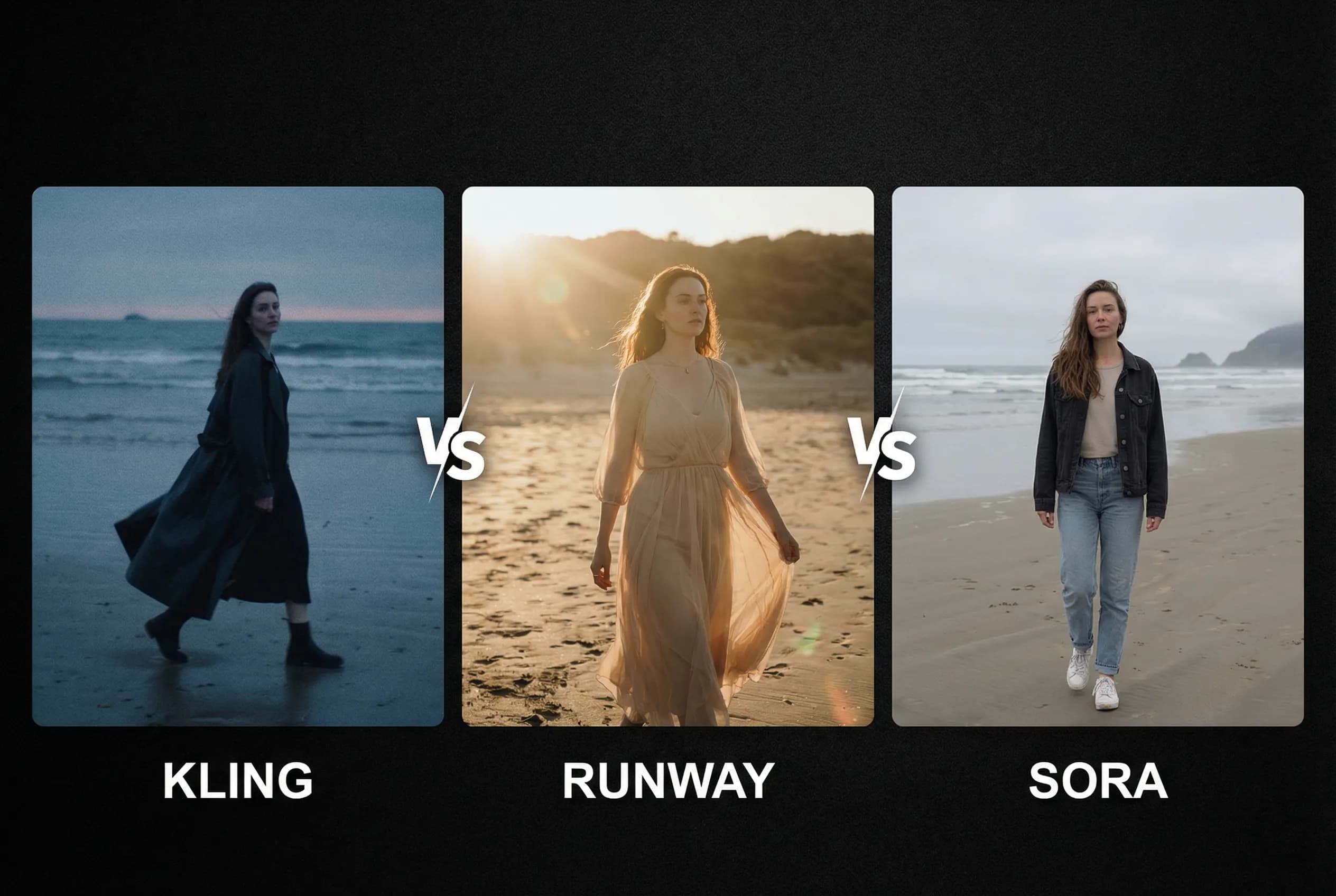
Seedance 2.5 and Kling 3 both run on Oakgen, and Veo 3.1 does not. Seedance 2.5 makes the longest single clip (up to 30 seconds on Oakgen) and takes the most references. Kling 3 is cheaper per second, at 57 credits with audio against 160 for Seedance 2.5 at 720p (Oakgen pricing, 2026-10-25). Veo 3.1 is the only one with documented 4K output, on Google's Vertex AI.
None of the three wins every job. This comparison uses each vendor's own pages and Oakgen's model settings, all read on 2026-10-25. We did not run a side-by-side test for it.
How do Seedance 2.5, Kling 3 and Veo 3.1 compare?
Oakgen rows come from Oakgen's model settings and pricing code. The other rows come from ByteDance's Dreamina page, Kling's VIDEO 3.0 guide and Google's Vertex AI documentation. All were read on 2026-10-25.
| Seedance 2.5 | Kling 3 | Veo 3.1 | |
|---|---|---|---|
| Maker | ByteDance | Kuaishou | |
| On Oakgen | Yes | Yes, as Kling V3 Pro | No (all Veo models retired) |
| Clip length | 4 to 30 s on Oakgen. Dreamina says up to 30 s, or 180 s in a beta long-video mode | 3 to 15 s | 4, 6 or 8 s |
| Resolution | 480p, 720p, 1080p on Oakgen. Dreamina says 4K | 720p and 1080p (Kling guide). No picker on Oakgen | 720p, 1080p, 4K on Vertex AI |
| References | Up to 30 images, 10 videos, 10 audio files on Oakgen | Up to 2 elements on Oakgen image-to-video. Kling's guide says 2 to 4 images per element | Reference images supported on Vertex AI |
| Start and end frame | Yes on Oakgen | Yes on Oakgen | Yes on Vertex AI |
| Generated audio | Yes, on/off switch on Oakgen | Yes, on/off switch on Oakgen | Yes |
| Oakgen price per second | 75 (480p), 160 (720p), 394 (1080p) credits | 57 credits with audio, 38 without | Not on Oakgen |
| Oakgen price, 10 s clip | 746 (480p), 1,599 (720p), 3,935 (1080p) credits | 568 with audio, 379 without | Not on Oakgen |
Is Veo 3.1 still available?
Only through Google, and not everywhere. Google's Gemini API deprecations page lists the three Veo 3.1 preview models with a shutdown date of 22 October 2026 and names gemini-omni-1.1-flash as the replacement. On Vertex AI, the generally available veo-3.1-generate-001 model is still listed, with a retirement date of "November 17, 2026 or later".
Veo is not on Oakgen. Oakgen retired every Veo model. Google names gemini-omni-1.1-flash as the Gemini API replacement. Oakgen runs Gemini Omni Flash, from the same Gemini Omni family, at 34 credits per second as of 2026-10-25.
If you have a working Veo 3.1 pipeline on Vertex AI, check Google's model page for the current retirement date before you plan a campaign around it.
When is Seedance 2.5 the right test?
Seedance 2.5 is the model to try when the brief is one continuous scene longer than 15 seconds, or when it needs many references.
- Long scenes. Oakgen runs it from 4 to 30 seconds per generation. Kling 3 stops at 15 and Veo 3.1 at 8.
- Big reference packs. The Oakgen reference form takes up to 30 images, 10 videos and 10 audio files. You refer to them in the prompt as @Image1, @Video1 and @Audio1. Dreamina's page describes "up to 50 multimodal inputs" on ByteDance's own app.
- Local fixes. Dreamina's page says Seedance 2.5 can edit specific regions of a video without regenerating the whole scene. That is ByteDance's description of its own app. We have not checked how it behaves on Oakgen's forms.
The cost is the trade-off. At 720p a 10-second Seedance 2.5 clip is 1,599 credits on Oakgen, close to three times the 568 credits for the same length on Kling V3 Pro with audio.
When is Kling 3 the right test?
Kling 3 is the one to try when the clip is 15 seconds or shorter and you want more attempts for the same credits.
- Price. 57 credits per second with audio and 38 without on Oakgen, as of 2026-10-25. A 5-second clip is 284 or 190 credits. That is fal's list price of $0.168 per second with audio and $0.112 without, converted at Oakgen's standard rate.
- Start and end frames. Kling V3 Pro image-to-video on Oakgen takes a start frame and an optional end frame. When you add an end frame, Oakgen sends the request with audio off, so it is billed at 38 credits per second.
- Character references. The image-to-video form takes up to 2 elements, each a front-facing image plus up to 3 extra angles.
- Motion transfer. Kling V3 Pro Motion Control copies the movement from a 3 to 30 second reference clip onto a character image. See the Kling motion control guide.
- Editing. Oakgen also runs Kling O3 Pro video edit for changing an existing clip.
Kling's VIDEO 3.0 guide also describes multi-shot generation, with automatic or custom shot splits.
When is Veo 3.1 the right test?
Veo 3.1 is the one to try when the delivery needs 4K and you can run it on Google Cloud. Google's Vertex AI page lists 720p, 1080p and 4K output, sound generation, reference images, and first and last frame generation. Clips are 4, 6 or 8 seconds, and reference-image-to-video is 8 seconds only.
It is the weakest fit for long scenes, because the longest clip is 8 seconds. It is also outside Oakgen, so testing it means a separate Google Cloud account and billing.
Pros and cons
Seedance 2.5
- Pro. Longest single clip of the three, up to 30 seconds on Oakgen.
- Pro. Largest reference pack on Oakgen (30 images, 10 videos, 10 audio files).
- Con. The most expensive per second on Oakgen at 720p and 1080p.
- Con. Oakgen offers up to 1080p, not the 4K that Dreamina's page describes.
Kling 3 (Kling V3 Pro on Oakgen)
- Pro. The lowest per-second price of the three on Oakgen.
- Pro. Motion control and video edit in the same model family on Oakgen.
- Con. Clips stop at 15 seconds.
- Con. 1080p at most, with no resolution picker on Oakgen.
Veo 3.1
- Pro. The only one with documented 4K output.
- Pro. Sound, reference images, and first and last frames in one model.
- Con. Not on Oakgen, and the Gemini API preview models shut down on 22 October 2026.
- Con. 8 seconds at most per clip.
When is another tool the better choice?
- You need 4K from a single model. Neither Seedance 2.5 nor Kling V3 Pro gives 4K on Oakgen. Veo 3.1 on Vertex AI does. On Oakgen, Seedance 2.0 has a 4K option (526 credits per second as of 2026-10-25).
- You already have a validated Veo or Kling workflow elsewhere. Switching models costs testing time. Keep a pipeline that already works for a campaign with a real deadline.
- You only need short, cheap drafts. On Oakgen, Grok Imagine Video and MiniMax H3 Max both cost 85 credits for 5 seconds at 480p, a fraction of either model here.
How should you compare them on the same brief?
Use the same prompt, the same references and the same number of attempts for each model. A launch reel from the vendor is not a fair sample. Score the first generation and one revision, not each model's best result after many rerolls.
| What to check | Pass condition |
|---|---|
| Identity or product fidelity | Faces, logos and product details stay the same to the last frame |
| Action order | Every action in the prompt happens, in order |
| Camera | Movement and framing follow the brief |
| Audio | Dialogue and effects match what is on screen |
| Continuity | Lighting and positions stay consistent |
| Ending | The last frame works for where the clip will run |
Record the credits spent per usable clip, not per generation. A cheaper model that needs four tries can cost more than an expensive one that works the first time.
Run the same brief on Seedance 2.5 and Kling 3
Both are in Oakgen's AI video generator on one credit balance, with the price shown before you generate.
Where to go next
For the version decision inside Seedance, read Seedance 2.5 vs Seedance 2.0. For a step-by-step workflow, see how to use Seedance 2.5. For ad production, see the Seedance 30-second ads framework. The Seedance 2.5 model page lists the current controls on Oakgen.
How we checked this
We read Oakgen's model settings for Seedance 2.5, Kling V3 Pro (text to video, image to video and motion control) and the retired-model list on 2026-10-25, and took every credit price from Oakgen's pricing code on the same day. Vendor facts come from ByteDance's Dreamina page for Seedance 2.5, Kling's VIDEO 3.0 user guide, fal's Kling v3 Pro page, Google DeepMind's Veo page, Google's Vertex AI Veo 3.1 documentation and Google's Gemini API deprecations page, all read on 2026-10-25. Dreamina's page is a product page. Its claims about 4K output, 50 inputs and editing parts of a video are ByteDance's descriptions, and we have not checked them. We did not generate test clips with any of the three models for this article and do not rank their output quality.
Frequently asked questions
Which is better: Seedance 2.5, Kling 3, or Veo 3.1?
None wins every job, and we have not run a controlled test of the three. Seedance 2.5 is the pick for long scenes and large reference packs (up to 30 seconds on Oakgen). Kling 3 is the cheaper pick for clips of 15 seconds or less (57 credits per second with audio on Oakgen, as of 2026-10-25). Veo 3.1 is the only one of the three with documented 4K output, through Google's Vertex AI, and it is not on Oakgen.
Are Seedance 2.5 and Kling 3 available on Oakgen?
Yes. Current availability, as of 2026-10-25: Oakgen runs Seedance 2.5 (text, image and reference to video) and Kling V3 Pro (text to video, image to video and motion control), plus Kling O3 Pro video edit. Veo 3.1 is not on Oakgen, and every Veo model is retired there.
Is Veo 3.1 shut down?
Partly. Google's Gemini API deprecations page lists the Veo 3.1 preview models (veo-3.1-generate-preview, veo-3.1-fast-generate-preview and veo-3.1-lite-generate-preview) with a shutdown date of 22 October 2026, replaced by gemini-omni-1.1-flash. The generally available veo-3.1-generate-001 model is still on Vertex AI, where Google lists a retirement date of 17 November 2026 or later. Checked 2026-10-25.
Which model should I use for a 30-second ad?
Seedance 2.5 is the only one of the three that makes a 30-second clip in one generation. On Oakgen it runs 4 to 30 seconds. Kling 3 stops at 15 seconds and Veo 3.1 at 8, so a 30-second spot needs several clips edited together. A 30-second Seedance 2.5 clip at 720p costs about 4,797 credits on Oakgen as of 2026-10-25.
Which of the three can generate audio?
All three. Seedance 2.5 and Kling V3 Pro on Oakgen have a generate-audio switch that is on by default. Kling's VIDEO 3.0 guide describes native audio-visual output, and Google's Vertex AI page lists sound generation as supported for Veo 3.1.
Does Kling 3 make 4K video?
Not according to Kling. Its VIDEO 3.0 user guide, read on 2026-10-25, lists 720p and 1080p. Oakgen's Kling V3 Pro forms have no resolution picker, and Oakgen retired its Kling v3 4K variants.
Sources
- Dreamina, Seedance 2.5 overview (read 2026-10-25)
- Kling AI, VIDEO 3.0 Model User Guide (read 2026-10-25)
- fal, Kling Video v3 Pro text-to-video pricing (read 2026-10-25)
- Google DeepMind, Veo overview (read 2026-10-25)
- Google Cloud, Veo 3.1 model documentation (read 2026-10-25)
- Google AI for Developers, Gemini API deprecations (read 2026-10-25)