HappyHorse 1.0 vs Sora 2: Stealth #1 vs OpenAI's Heavyweight (2026)
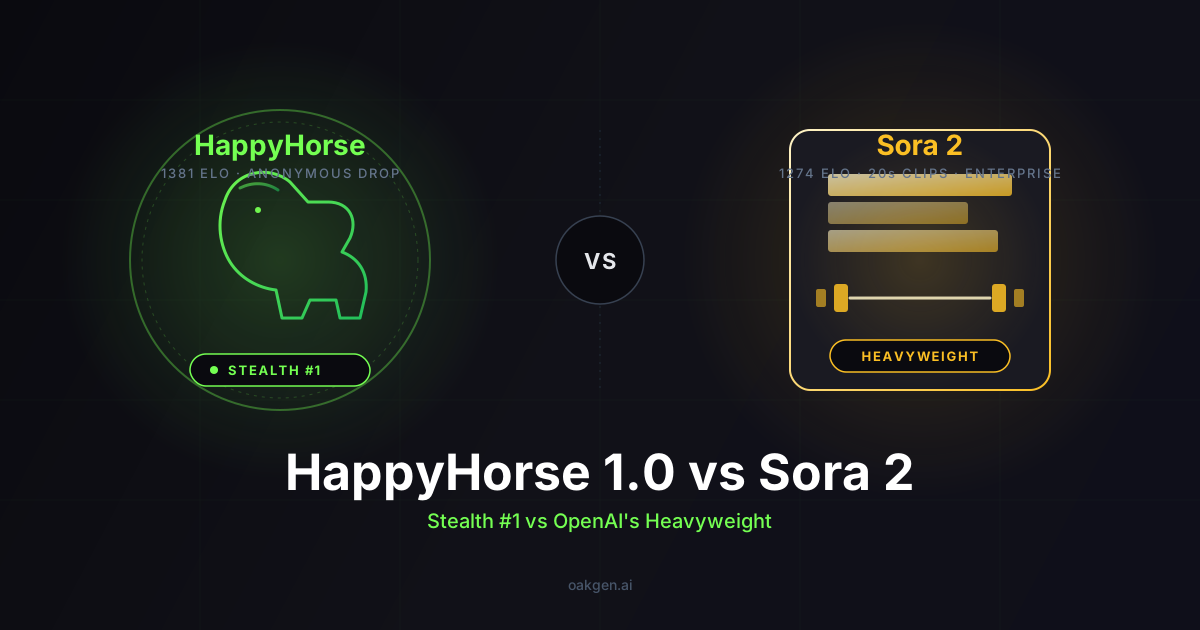
Sora 2 was the assumed king of AI video heading into Q2 2026 — until an anonymous model called "happyhorse-1.0" appeared on the Artificial Analysis Video Arena on April 7 and started winning blind evaluations. Three days later Alibaba claimed it. By April 26 it was on the fal API, and by April 29 it was live on Oakgen. HappyHorse commands the top aggregate position with a triple-digit Elo lead that no other model in the arena has come close to closing. Sora 2 still beats it on clip length (20s vs 15s), enterprise trust, and long-form narrative coherence. This is the honest split.
OpenAI pulled the plug on the standalone Sora app on April 26, 2026 — the same day HappyHorse hit the fal API. The Sora API will fully deprecate on September 24, 2026. If you built pipelines around Sora 2, they are already broken or on borrowed time. Read the full breakdown in our Sora 2 shutdown and best replacements guide. For creators looking to migrate, HappyHorse 1.0 is the top-ranked alternative available on Oakgen right now.
For most of 2025 and Q1 2026, the AI video conversation centered on Sora 2. OpenAI had the brand, the demo budget, the enterprise meetings. The assumption was that Sora 2 set the bar.
That broke quietly. On April 7, 2026, a model labeled "happyhorse-1.0" started appearing in Artificial Analysis Video Arena blind evaluations. Within a week it topped the leaderboard. On April 10 Alibaba's ATH-AI Innovation Division confirmed authorship. By April 26 it shipped via fal; by April 29 it was live on Oakgen. This is the head-to-head.
The timing is worth noting: Sora 2's standalone app shut down the same day HappyHorse went live on fal. OpenAI was burning an estimated $15 million per day on Sora compute while generating only $2.1 million in total lifetime revenue. The heir apparent arrived the same afternoon the king abdicated.
Verdict: HappyHorse Wins on Score, Speed, and Audio. Sora 2 Wins on Length and Trust.
If you only read one section: HappyHorse 1.0 is the higher-scoring model on public blind evaluation, generates faster (~10 seconds avg per clip), supports native audio in a single forward pass, and ships multilingual lip-sync across 7 languages. Sora 2 supports longer single clips (up to 20 seconds), comes with OpenAI's enterprise trust posture, and tends to read more coherent across longer narrative beats inside one render.
For short-form social, talking-head reads, multilingual UGC, and any workflow where leaderboard-grade quality and 10-second latency matter, HappyHorse is the stronger pick. For long-form narrative shots, brand-safety-sensitive enterprise pipelines, or any case where you specifically need a 20-second single render, Sora 2 still earns its slot — though with the Sora app now dead, access is increasingly limited to ChatGPT Plus and select API partners.
The Leaderboard Story: A Stealth Drop That Dethroned the Incumbent
The Artificial Analysis Video Arena is a public blind-evaluation leaderboard. Two clips render from the same prompt on two different anonymized models. Human evaluators pick a winner. Over thousands of comparisons, models accumulate Elo ratings. Brand recognition is irrelevant — evaluators don't know which model produced which clip until after they vote.
Sora 2 was the assumed king going into April 2026. Then "happyhorse-1.0" started appearing on the comparison feed. No press release, no product page, no maker attribution. Within 72 hours it had climbed to the top of the aggregate ranking. Three days later, Alibaba's ATH-AI Innovation Division (the team behind "快乐小马," literally "Happy Horse") confirmed authorship. The fal API launch came on April 26 at 9 PM PST. Oakgen had it in the model picker by April 29.
The gap is not a rounding error. HappyHorse's aggregate lead over the next-closest model exceeds 100 Elo points — the statistical equivalent of a tier boundary, not a marginal fluctuation. In chess Elo terms, that is the difference between a grandmaster and a strong international master. The gap opened up against a field that included Sora 2, Veo 3.1, Seedance 2.0, and Kling 3.0.
A fairness note: Sora 2 does not appear in every Artificial Analysis category in the same blind format HappyHorse and Seedance compete in. Some Sora 2 evaluation data lives in OpenAI's published testing rather than the public arena, so direct Elo-to-Elo comparison isn't always possible. What is possible is comparing the spec sheet, public clip outputs, and documented capabilities side by side.
Spec-by-Spec: HappyHorse 1.0 vs Sora 2 in 2026
| Feature | HappyHorse 1.0 | Sora 2 |
|---|---|---|
| Maker | Alibaba ATH-AI | OpenAI |
| Aggregate Elo (AA Video Arena) | 1381 (#1, +107 margin) | Not in same blind eval set |
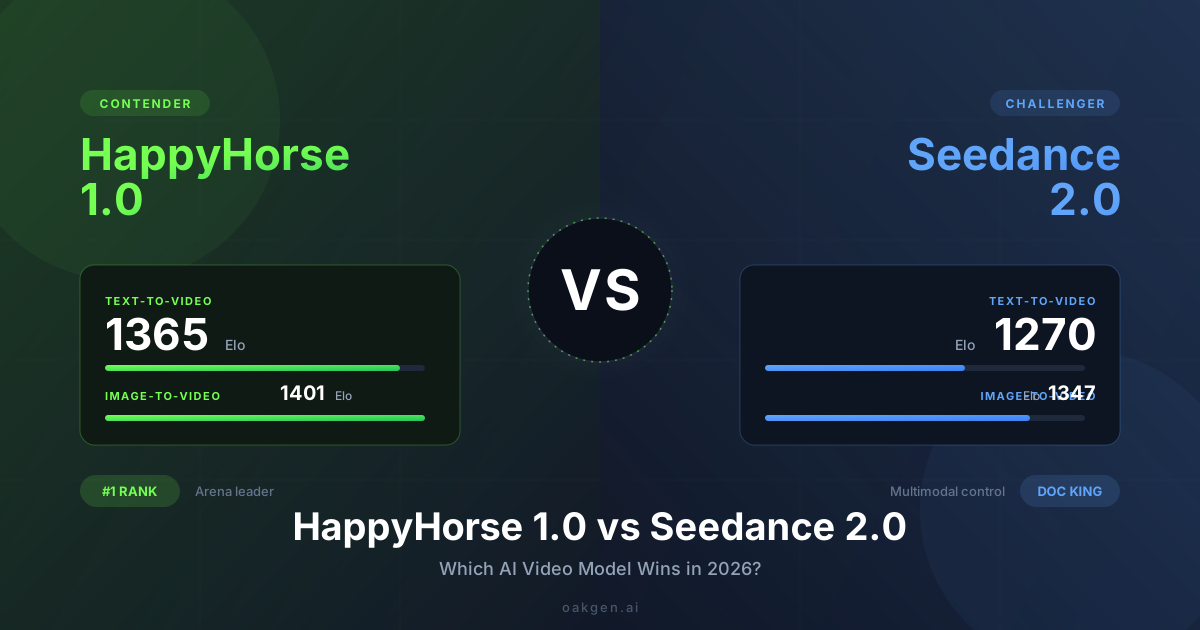
| Text-to-Video Elo (no audio) | 1365 | Not directly listed |
| Image-to-Video Elo (no audio) | 1401 | Not directly listed |
| Max clip length | 15s (paid tier) | Up to 20s |
| Native resolution | 1080p HD | 1080p+ (model-dependent) |
| Native audio in single pass | Yes (single-stream architecture) | No native audio generation |
| Multilingual lip-sync | 7 languages | English-primary |
| Avg generation speed | ~10s per clip | Slower (model-dependent, longer runs) |
| 1080p single-clip on H100 | ~38 seconds | Not directly published |
| Input modalities | Text, image | Text, image, video |
| Long-form narrative coherence | Strong up to 15s | Stronger across full 20s |
| Architecture | Unified Transformer — 40 layers, ~15B params, video + audio in one pass | Diffusion transformer (specifics not fully public) |
| API access (April 2026) | fal (live) | Sora app dead; API deprecating Sept 2026 |
The spec table tells the story the leaderboard implied. HappyHorse wins on the metrics with public, independently verified numbers (Elo, generation speed, multilingual lip-sync, native audio). Sora 2 wins on the metrics where length and OpenAI's distribution muscle matter (max clip length, enterprise trust, broad input modality support including video-to-video).
For a deeper look at the HappyHorse architecture and what "single-stream" actually means in practice — versus Sora-style diffusion pipelines that bolt audio on after the fact — the HappyHorse 1.0 review walks through the technical posture in detail. You can also explore native audio video generation as a feature category to see which other models in Oakgen's lineup ship sound and picture together.
The Architecture Difference: Why It Matters for Creators
Most video models in 2026 — including Sora 2 — treat video generation and audio generation as two separate problems solved by two separate subsystems. The video pipeline produces frames; a distinct audio module (often a diffusion model or vocoder) produces the soundtrack. Cross-attention layers stitch the two together, but the seams can show: lip-sync drift, ambient-sound mismatches, dialogue that floats a few frames off the mouth shapes.
HappyHorse takes a fundamentally different approach. Its unified Transformer stack processes video tokens and audio tokens through the same 40-layer attention mechanism in a single forward pass. There is no "audio model" bolted onto a "video model" — the entire clip, visuals and sound, emerges from one inference run. The practical payoff: tighter synchronization, fewer artifacts at the audio-visual boundary, and the ability to lip-sync across seven languages without a post-processing dubbing step.
For creators working on text-to-video projects where dialogue or ambient sound matters, this architectural distinction is the difference between "generate and ship" and "generate, then fix the audio in post."
Length, Resolution, Audio, Speed: Where the Real Workflow Differences Live
Length. Sora 2 supports single-render clips up to 20 seconds. HappyHorse caps at 15 seconds on the paid tier (12 on Lite). For a 30-second narrative scene, Sora can do it in two cuts; HappyHorse needs three. For most short-form social work — TikTok, Reels, Shorts, vertical UGC — the 15-second cap is more than enough. Where it bites: longer narrative beats where the camera-and-character coherence inside one render matters more than across-render stitching.
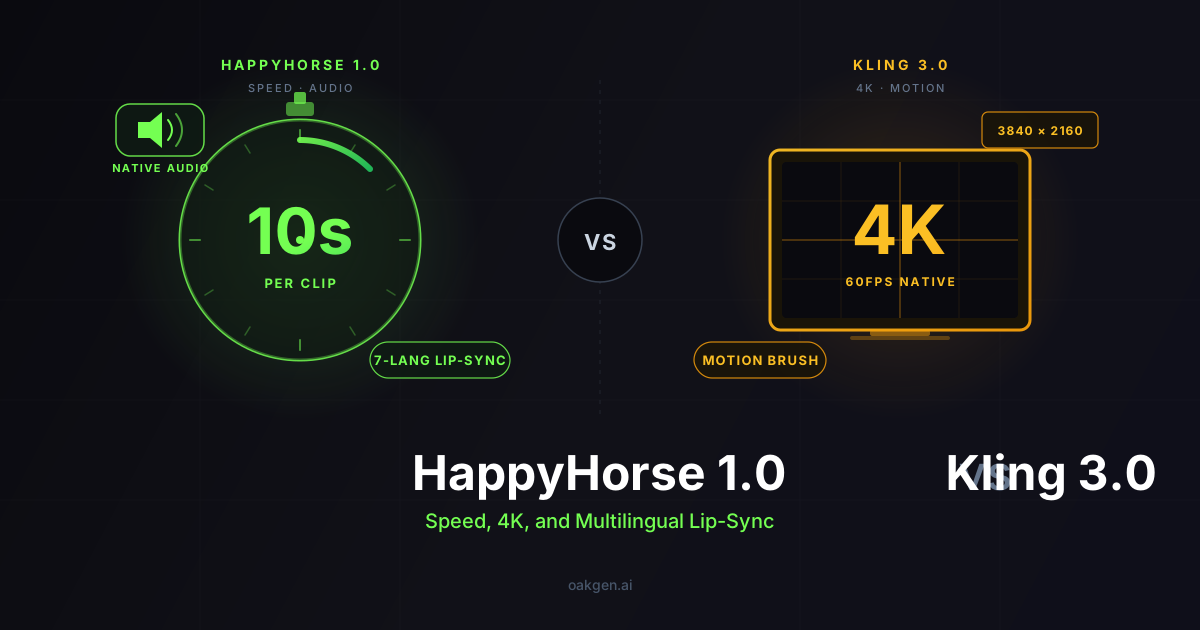
Resolution. Both ship 1080p as a serviceable native output. Neither is the resolution king of 2026 (Kling 3.0 still holds 4K/60fps). For social, 1080p is the right answer. For broadcast or 4K masters, you're using Kling for the master cut regardless of which side of this comparison you pick.
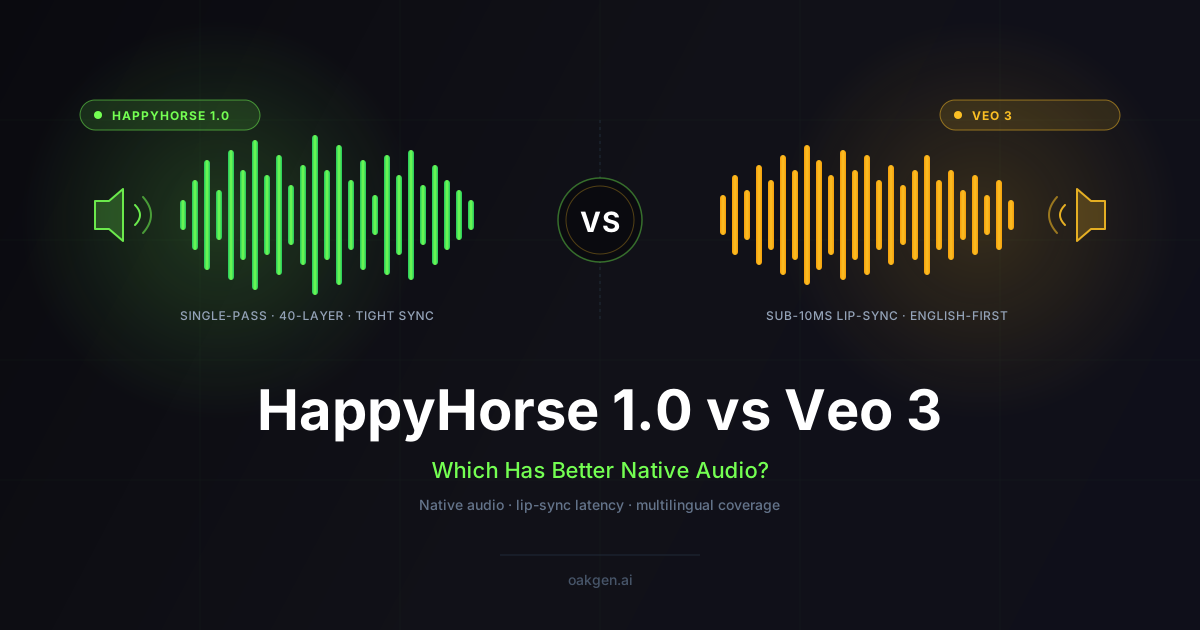
Native audio. This is where the architectural difference shows up loudest. HappyHorse generates video and audio in one forward pass — no cross-attention, no separate audio model, no post-hoc TTS layer. The result is dialogue and ambient sound that rides synchronized with the visual stream from frame zero. Sora 2 does not generate audio natively. To ship a Sora 2 clip with sound, you need a separate TTS or music pass and a sync step. For multilingual UGC ads where lip-sync coherence matters, HappyHorse's single-pass architecture is the practical advantage. Oakgen also offers dedicated text-to-speech and music generation tools if you need standalone audio for other workflows.
Speed. HappyHorse averages ~10 seconds per generation, with 1080p single clips landing near 38 seconds on a single H100. Sora 2 generations run longer — exact published numbers vary by tier and prompt complexity, but the practical experience inside creator tools is that Sora 2 is "wait a couple of minutes" while HappyHorse is "wait one breath." For creators iterating on prompt variants, that latency gap reshapes the workflow. The fastest AI video generators of 2026 breakdown ranks the field on raw render time.
Multilingual lip-sync. HappyHorse supports synchronized lip-sync across English, Mandarin, Cantonese, Japanese, Korean, German, and French as part of the same generation pass. Sora 2 is English-primary; non-English work usually requires post-processing or a separate dubbing pipeline. For global brand work and localized UGC, HappyHorse's seven-language native lip-sync removes a step from the pipeline.
Generate HappyHorse 1.0 Videos Now
When Sora 2 Wins
This is the honest section. HappyHorse holds the leaderboard, the speed advantage, and the audio-architecture edge. Sora 2 still wins clearly in three places.
Long-form narrative shots in a single render. The 20-second max clip length is a real advantage when the shot needs to breathe — a tracking sequence through a transition, a music-video beat on one continuous camera move, a product demo with a full arc inside one cut. HappyHorse's 15-second cap means you stitch in the editor. Usually fine; sometimes not.
Brand-safety and enterprise trust posture. OpenAI has spent years building enterprise relationships and content-policy governance around Sora. For brands that already have OpenAI in procurement or need defensible content-moderation paper trails, Sora 2 is the easier procurement story. Alibaba's Western enterprise posture is still developing. For indie creators this is a non-issue; for Fortune 500 brand teams it's often the deciding factor.
Video-to-video input. Sora 2 accepts video as a reference input. HappyHorse 1.0 is text and image only. For workflows that depend on driving generation from existing footage — re-lighting, restyling, extending a render — Sora has the input modality coverage HappyHorse launches without.
Sustained narrative coherence. Inside a single 20-second render, Sora 2 holds character identity, camera logic, and scene physics more reliably than HappyHorse pushed to its 15-second cap. HappyHorse is stronger at the 5-to-10-second sweet spot. Sora 2 is stronger at 15-to-20.
When HappyHorse 1.0 Wins
The reverse is also a clean list. HappyHorse wins definitively in four scenarios.
Public leaderboard quality at standard clip lengths. The triple-digit Elo gap separating HappyHorse from the rest of the arena is the kind of margin that signals a genuine generational step — not noise, not prompt-selection variance, but a persistent advantage across thousands of blind comparisons. For 5-to-10-second clips — where most short-form work lives — HappyHorse is the highest-rated model in the field as of April 2026.
Native audio inside the same generation. HappyHorse generates the audio track as part of the single forward pass. Sora 2 does not. For creator workflows that ship sound-on by default — TikTok, Reels, talking-head UGC, dialogue shorts — HappyHorse removes a step. The HappyHorse vs Seedance 2.0 head-to-head covers the audio architecture in more depth, including the one category Seedance still leads narrowly on Image-to-Video with audio.
Multilingual lip-sync across 7 languages. Native synchronized lip-sync in English, Mandarin, Cantonese, Japanese, Korean, German, and French. For global UGC and localized ad creative, that's the practical differentiator. Sora 2's English-primary posture means non-English work usually needs a separate dubbing pass.
Generation speed and iteration loop. ~10 seconds vs Sora 2's longer times changes how you work. When a prompt iteration is one breath instead of two minutes, you ship more variants and pick the best. For batch testing and iterative shot development, fast generation isn't nice-to-have — it's the workflow.
Pricing and Access on Oakgen
Need help picking the right model for a specific shot? Oakgen's Agent Chat can walk you through model selection, prompting strategy, and credit estimation in a conversational interface.
A note on Sora 2 access: with the Sora app now shut down and the API deprecating in September 2026, direct Sora 2 access is limited to ChatGPT Plus and select API partners on borrowed time. For HappyHorse 1.0, it's live on Oakgen now with no access restrictions.
Earn 25% recurring on every referral.
Share Oakgen, get paid every month they stay.
The Bottom Line
The leaderboard story is the headline, but the practical takeaway is more interesting. HappyHorse 1.0 is the stronger short-form model — better leaderboard score at standard clip lengths, native audio, multilingual lip-sync, ~10-second generation. Sora 2 is the stronger long-form model and the safer enterprise procurement story — but it is also a product in active wind-down, with its standalone app already dead and its API on a published deprecation timeline. The right answer for any creator workflow is to know which lane the shot lives in, and route accordingly.
For short-form social, multilingual UGC, dialogue-driven creator work, and anyone iterating on prompt variants where speed of feedback matters more than max clip length, HappyHorse is now the model to beat. For long-form narrative scenes that need 20-second single renders, video-to-video input, or formal enterprise governance, Sora 2 still earns its slot — for as long as it remains accessible. The fact that HappyHorse exists as a viable alternative at the top of the public leaderboard is what changed in April 2026 — not that Sora 2 stopped being good. What changed in late April is that Sora 2 stopped being available.
Frequently Asked Questions
Is Sora 2 still available after the April 2026 shutdown?
The standalone Sora app at sora.com is dead as of April 26, 2026. Sora 2 model access is still available through ChatGPT Plus and select API partners, but the dedicated app, free tier, and storyboard editor are gone permanently. The Sora API will fully deprecate on September 24, 2026. If you need a reliable text-to-video pipeline, HappyHorse on Oakgen is the top-ranked alternative with no deprecation risk.
Can HappyHorse 1.0 replace Sora 2 for my workflow?
For short-form social content, talking-head videos, multilingual UGC, and anything under 15 seconds — yes, HappyHorse is the stronger model by leaderboard score, generation speed, and native audio capability. For 20-second single-render narrative shots or video-to-video input workflows, HappyHorse does not yet match Sora 2's clip length or input flexibility. Most creators migrating from Sora find HappyHorse covers 80-90% of their use cases with better quality. See the full Sora replacement guide for model-by-model migration paths.
How does HappyHorse generate audio without a separate TTS step?
HappyHorse uses a unified 40-layer Transformer that processes video and audio tokens through the same attention stack in one forward pass. There is no separate audio model — the clip's visuals and sound emerge from a single inference run. This is different from most competitors (including Sora 2) that generate silent video first, then produce audio in a separate step. The result is tighter lip-sync and more natural ambient sound. For workflows that still need standalone voiceover or music, Oakgen also offers dedicated music and audio generation tools.
Which model is faster — HappyHorse or Sora 2?
HappyHorse averages roughly 10 seconds per generation for a standard clip. Sora 2 typically takes one to three minutes depending on prompt complexity and tier. For iterative workflows where you test multiple prompt variations, that speed difference is the practical dividing line.
What does the 1381 Elo score actually mean?
Elo ratings on the Artificial Analysis Video Arena come from thousands of blind head-to-head comparisons where human evaluators pick the better clip without knowing which model made which. A gap of 100+ Elo points is statistically significant — it means that in a random matchup, the higher-rated model wins roughly 64% of the time. HappyHorse's margin over the next-closest model is the largest single-model lead the arena has recorded.
Can I use both HappyHorse and other models on Oakgen without separate subscriptions?
Yes. Oakgen uses a single credit pool across all models — 30+ video models, 35+ image generators, music generation, and TTS. You pick the right model per shot without managing multiple subscriptions. Plans start at $9/month; check the pricing page for credit allocations by tier.
What to read next
- Sora 2 Is Dead: The 5 Best AI Video Generators That Replaced It — the full shutdown timeline and model-by-model migration guide for former Sora users.
- HappyHorse 1.0 Review: Alibaba's #1 AI Video Model Tested on Oakgen — deep dive on the architecture, the leaderboard math, and what the top Elo score actually means in practice.
- HappyHorse 1.0 vs Seedance 2.0: Which AI Video Model Wins in 2026? — the closer head-to-head, including the one category Seedance still leads (Image-to-Video with audio).
- Fastest AI Video Generators in 2026 (10-Second Generation Test) — render-time benchmarks across the field, with HappyHorse holding the speed crown.
- Best AI Video Generators in 2026: Every Model Ranked — the full field ranking beyond just HappyHorse and Sora.
- Best AI Video Model with Native Audio in 2026 (Tested) — if native audio is your deciding factor, this is the dedicated comparison.
- How to Build a Full AI Content Pipeline: Script to Published Video — end-to-end workflow guide using Oakgen's video, image, and audio tools together.