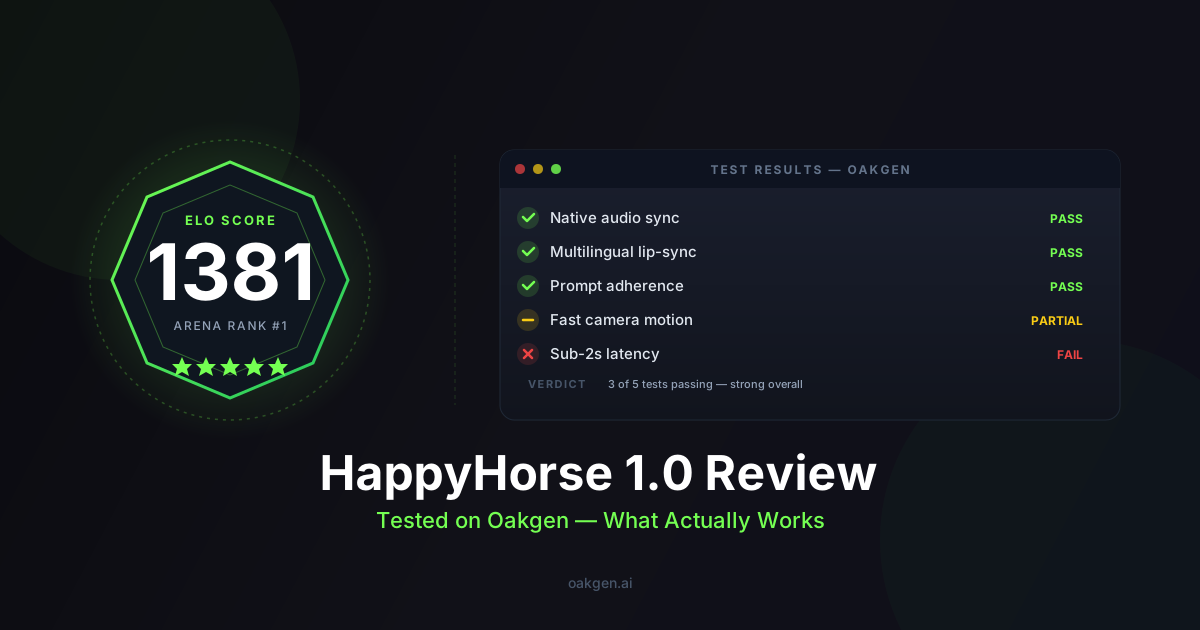
Alibaba's ATH-AI Innovation Division dropped HappyHorse 1.0 onto the Artificial Analysis Video Arena leaderboard with zero fanfare on April 7, 2026 -- and it immediately claimed the #1 rank with a 1381 aggregate Elo. The model produces 1080p video with synchronized audio in a single forward pass, supports lip-sync across seven languages, and typically completes a generation in about ten seconds. The fal API opened on April 26, and Oakgen integrated it into the unified credit pool on April 29. Below is the straight-answer reference covering cost, hard limits, region access, commercial rights, and the 14 questions people ask most.
What Is HappyHorse 1.0 in 60 Words
HappyHorse 1.0 is a single-stream 40-layer Transformer (~15B parameters) from Alibaba's ATH-AI Innovation Division that generates video and audio in one forward pass -- no separate audio model, no cross-attention bolt-on. It produces native 1080p clips up to 15 seconds, runs in roughly 10 seconds on an H100, and supports 7-language lip-sync. As of April 2026 it ranks #1 on the public Artificial Analysis Video Arena leaderboard.
How Much Does HappyHorse 1.0 Cost?
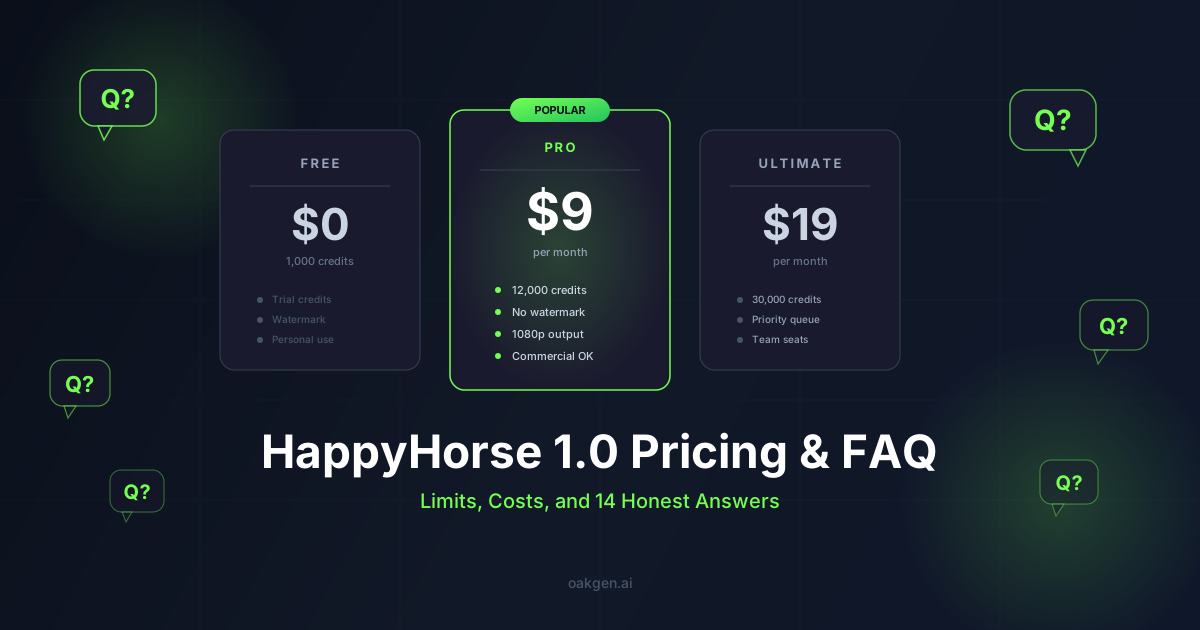
Pricing depends on where you run it.
Direct via happyhorse.app: Public pricing is opaque. The official site does not publish a per-second or per-clip rate. Access funnels through a web demo with tier gating (Lite vs Paid).
Via the fal API (since April 26, 2026): Pay-per-generation, billed by clip length and resolution. fal sets the wholesale rate.
Via Oakgen: HappyHorse 1.0 is part of the unified credit pool. The same credits work across HappyHorse, Seedance 2.0, Veo 3.1, Kling 3.0, Kling v3 Pro, and 25+ other video models -- plus every image, audio, and music model on the platform. If you need help choosing the right model or comparing costs, you can also ask Oakgen's AI Agent to walk you through options based on your project.
Oakgen Plan Structure
- Paid plans: Start at $9/month with monthly credit allocations.
- Annual plans: Distribute credits monthly with a discount versus monthly billing.
- Add-on credits: One-time top-ups on every plan.
If you are a freelancer juggling multiple client projects or a small business running lean on marketing budget, the unified pool is especially useful -- one subscription covers video, image, voice, and music instead of stacking four separate tools.
Credit Cost Per HappyHorse Generation
Credit consumption is calculated from the third-party fal cost using a 1:1 conversion (1 USD = 260 credits). A short 1080p HappyHorse clip falls in the same band as comparable Seedance 2.0 and Kling 3.0 generations. Exact credit cost is shown in the generator UI before you click generate, and it scales with clip length. Failed generations are automatically refunded.
If you use one model exclusively, going direct may be marginally cheaper. If you use two or more video models, or pair video with image and audio generation, the unified credit pool on Oakgen is meaningfully cheaper because you avoid stacking subscriptions.
HappyHorse 1.0 Hard Limits
These are the model's real constraints. Read them before you build a workflow around it.
| Limit | Value | Notes |
|---|---|---|
| Max clip length (Paid tier) | 15 seconds | Single generation, no extension |
| Max clip length (Lite tier) | 12 seconds | Lower-tier access |
| Max resolution | 1080p | Native, no upscale to 4K |
| Average generation time | ~10 seconds per clip | ~38 seconds for full 1080p on a single H100 |
| Lip-sync languages | 7 | English, Mandarin, Cantonese, Japanese, Korean, German, French |
| Input modalities | Text and image | No video reference, no audio reference |
| Output modalities | Video plus native audio | Single forward pass, no separate audio model |
| Architecture | Single-stream 40-layer Transformer | ~15B parameters |
If your project needs longer than 15 seconds, higher than 1080p, an 8th language, or video reference inputs, HappyHorse alone will not cover it. Oakgen lets you mix it with Sora 2 (20s), Kling 3.0 (4K), or Seedance 2.0 (12-file multi-modal) in the same project.
Availability Timeline
- April 7, 2026: Stealth appearance on Artificial Analysis Video Arena leaderboard at #1.
- April 10, 2026: Alibaba ATH-AI Innovation Division officially confirmed authorship on X.
- April 26, 2026 (9 PM PST): fal API launched -- first public programmatic access.
- April 29, 2026: Live on Oakgen as part of the unified credit pool, no waitlist.
Before April 26, the only way to use HappyHorse was a web demo on the official site with no API access and no commercial license clarity. The fal launch and Oakgen integration are what made it usable for production workflows outside China.
Commercial Use Rights
HappyHorse 1.0 generations made through the fal API (and therefore through Oakgen) carry commercial-use rights under the standard fal model terms -- you can use outputs in marketing, advertising, social content, paid ads, branded video, product demos, and client work. Oakgen does not add additional restrictions on top of fal's licensing.
The standard 2026 caveat applies: do not depict real, identifiable individuals without consent, and do not generate content that violates safety policies (CSAM, non-consensual intimate imagery, deceptive political deepfakes). These are non-negotiable across every provider on Oakgen.
Generate HappyHorse 1.0 Videos Now
Honest Limitations
HappyHorse 1.0 is the highest-ranked aggregate model on the public Elo leaderboard, but it is not best on every individual axis.
- Resolution: Caps at 1080p. Kling 3.0 and Veo 3.1 both support native 4K. If your output is destined for cinema or 4K streaming, HappyHorse will need upscaling.
- Clip length: Caps at 15 seconds (12s on Lite). Sora 2 supports single clips up to 20 seconds. Seedance 2.0 supports extension without regeneration; HappyHorse does not.
- Image-to-Video with audio: Seedance 2.0 narrowly leads on this category (1182 vs 1167 Elo). For image-anchored clips with synchronized audio, Seedance is the tighter choice.
- Dialogue lip-sync latency: Veo 3 has stronger sub-10ms dialogue lip-sync for spoken English and is preferred for talking-head content.
- Input modalities: Text and image only. No video reference (Seedance offers @camera, @action, @effect, @style), no audio reference.
- Documentation: Model just dropped. Prompt library is thin compared to Veo, Sora, and Kling.
- Languages: 7 lip-sync languages is strong but not exhaustive. Spanish, Portuguese, Hindi, Arabic, and Italian are not supported.
Frequently Asked Questions
Is HappyHorse free?
Is HappyHorse better than Seedance?
On aggregate Elo, yes -- HappyHorse leads 1381 to Seedance 2.0's roughly 1274 average across the four arena categories, a 107-point margin. HappyHorse wins text-to-video (1365 vs 1270), image-to-video without audio (1401 vs 1347), and text-to-video with audio (1230 vs 1221). Seedance wins one category: image-to-video with audio (1182 vs 1167). For most use cases HappyHorse is the better default, but Seedance still wins on multi-modal input flexibility (12 files, video reference) and image-anchored audio work.
Is HappyHorse better than Sora?
On the public Artificial Analysis leaderboard, HappyHorse 1.0 ranks higher than Sora 2 by aggregate Elo. HappyHorse also generates faster (~10s vs Sora's longer queue times) and supports native audio in a single pass. Sora's advantage is single-clip length: up to 20 seconds versus HappyHorse's 15-second cap, and Sora's cinematic look is distinctive on long-form narrative content. If you need clips over 15 seconds, choose Sora 2; if you need speed, native audio, and the highest blind-evaluation rank, choose HappyHorse.
What languages does HappyHorse support?
HappyHorse 1.0 supports synchronized lip-sync in 7 languages: English, Mandarin, Cantonese, Japanese, Korean, German, and French. The lip-sync is generated as part of the same forward pass that produces the video, so phoneme timing is tight. Languages outside this set (Spanish, Portuguese, Hindi, Arabic, Italian, Russian) will still produce video but without language-accurate mouth movement. For multilingual marketing campaigns covering languages outside the 7, pair HappyHorse with ElevenLabs voice cloning on Oakgen.
How long is a HappyHorse video?
Up to 15 seconds on the paid tier and up to 12 seconds on the Lite tier. There is no extension feature exposed through the fal API today, so 15 seconds is the hard maximum from a single generation. For longer sequences, you chain multiple clips -- generate two or three 15-second clips with consistent prompts and edit them together. This is a common workflow on Oakgen for trailers and longer narrative pieces. If you need a single unbroken clip over 15 seconds, switch to Sora 2 (20s) for that shot.
Does HappyHorse have an API?
Yes, since April 26, 2026 (9 PM PST). HappyHorse 1.0 is available through the fal API, and Oakgen's video generator routes to that API directly. Before April 26 there was no programmatic access -- only a web demo on the official site. The fal API supports text-to-video and image-to-video with the standard parameters (prompt, image, duration, resolution). Oakgen's /ai-video-generator?model=happyhorse-1-0 deep-link is the simplest path if you want to use it without writing fal API code yourself.
Is HappyHorse available outside China?
Yes. HappyHorse 1.0 is accessible outside China through the fal API and through any platform that integrates fal -- including Oakgen. Oakgen has no region restrictions and does not require a business email or Chinese phone number for sign-up. The model itself is hosted on fal's global infrastructure, so latency is comparable to other fal-hosted models regardless of where you are calling from.
How fast is HappyHorse?
Roughly 10 seconds per clip on average, and approximately 38 seconds for a full 1080p generation on a single H100 GPU. Alibaba's published benchmarks claim HappyHorse 1.0 is 30 to 40 percent faster than Seedance 2.0 on equivalent hardware. In practice, that means you can iterate on a prompt 5 or 6 times in the time it takes one Sora 2 generation to complete. Speed is one of HappyHorse's strongest selling points alongside its leaderboard rank.
Can I use HappyHorse for commercial work?
Yes, when accessed through the fal API or through Oakgen. Outputs carry commercial-use rights under fal's standard model terms, which means you can use them in advertising, social content, paid ads, branded video, client deliverables, and product marketing. Oakgen does not add additional restrictions. The standard ethical limits apply across all providers: do not depict real, identifiable individuals without consent, and do not generate content that violates platform safety policies. Direct happyhorse.app commercial terms are less clearly published -- the fal route is the cleaner commercial path.
Who made HappyHorse?
Alibaba's ATH-AI Innovation Division -- a research group inside Alibaba's larger AI organization. The translated Chinese name is "快乐小马" (kuaile xiaoma, literally "Happy Little Horse"). The model first appeared anonymously on the Artificial Analysis Video Arena leaderboard on April 7, 2026, and Alibaba officially confirmed authorship on X on April 10, 2026. The team has not published a full technical paper as of late April 2026, but architecture details have been shared informally: a single-stream 40-layer Transformer, ~15B parameters, with video and audio synthesized in one forward pass.
Is HappyHorse open source?
No. HappyHorse 1.0 is a closed-weight commercial model. There are no model weights on Hugging Face, no GitHub release, and no published license for self-hosting. Alibaba has not announced plans for open release. If you specifically need an open-weight video model in 2026, look at Kling v3 Pro (Alibaba's other video model line, partially open) or Mochi-1 -- but expect a meaningful quality gap versus HappyHorse 1.0's leaderboard-leading output.
How is HappyHorse different from Seedance 2.0 architecturally?
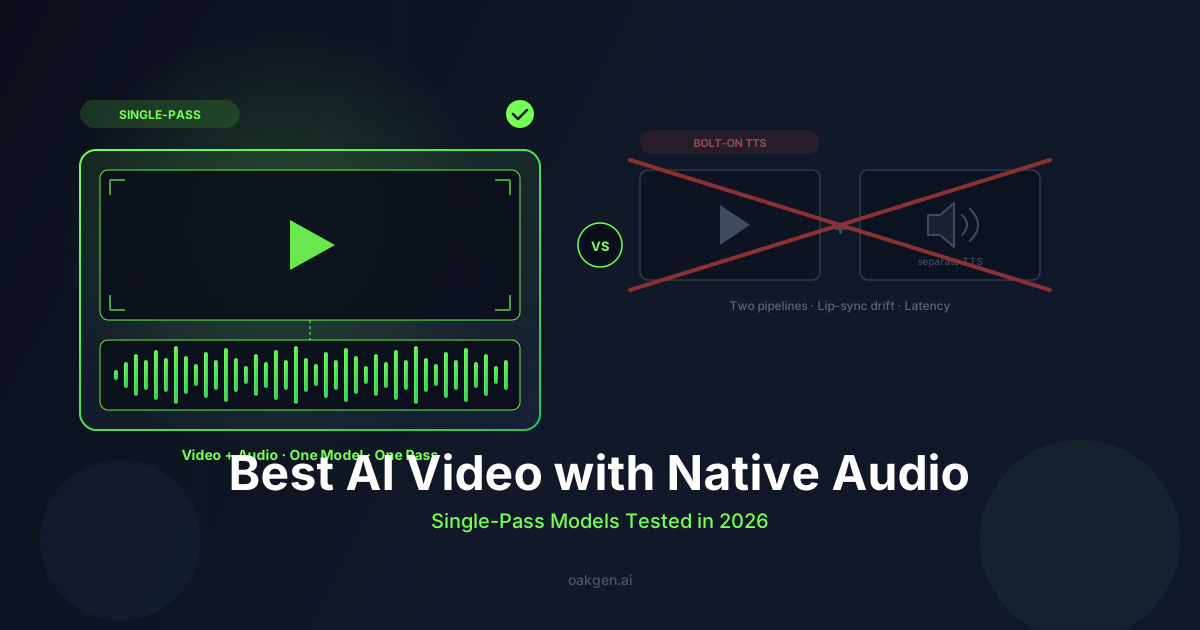
The core difference is the audio path. Seedance 2.0 uses a video model with a separate audio generation stage -- high-quality but technically two passes stitched together. HappyHorse 1.0 uses a single-stream Transformer that generates video and audio in one forward pass, with no cross-attention bridge between modalities and no separate audio model. This is why HappyHorse can do tight lip-sync at low latency: the same network is producing pixels and phonemes simultaneously. Seedance counters with broader input flexibility (text, 9 images, 3 videos, 3 audio files -- 12 inputs total) and the @ reference system, neither of which HappyHorse offers. Architecturally: HappyHorse optimizes for unified generation; Seedance optimizes for input control.
Does HappyHorse support image-to-video?
Yes. Image-to-video is a first-class input mode and is the category where HappyHorse posts its highest Elo score (1401 without audio, 1167 with audio). Upload a reference image as the visual anchor, write a text prompt describing motion and mood, and HappyHorse generates a 1080p clip up to 15 seconds. Note that for image-to-video specifically with audio, Seedance 2.0 narrowly outranks HappyHorse -- so test both on your actual prompt before committing to one.
What hardware do I need to run HappyHorse?
None. HappyHorse 1.0 is closed-source and runs on Alibaba/fal infrastructure -- you access it through an API call or a web interface. The published benchmark of ~38 seconds for a full 1080p generation on a single H100 gives you a sense of the model's compute footprint, but you cannot replicate it locally because the weights are not released. For self-hosted video, look at Kling v3 Pro or Mochi-1.
Earn 25% recurring on every referral.
Share Oakgen, get paid every month they stay.
Bottom Line
HappyHorse 1.0 is the best aggregate AI video model on the public leaderboard as of April 2026, and it is now usable in production via the fal API and via Oakgen. It is fast, native audio comes free, lip-sync works in 7 languages, and the unified credit pool lets you compare it directly against Seedance 2.0, Veo 3.1, Kling 3.0, and Sora 2 without juggling subscriptions. It is not the right choice if you need 4K, clips over 15 seconds, video reference inputs, or languages outside the 7 supported -- for those, swap models inside the same Oakgen project.
What to Read Next
- HappyHorse 1.0 Complete Guide -- full deep-dive on architecture, prompting, and how to use the model end-to-end.
- HappyHorse 1.0 vs Seedance 2.0 -- the head-to-head that matters most in 2026, with prompt-by-prompt comparisons.
- HappyHorse 1.0 Review -- the honest tested-on-Oakgen review, with strengths, weaknesses, and the prompts that broke it.
- Oakgen Pricing Explained -- full transparent breakdown of every plan, credit cost per model, annual savings, and add-on packages.
- The Real Cost of AI Generation: Pricing Breakdown -- what AI generations actually cost across providers and how the credit math works.
- AI Tools for Freelance Designers -- how freelancers use AI to deliver more projects without burning out or stacking subscriptions.
- AI Marketing for Small Business Owners -- one platform for images, videos, voiceovers, and music instead of five separate tools.