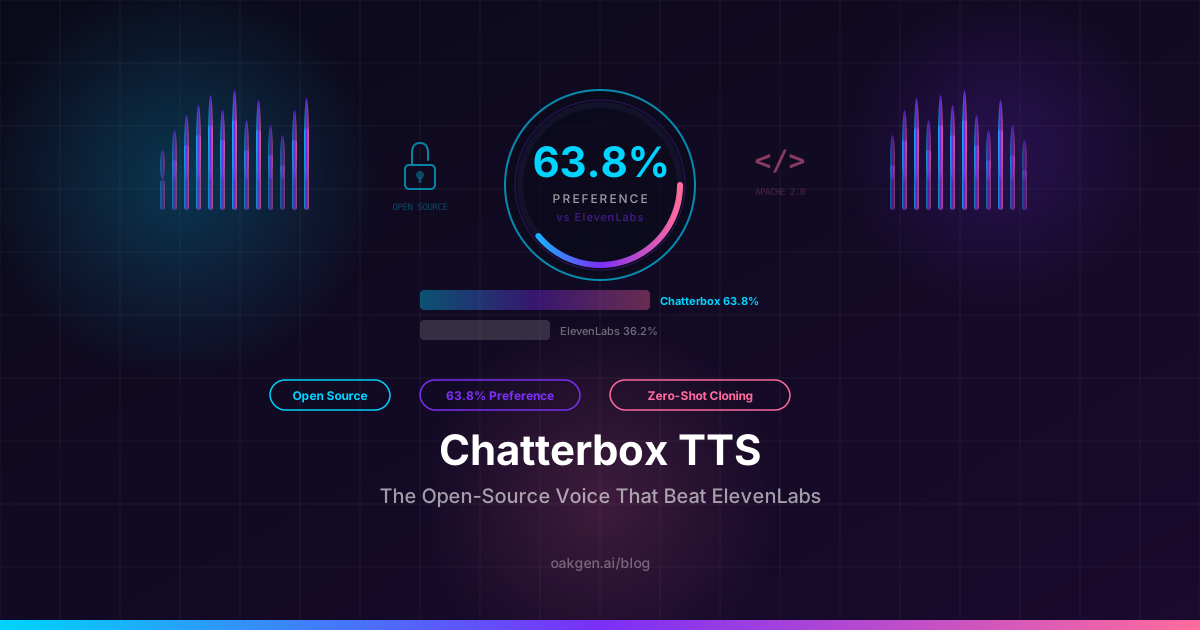
Chatterbox TTS is Resemble AI's family of open-source text-to-speech models, released under the MIT license. You can download the weights, clone a voice from a short reference clip, and use the audio commercially without per-character fees. As of September 2026 the family has four main models. Chatterbox-Turbo (350M parameters, English) is the fast one. Chatterbox-Nano (110M) runs on a CPU. Chatterbox Multilingual V3 (0.5B) covers 23+ languages. The original 500M model is still available. In Resemble's published listening tests, people preferred Chatterbox over ElevenLabs about two times out of three.
The catch: the open weights are self-hosted, so you run the hardware, and the tests were run by the vendor. If you want a managed option, Resemble also sells a hosted service.
We re-checked every claim against Resemble AI's GitHub repo, Hugging Face card, PyPI and the Podonos evaluation pages on September 26, 2026. Corrections to the May version:
- The license is MIT, not Apache 2.0.
- In the original test, ElevenLabs was preferred in 27.5% of ratings, not 36.2%. The other 8.75% had no preference.
- Chatterbox is no longer English-only. Multilingual (23 languages) shipped in September 2025, and Multilingual V3 followed in June 2026.
- Added Chatterbox-Turbo and Chatterbox-Nano, released after the original model.
- Chatterbox has a built-in PerTh watermark. The earlier "no safety rails" claim was wrong.
- We removed GPU size claims and competitor figures we could not verify.
Chatterbox TTS Models Compared
Choosing a model is the first real decision. Here is the lineup from Resemble's README:
| Model | Size | Languages | Stand-out feature | Best for |
|---|---|---|---|---|
| Chatterbox-Turbo | 350M | English | One-step decoder, native tags like [laugh] and [cough] | Voice agents, narration, low latency |
| Chatterbox-Nano | 110M | English | Same architecture as Turbo, runs on CPU (3x realtime on 8 cores) | On-device apps, tight memory budgets |
| Chatterbox Multilingual V3 | 0.5B | 23+ | Better speaker similarity and fewer hallucinations than earlier multilingual versions | Non-English and mixed-language content |
| Single Language Pack | Fine-tunes | 6 locales | Dedicated models for Chinese, Latin American Spanish, Spain Spanish, Brazilian Portuguese, European Portuguese and Hindi | Production work in one of those locales |
| Chatterbox (original) | 500M | English | Exaggeration and CFG controls for expressive delivery | Creative control, dramatic reads |
Our quick pick: start with Turbo for English. Use Nano if you have no GPU. Use Multilingual V3 for anything else, or the matching Single Language Pack model if your language is on that list.
The 23 languages are Arabic, Danish, German, Greek, English, Spanish, Finnish, French, Hebrew, Hindi, Italian, Japanese, Korean, Malay, Dutch, Norwegian, Polish, Portuguese, Russian, Swedish, Swahili, Turkish and Chinese.
Need Voiceovers Without Running a GPU?
Paste a script into Oakgen and render it with ElevenLabs v3 or Turbo v2.5. No install, no server to run.
Chatterbox TTS vs ElevenLabs: What the Blind Tests Showed
Resemble published two head-to-head evaluations on Podonos, a speech evaluation platform:
| Test | Ratings | Preferred Chatterbox | No preference | Preferred ElevenLabs |
|---|---|---|---|---|
| Original Chatterbox vs ElevenLabs | 80 (8 clips) | 51 (63.75%) | 7 (8.75%) | 22 (27.5%) |
| Chatterbox-Turbo vs ElevenLabs Turbo v2.5 | 2,500 | 1,632 (65.3%) | 255 (10.2%) | 613 (24.5%) |
In the Turbo test, 42.1% of all ratings strongly preferred Chatterbox-Turbo. The README also links Podonos comparisons against Cartesia Sonic 3 and VibeVoice 7B.
How much weight to give these numbers:
- The vendor ran them. Resemble commissioned and published both evaluations. That doesn't make them wrong, but they are not independent.
- The first test is small. 80 ratings across 8 clips is enough for a signal, not a verdict. The Turbo test, at 2,500 ratings, is far more convincing.
- Short clips favor peak quality. A few sentences won't show how a voice holds up across a 40-minute audiobook, or how it handles product names and numbers.
- The first test doesn't name the ElevenLabs model. The Turbo test does (Turbo v2.5), and ElevenLabs has since released Eleven v3.
So the fair summary: in Resemble's own tests, listeners picked Chatterbox roughly two times out of three. If voice quality is your deciding factor, run your own script through both before you commit.
Chatterbox vs ElevenLabs: Feature Comparison
| Feature | Chatterbox TTS | ElevenLabs | Oakgen (managed TTS) |
|---|---|---|---|
| License / access | MIT, open weights | Proprietary app and API | Hosted, credit-based |
| Languages | English (Turbo, Nano, original); 23+ (Multilingual V3) | 70+ with Eleven v3; 29 with Multilingual v2 | Depends on model (ElevenLabs, Google, OpenAI, MiniMax) |
| Voice cloning | Zero-shot from a short reference clip | Instant clones; Professional Voice Clones from the Creator plan up | Voice cloning via MiniMax |
| Expressive control | Exaggeration and CFG (original); paralinguistic tags (Turbo, Nano) | Voice settings per model | Model-dependent |
| Latency | Your hardware; Resemble's paid hosted service advertises sub-200ms | About 75ms model inference with Flash, excluding app and network latency; the older Turbo v2.5 is around 300ms | Queue plus model time |
| Price | Free weights; you pay for compute | API from $0.05 per 1K characters (Flash/Turbo), $0.10 (v3, v2) | 13 to 26 credits per 1K characters for ElevenLabs models |
| Watermark | PerTh on every output | Platform safeguards | Provider safeguards |
| Fine-tuning | Yes, open weights | No | No |
Disclosure: Oakgen is our product. We include it because it is relevant to this workflow, but the comparison also covers where standalone tools may be better.
Where Chatterbox is the better choice: high English volume, full control over the pipeline, fine-tuning, or on-device deployment. Where ElevenLabs or a managed platform is better: no engineering time, the widest language coverage, guaranteed low latency, and someone else handling uptime.
What Chatterbox TTS Does Well
Expressive English. Resemble's Hugging Face card calls the original model the first open-source TTS model with emotion exaggeration control. The exaggeration setting moves delivery from calm to theatrical. Turbo and Nano add inline tags such as [laugh], [cough] and [chuckle], so you can write the reaction into the script.
Zero-shot cloning. Pass a short reference clip and Chatterbox speaks in that voice with no training step. Resemble's examples use a 10-second clip.
Real deployment options. Nano's CPU speed makes on-device voice practical, and Turbo's one-step decoder cuts the decoding bottleneck from 10 steps to 1. Resemble says Turbo needs less compute and VRAM than its earlier models.
A permissive license. MIT lets you fine-tune, modify, bundle and redistribute the model. You only need to keep the license notice.
Built-in provenance. Every output carries Resemble's PerTh watermark. It is inaudible and designed to survive MP3 compression and editing. That matters if you publish cloned voices at scale.
Where Chatterbox Falls Short
- You run the infrastructure. GPU provisioning, scaling, updates and monitoring are your job. That is fine for an engineering team and a real cost for a solo creator.
- The best English models are English-only. Turbo and Nano don't cover other languages. For those you switch to Multilingual V3, a larger model with its own tuning.
- Accent bleed across languages. Resemble's own tip: if the reference voice speaks a different language from the target, set
cfg_weightto 0 to reduce accent carry-over. You will need to tune it. - No independent long-form evidence. We found no published evaluation of Chatterbox on hour-long narration. If you plan to use it for audiobooks, test long passages yourself.
- Guardrails are yours to build. The watermark helps with provenance, but consent checks and abuse prevention for voice cloning are up to you. Our voice cloning ethics guide covers what to put in place.
How to Install and Run Chatterbox TTS
Resemble publishes Chatterbox on PyPI as chatterbox-tts. Version 0.1.7, released March 26, 2026, is the latest at the time of writing. The repo was developed on Python 3.11 and supports cuda, cpu and mps (Apple Silicon) devices.
pip install chatterbox-tts
English with Turbo, cloning from a reference clip:
import torchaudio as ta
from chatterbox.tts_turbo import ChatterboxTurboTTS

model = ChatterboxTurboTTS.from_pretrained(device="cuda")
text = "Welcome back to the show. [chuckle] Today we have a lot to cover."
wav = model.generate(text, audio_prompt_path="your_10s_ref_clip.wav")
ta.save("turbo.wav", wav, model.sr)
For Nano, use the same class with nano=True, and device="cpu" if you have no GPU:
model = ChatterboxTurboTTS.from_pretrained(device="cpu", nano=True)
Another language with Multilingual V3:
from chatterbox.mtl_tts import ChatterboxMultilingualTTS

model = ChatterboxMultilingualTTS.from_pretrained(device="cuda", t3_model="v3")
wav = model.generate("Bonjour, bienvenue dans notre émission.", language_id="fr")
Tuning the original model, from Resemble's own tips:
| Goal | exaggeration | cfg_weight |
|---|---|---|
| General use (default) | 0.5 | 0.5 |
| More dramatic, expressive delivery | about 0.7 | about 0.3 |
| Fast-talking reference voice | 0.5 | about 0.3 |
| Reference voice in a different language | 0.5 | 0 |
Chatterbox TTS Cost vs ElevenLabs and Oakgen
Chatterbox has no per-character fee, but it isn't free to run at scale. Your cost is the GPU or CPU time, and that depends entirely on your setup, so we don't quote a number for it. For the managed options, here is what 100,000 characters costs. That is roughly 100 minutes of speech, based on ElevenLabs' plan math, where 10,000 characters is about 10 minutes.
| Option | Rate | 100,000 characters |
|---|---|---|
| Chatterbox, self-hosted | No per-character fee | Your compute cost only |
| ElevenLabs API, Eleven v3 or Multilingual v2 | $0.10 per 1K characters | $10 |
| ElevenLabs API, Flash or Turbo | $0.05 per 1K characters | $5 |
| Oakgen, ElevenLabs v3 or Multilingual v2 | 26 credits per 1K characters | 2,600 credits ($10 at 260 credits per $1) |
| Oakgen, ElevenLabs Turbo v2.5 | 13 credits per 1K characters | 1,300 credits ($5) |
ElevenLabs API prices come from its API pricing page. Oakgen prices come from our model configuration as of September 26, 2026. For the full breakdown of ElevenLabs plans, overages and top-ups, see our ElevenLabs cost guide.
Oakgen does not host Chatterbox. If you want Chatterbox specifically, self-host it or use Resemble's paid service. Oakgen's pitch is different. You get managed ElevenLabs, Google, OpenAI and MiniMax voices from the same credit balance you use for images, video and music. Compare plans on the pricing page or read the Oakgen vs ElevenLabs breakdown.
Price Your Script on Oakgen
ElevenLabs Turbo v2.5 on Oakgen costs 13 credits per 1,000 characters, from the same balance as your images and video.
Who Should Use Chatterbox TTS?
Use Chatterbox if you:
- Ship an app or game that needs a lot of English speech and have engineers to run models
- Need on-device or offline TTS (Nano)
- Want to fine-tune on your own voice data
- Care more about control and license terms than setup time
Use a managed TTS service if you:
- Want to paste a script and download audio today
- Need more than 23 languages, or guaranteed low latency without running hardware
- Don't want to maintain GPU infrastructure
For other options in both camps, see our best AI text-to-speech tools roundup, the free ElevenLabs alternatives list, and the ElevenLabs alternatives page. If commercial licensing is your main concern, read free text-to-speech for commercial use.
Earn 25% recurring on every referral.
Share Oakgen, get paid every month they stay.
Frequently Asked Questions
What is Chatterbox TTS?
Chatterbox TTS is a family of open-source text-to-speech models from Resemble AI. It includes the original 500M-parameter Chatterbox, Chatterbox-Turbo (350M), Chatterbox-Nano (110M) and Chatterbox Multilingual V3 (0.5B, 23+ languages). All of them clone a voice from a short reference clip.
Is Chatterbox TTS free for commercial use?
Yes. Chatterbox is released under the MIT license, which allows commercial use, modification and redistribution as long as you keep the license notice. You pay only for the hardware or cloud GPU you run it on.
Did Chatterbox really beat ElevenLabs?
In evaluations Resemble AI published through Podonos, listeners preferred Chatterbox in 51 of 80 ratings (63.75%) against ElevenLabs, and Chatterbox-Turbo in 1,632 of 2,500 ratings (65.3%) against ElevenLabs Turbo v2.5. These are vendor-published tests on short clips, so treat them as a strong signal, not an independent verdict.
What languages does Chatterbox TTS support?
Chatterbox Multilingual supports 23 languages, including Arabic, Chinese, French, German, Hindi, Japanese, Korean, Spanish and Swahili. The original model, Turbo and Nano are English-only. Resemble also offers a Single Language Pack of six dedicated fine-tunes.
Can Chatterbox TTS run on a CPU?
Chatterbox-Nano is built for CPU and on-device use. Resemble says it runs about 3x faster than realtime on 8 CPU cores. The other models support CUDA, CPU and Apple MPS devices, but a GPU is the practical choice for Turbo and Multilingual at volume.
Does Chatterbox add a watermark?
Yes. Every file Chatterbox generates carries Resemble AI's PerTh neural watermark. It is inaudible and designed to survive MP3 compression and common edits, and Resemble publishes a script to detect it.
Is Chatterbox TTS available on Oakgen?
No. Oakgen does not host Chatterbox. Oakgen offers managed text-to-speech with ElevenLabs v3, Multilingual v2 and Turbo v2.5 plus Google, OpenAI and MiniMax voices, starting at 13 credits per 1,000 characters.
Sources
All accessed September 26, 2026.
- Resemble AI: Chatterbox GitHub repository and README
- Chatterbox LICENSE (MIT)
- Resemble AI: Chatterbox model card on Hugging Face
- PyPI: chatterbox-tts release history
- Podonos: Chatterbox vs ElevenLabs evaluation
- ElevenLabs API pricing
- ElevenLabs plans and pricing
- ElevenLabs models documentation (latency figures)
- ElevenLabs Help Center: low-latency models for conversational use
Clone a Voice Without Self-Hosting
Record a sample, create a voice with MiniMax voice cloning on Oakgen, and use it in your next voiceover.