You spend 45 minutes crafting a detailed prompt, run it through three different AI models, select the best output, upscale it, adjust the colors, composite it with other elements, and publish it as part of a marketing campaign. Who owns that image?
The answer, as of late 2025, is more complicated than it should be -- and it varies dramatically depending on where you live, how much human involvement went into the creation process, and which legal jurisdiction would hear a dispute. Copyright law has not caught up with the technology, and creators are operating in a genuine gray zone.
This article breaks down what the law actually says right now, what the major rulings have established, how different countries are approaching the question, and what practical steps creators should take to protect their work. This is not legal advice -- if you have a specific legal situation, consult an attorney. But every creator using AI tools should understand the landscape.
The Core Legal Question
Copyright law in most countries is built on a foundational assumption: creative works are made by humans. The U.S. Copyright Act protects "original works of authorship." The Berne Convention, which governs international copyright for 181 countries, requires that protected works be "intellectual creations." Both frameworks implicitly assume a human creator.
AI-generated art challenges this assumption at its root. If you type a text prompt and an AI model generates an image, who is the author? The person who wrote the prompt? The company that trained the model? The model itself? The thousands of artists whose work was in the training data?
Different legal systems are reaching different conclusions, and the answers are still evolving rapidly.
U.S. Copyright Office: The Rulings So Far
The Thaler Decision (2023)
The foundational U.S. case is Thaler v. Perlmutter (August 2023), where Stephen Thaler attempted to register a copyright for an image created entirely by his AI system, DABUS, with no human creative input. The court ruled definitively: works created solely by AI, with no human authorship, are not copyrightable under U.S. law.
The ruling was narrow but clear. Judge Beryl Howell wrote that "human authorship is a bedrock requirement of copyright." This established that purely AI-generated works -- where a human presses a button and AI does the rest -- have no copyright protection in the United States.
The Zarya of the Dawn Decision (2023)
The more nuanced and practically relevant case is the U.S. Copyright Office's ruling on Zarya of the Dawn, a graphic novel by Kris Kashtanova that used Midjourney-generated images with human-written text and human-directed arrangement.
The Copyright Office issued a split ruling:
- The text was copyrightable -- Kashtanova wrote it, straightforward human authorship
- The overall arrangement and selection were copyrightable -- The creative choices in selecting, arranging, and sequencing images reflected human authorship
- The individual AI-generated images were NOT copyrightable -- Because Midjourney users "do not have sufficient control over generated images to be treated as the author"
This ruling established what might be called the "selection and arrangement" doctrine for AI-assisted creative works. The human creative choices surrounding AI output may be protectable, even if the AI-generated elements themselves are not.
In the United States, purely AI-generated images are currently not copyrightable. However, creative works that incorporate AI-generated elements alongside substantial human creative input -- through selection, arrangement, modification, and composition -- may receive copyright protection for the human-authored aspects. The more human creative involvement you can demonstrate, the stronger your copyright position.
The Copyright Office Guidance (2023-2025)
Following these decisions, the U.S. Copyright Office issued formal guidance requiring applicants to disclose AI-generated content in copyright registrations. Key points from the guidance:
- Works must contain "human authorship" to be registrable
- Applicants must disclose AI-generated content and describe the human authorship
- The Office evaluates registrations "on a case-by-case basis" based on the degree of human creative control
- Merely providing a text prompt is generally insufficient to establish authorship
- Significant modification of AI output (editing, compositing, painting over) may establish authorship
The "case-by-case" language is both a feature and a problem. It provides flexibility, but it leaves creators without clear bright-line rules about how much human involvement is enough.
Pending Legislation
As of late 2025, several pieces of U.S. legislation related to AI and copyright are in various stages of committee review, including proposals that would:
- Require disclosure of AI-generated content in commercial use
- Establish a framework for AI training data licensing
- Create a new category of "AI-assisted works" with modified copyright protections
- Mandate transparency about AI involvement in creative works submitted for copyright registration
None of these have been enacted into law yet, but the legislative direction suggests that the U.S. will eventually create more specific frameworks rather than relying on case-by-case adjudication.
International Approaches: A Patchwork
Copyright law is territorial -- what applies in the U.S. does not necessarily apply anywhere else. For creators distributing work internationally, understanding the global patchwork is essential.
European Union
The EU's approach is shaped by the AI Act (entered into force in 2024) and ongoing copyright directive interpretations. Key positions:
- The EU requires human intellectual creation for copyright protection, similar to the U.S.
- The AI Act mandates transparency: AI-generated content in certain contexts must be labeled
- The EU is generally more protective of training data rights, with several member states enforcing opt-out mechanisms for artists who do not want their work used in AI training
- Text and data mining exceptions exist under EU copyright law, but their application to AI training is being actively litigated
The European Copyright Society has recommended that AI-generated works should not receive copyright protection unless there is "meaningful human creative contribution," a standard very similar to the U.S. position.
United Kingdom
The UK has an unusual provision that the rest of the world is watching. The Copyright, Designs and Patents Act 1988 already includes a category for "computer-generated works" -- defined as works "generated by computer in circumstances such that there is no human author." For these works, the copyright belongs to "the person by whom the arrangements necessary for the creation of the work are undertaken."
This could mean that AI-generated works ARE copyrightable in the UK, with the copyright belonging to the person who directed the AI. However, this provision was written for much simpler computer-generated works (like algorithmic patterns) and has not been tested in court with modern generative AI. The UK Intellectual Property Office launched a consultation in 2022 on whether to revise this provision, but no changes have been enacted.
China
China has moved faster than most jurisdictions. In a November 2023 ruling by the Beijing Internet Court (Li v. Liu), a Chinese court held that an AI-generated image could be protected by copyright, finding that the plaintiff's use of prompts, parameter adjustments, and selection of output constituted sufficient "intellectual investment" to qualify as an original work.
This ruling is notable because it explicitly recognized prompt engineering and parameter selection as forms of creative authorship -- a position that goes further than any U.S. ruling to date. However, it is a single district-level decision and may not represent the final word from Chinese courts.
Japan
Japan's copyright law permits AI training on copyrighted material without permission under its 2018 amendment to the Copyright Act. For output, Japan follows a similar approach to the U.S.: AI-generated works without human creative involvement are not copyrightable, but works with substantial human creative input may be.
| Jurisdiction | AI Output Copyrightable? | Prompt = Authorship? | Training Data Rights | Key Ruling/Law |
|---|---|---|---|---|
| United States | Only with human input | Generally no | Under litigation | Thaler v. Perlmutter |
| European Union | Only with human input | Case-by-case | Strong opt-out rights | AI Act + directives |
| United Kingdom | Possibly yes | Possibly | Standard fair dealing | CDPA 1988 Sec. 9(3) |
| China | Yes with prompting | Yes (per Beijing court) | Permissive | Li v. Liu (2023) |
| Japan | Only with human input | Case-by-case | Very permissive | 2018 Copyright Amendment |
| India | Unclear | No precedent | Under review | No specific law |
The Training Data Question
A separate but related legal question is whether AI companies have the right to train models on copyrighted works. This question directly affects creators in two ways: artists whose work was used in training data, and users whose AI-generated output might be challenged on the basis of training data rights.
Major Lawsuits
Several high-profile lawsuits are working through U.S. courts as of late 2025:
- Getty Images v. Stability AI -- Getty alleges that Stable Diffusion was trained on millions of copyrighted Getty images without permission
- Andersen v. Stability AI, Midjourney, DeviantArt -- A class action by artists alleging copyright infringement through training data use
- New York Times v. OpenAI -- While focused on text, this case could establish precedents that apply to image generation models
- Multiple music industry lawsuits against AI music generation companies
None of these cases have reached final judgment, and the outcomes will significantly shape the AI creative tools landscape. If courts rule that training on copyrighted works constitutes infringement, it could force model providers to retrain on licensed or public domain data -- potentially reducing output quality but creating a clearer legal foundation.
The Fair Use Defense
AI companies generally argue that training on copyrighted works constitutes fair use under U.S. copyright law, particularly because:
- The use is "transformative" -- the AI model creates new works rather than copying originals
- The training process is analogous to how human artists learn by studying existing works
- AI-generated output does not typically substitute for the specific training images
Critics counter that:
- Training involves literal copying of copyrighted works into training datasets
- AI output can closely replicate the style and sometimes content of specific training images
- AI-generated images directly compete in the same market as the works they were trained on
The fair use question remains unresolved, and its resolution will have massive implications for the industry.
Several AI providers have begun offering copyright indemnification to users. Adobe Firefly, trained on licensed and public domain images, offers indemnification for enterprise customers. Some model providers accessible through platforms like Oakgen train on licensed datasets or offer commercial-use licenses that include liability protections. When choosing AI tools for commercial work, the provider's training data practices and indemnification policies should factor into your decision.
Practical Guidelines for Creators
Given the legal uncertainty, creators need practical strategies to protect themselves and their work. Here are evidence-based guidelines:
Document Everything
The single most important step is documentation. If a copyright dispute ever arises, your ability to demonstrate human creative involvement will be critical. For every significant commercial AI-generated work, document:
- The prompts you used -- including iterations, refinements, and the reasoning behind them
- Model selection decisions -- why you chose a specific model for this project
- Parameter settings -- aspect ratio, style settings, seed values, negative prompts
- Selection process -- how many outputs you generated and why you chose the ones you did
- Post-processing -- any editing, compositing, color correction, or modification you performed
- Creative context -- the brief, the strategy, the client requirements that informed your choices
This documentation creates a paper trail of human creative decision-making that strengthens your position under current U.S. and EU copyright frameworks.
Maximize Human Creative Involvement
The more human creative input you add to an AI-generated work, the stronger your copyright position. Practical strategies include:
- Use AI as a starting point, not a final product. Generate AI images and then substantially modify them through editing, compositing, painting over, or combining with other elements.
- Create composite works. Combine AI-generated elements with original photography, hand-drawn elements, human-designed typography, and custom layouts.
- Apply significant post-processing. Color grading, retouching, adding textures, adjusting composition -- each human creative decision strengthens the authorship argument.
- Build on AI concepts. Use AI for rapid ideation, then execute the final version through traditional design methods.
Understand Your Platform's Terms
Every AI generation platform has terms of service that define who owns the output. These terms vary significantly:
- Some platforms grant full commercial rights to users for all generated content
- Some require attribution to the AI tool or platform
- Some retain rights to use generated content for training or marketing
- Some have different terms for free vs. paid users
Read the terms of service for every platform you use for commercial work. This is boring but essential. The contractual terms between you and the platform are separate from copyright law, and both matter.
Consider Copyright Registration
For commercially valuable AI-assisted works, consider filing for U.S. copyright registration. Key points:
- Disclose AI involvement honestly. The Copyright Office requires it, and failure to disclose can invalidate your registration.
- Describe your human authorship clearly. Detail the creative choices you made in directing, selecting, arranging, and modifying the AI output.
- Focus on what you created. The registration should emphasize the human-authored elements: composition, selection, arrangement, modification, and integration with other creative elements.
Registration does not guarantee protection, but it creates a legal presumption of validity and is required before you can file a copyright infringement lawsuit in the U.S.
For high-value commercial projects, the safest approach is to use AI for ideation and initial exploration, then have a human designer create the final deliverables based on AI-generated concepts. This workflow maximizes the efficiency benefits of AI while maintaining the clearest possible copyright position. The AI output serves as a sophisticated reference, not the final product.
What About AI-Generated Music and Video?
The copyright analysis applies similarly to AI-generated music and video, with some additional considerations.
Music
AI-generated music faces particularly intense scrutiny because the music industry has well-established copyright enforcement mechanisms and a history of aggressive litigation. The Recording Industry Association of America (RIAA) has been actively lobbying against AI music generation and has filed multiple lawsuits against AI music companies.
For creators using AI music tools, the same principles apply: document your creative involvement, maximize human input (writing lyrics, specifying instrumentation, arranging and editing output), and understand platform terms. AI-generated background music for a video has a different risk profile than releasing an AI-generated song on Spotify.
Video
AI video generation is newer, and there is less legal precedent specifically addressing AI-generated video. However, the same copyright principles apply. A video that combines AI-generated footage with human-directed editing, narration, sound design, and compositional choices is more likely to receive copyright protection than a raw AI-generated clip.
The multi-step workflow common in AI video production -- generating clips, selecting the best takes, editing them together, adding audio, color grading -- naturally involves substantial human creative input that strengthens the copyright argument.
The Future of AI Copyright Law
The legal landscape is evolving rapidly, and several developments are likely in the next 2-3 years:
Expected Developments
- Resolution of major training data lawsuits -- The Getty, Andersen, and NYT cases will eventually produce rulings that clarify fair use for AI training
- New legislation -- Both the U.S. and EU are expected to pass AI-specific copyright legislation
- Industry licensing frameworks -- Voluntary licensing agreements between AI companies and content creators are likely to proliferate
- Technical solutions -- Watermarking, provenance tracking (like the C2PA standard), and content credentials will become more widespread
- International harmonization -- As more countries develop AI copyright frameworks, pressure for international consistency will increase
The Likely Equilibrium
Most legal experts predict that the eventual equilibrium will involve:
- AI-generated works receive limited or no standalone copyright protection in most jurisdictions
- AI-assisted works with substantial human input receive standard copyright protection
- AI training on copyrighted works is permitted with some limitations, potentially through compulsory licensing or expanded fair use doctrine
- Disclosure requirements become standard -- creators will be expected to disclose AI involvement in commercial works
- Technical provenance systems complement legal frameworks to track how works were created
| Scenario | Likelihood | Impact on Creators | Timeline |
|---|---|---|---|
| AI output never copyrightable | Low | Forces human-heavy workflows | Unlikely |
| AI output copyrightable with human direction | High | Most creator-friendly | 2-3 years |
| New 'AI-assisted' copyright category | Medium | Reduced protection period/scope | 3-5 years |
| Mandatory AI content labeling | Very High | Administrative burden, transparency | 1-2 years |
| Training data licensing frameworks | High | Higher costs, cleaner legal basis | 2-4 years |
Frequently Asked Questions
Can I sell AI-generated art commercially?
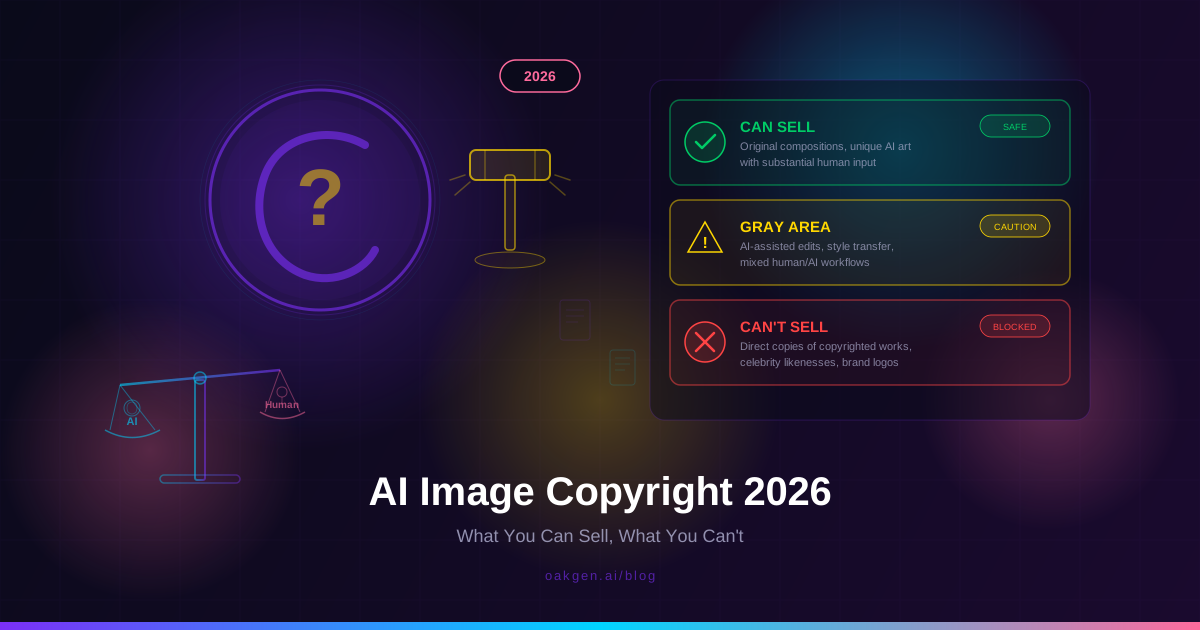
Yes, you can sell AI-generated art in most jurisdictions -- the question is not whether you can sell it, but whether you can prevent others from copying it. Without copyright protection, anyone could legally reproduce your purely AI-generated image. For commercial use, maximize your human creative involvement, document your process, and understand your platform's terms of service regarding commercial use rights.
Does the AI platform own my generated images?
This depends entirely on the platform's terms of service. Most major platforms (including Oakgen) grant users commercial rights to their generated content, but terms vary. Some platforms retain rights to use your generated content for training or promotional purposes. Always read the commercial use terms before using AI-generated content for business purposes.
If I modify an AI-generated image significantly, is it copyrightable?
Potentially, yes. Under current U.S. Copyright Office guidance, substantial human modification of AI-generated content can establish human authorship. The key word is "substantial" -- minor adjustments like cropping or color shifting are unlikely to be sufficient, while extensive editing, compositing, painting over, or integrating AI elements into a larger human-authored work likely would be. Document your modification process thoroughly.
Can someone copyright an image that looks like my AI-generated style?
Style itself is not copyrightable under U.S. law -- this is true for both human-created and AI-generated works. What is protectable is specific expression, not general style. If someone creates an image that is substantially similar to your specific work (not just your style), you may have a claim -- but only if your work has sufficient human authorship to qualify for copyright protection in the first place.
What should I do if someone copies my AI-generated work?
First, assess whether your work has copyright protection based on the degree of human creative input involved. If you have a strong authorship argument (substantial human creative involvement, documented process), consult a copyright attorney about your options. If the work was purely AI-generated with minimal human input, you may have limited legal recourse under current U.S. law. In all cases, platform-specific terms of service and contractual protections may provide additional avenues for action.
Create AI Art with Confidence
Oakgen.ai gives you access to 40+ AI image models with clear commercial-use terms. Document your creative process and build a stronger copyright position.