A car dealership's inventory turns over every 45-60 days on average. A mid-size dealership with 200 vehicles on the lot needs professional photography for every unit -- and those photos must be production-ready within 24-48 hours of the vehicle hitting the lot. The math is relentless: at 60-day average turn, a 200-unit dealership processes roughly 1,200 vehicles per year, each requiring 15-30 photos for online listings.
Traditional dealership photography costs $25-$75 per vehicle for a walk-around photo service, or $40,000-$80,000/year for a dedicated on-site photographer. That covers basic lot photography -- clean backgrounds, consistent angles, adequate lighting. Studio-quality photography with controlled backgrounds, professional lighting, and lifestyle contexts costs $200-$1,000 per vehicle, which is economically impossible at scale for any dealership that is not a luxury exotic brand.
The result is that 90% of vehicle listings online look identical: same lot background, same flat lighting, same uninspiring angles. In a market where the average car buyer visits 1.2 dealerships before purchasing (down from 5+ a decade ago), online listing quality is the primary battleground for customer acquisition. The dealership with better photos wins the click, the inquiry, and the sale.
AI car photography transforms basic lot photos into studio-quality imagery at a cost of $0.10-$2.00 per image. Background replacement, lighting enhancement, virtual studio placement, and lifestyle context generation turn a $30 lot photo session into imagery that rivals a $5,000 studio shoot. Here is how dealerships are implementing it.
The Business Case for Better Vehicle Photography
Before examining the technology, let's quantify the financial impact of vehicle listing quality:
Lead generation: Cox Automotive research shows that online vehicle listings with professional photography receive 3x more VDP (Vehicle Detail Page) views than those with amateur photography. More VDP views directly correlate with more leads.
Time to sale: Vehicles with high-quality listing photos sell 32% faster on average, according to data from vAuto and Dealersocket. For a dealership paying $50-$100/day in floorplan interest per vehicle, selling 10 days faster saves $500-$1,000 per unit.
Price realization: AutoTrader reports that listings with studio-quality photography command 5-8% higher transaction prices compared to listings with lot photos. On a $35,000 vehicle, that is $1,750-$2,800 in additional gross profit.
Customer trust: CDK Global found that 72% of car shoppers said photo quality influenced their perception of dealership trustworthiness.
Consider a 200-unit dealership selling 1,200 vehicles per year at an average transaction price of $35,000. If improved photography increases transaction prices by just 3% (conservative estimate), that represents $1,050 per vehicle, or $1,260,000 in additional annual gross revenue. Against an AI photography cost of $2,000-$5,000/year, the return exceeds 250:1. Even attributing a fraction of this lift to photography, the investment pays for itself hundreds of times over.
Cost Comparison: Dealership Photography Options
| Photography Approach | Per Vehicle Cost | Annual Cost (1,200 vehicles) | Quality Level |
|---|---|---|---|
| Lot attendant with smartphone | $0 (staff time only) | $0 + staff opportunity cost | Poor -- inconsistent, bad lighting |
| Freelance lot photographer | $25 - $50 | $30,000 - $60,000 | Adequate -- clean but basic |
| Professional on-site service | $50 - $75 | $60,000 - $90,000 | Good -- consistent, well-lit |
| Studio photography | $200 - $1,000 | Not feasible at volume | Excellent -- controlled, premium |
| Basic lot photo + AI enhancement | $5 - $15 | $6,000 - $18,000 | Excellent -- studio-quality output |
| AI-generated from reference | $1 - $5 | $1,200 - $6,000 | Very good -- virtual studio quality |
The sweet spot for most dealerships is the hybrid approach: capture basic lot photos (either with staff or a budget photography service) and use AI to transform them into studio-quality listings. This combines the accuracy of real vehicle photos with the visual quality of studio production.
How AI Car Photography Works for Dealerships
Approach 1: AI Background Replacement and Enhancement
The most practical AI application for dealerships is transforming existing lot photos. Take a basic photo of the vehicle on your lot, and use AI to:
- Replace the background with a professional studio setting, showroom floor, scenic driving road, or urban environment
- Enhance lighting to simulate studio-quality directional light with proper reflections on the paint surface
- Correct color to ensure paint colors are accurate and vibrant
- Remove distractions -- other vehicles, lot clutter, reflections, people in the background
This approach on Oakgen's image generator uses image-to-image capabilities. Upload the lot photo as reference, prompt for the desired background and lighting, and receive a studio-quality version in seconds.
Prompt structure for background replacement: "Professional automotive photography of [vehicle year, make, model, color], studio background with gradient lighting, dramatic side lighting highlighting the vehicle's body lines, polished showroom floor with subtle reflection, automotive advertisement quality, sharp detail, clean professional composition"
Approach 2: Virtual Studio Shots
Generate additional angles and contexts that were not captured in the original lot photography:
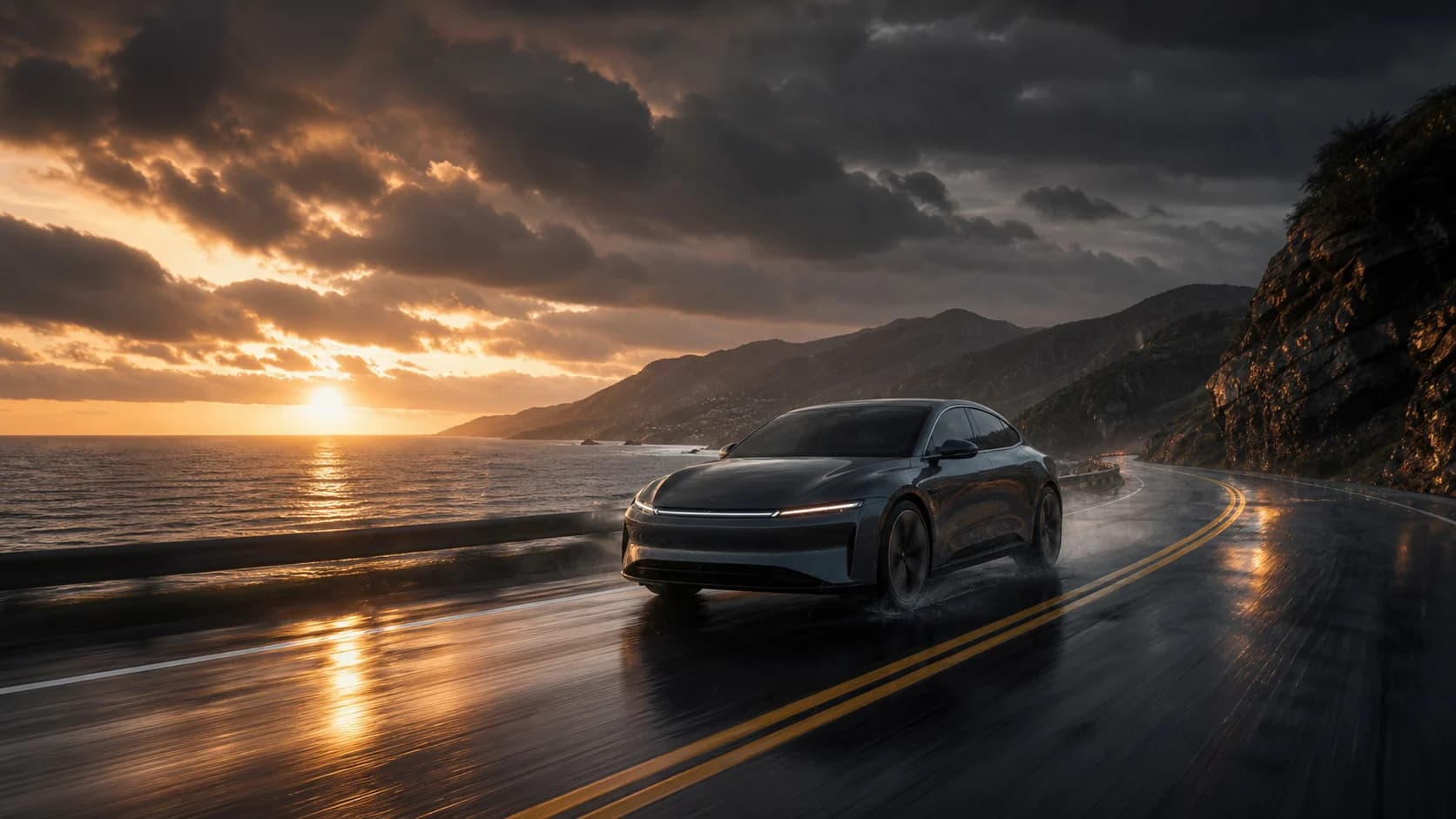
- Three-quarter front view with dramatic lighting (the hero shot)
- Profile/side view on a scenic road or in an architectural setting
- Rear three-quarter with emphasis on tail light design
- Interior detail shots with enhanced lighting and depth of field
- Lifestyle context -- the vehicle parked at a destination relevant to the target buyer (ski lodge for SUVs, downtown for sports cars, suburban home for family vehicles)
Approach 3: AI-Generated Marketing Imagery
Beyond listings, dealerships need marketing content for social media, email campaigns, website banners, and paid advertising. AI generates this content without scheduling a dedicated photo shoot for each campaign:
- Seasonal campaigns: Generate the same inventory in snow settings (winter sale), autumn landscapes (fall clearance), beach scenes (summer promotions)
- Holiday marketing: Fourth of July, Memorial Day, Black Friday, end-of-year sales events with themed backgrounds
- Social media content: Dynamic, scroll-stopping vehicle imagery for Instagram, Facebook, and TikTok
- Website hero images: Full-width banner images featuring current inventory
Cox Automotive data shows that vehicle listings with 20+ photos receive significantly more engagement than those with fewer images. Most dealerships publish 15-20 lot photos. Use AI to supplement with 5-10 additional images: studio background versions, lifestyle context shots, and detail-enhanced close-ups. Going from 15 basic lot photos to 25 images (15 original + 10 AI-enhanced) costs under $5 per vehicle and measurably increases VDP engagement.
Vehicle-Specific Photography Strategies
New Inventory
New vehicles arrive in pristine condition and benefit most from studio-quality presentation. AI background replacement is particularly effective because the vehicles are clean, undamaged, and photographically simple.
Recommended image set for new vehicle listings:
- Hero three-quarter front (AI studio background)
- Profile side view (AI scenic road background)
- Rear three-quarter (AI studio background)
- Front direct (AI studio background)
- Interior dashboard panoramic (AI lighting enhancement)
- Infotainment screen close-up (real photo, enhanced)
- Rear seat/cargo area (real photo, enhanced)
- Wheel/tire detail (AI enhanced)
- Engine bay (real photo if relevant to buyer)
- Lifestyle context shot (AI-generated, vehicle in buyer-relevant setting)
Pre-Owned/CPO Inventory
Used vehicles require more honest, detailed photography to build buyer trust. AI enhancement should improve visual quality without obscuring the vehicle's actual condition:
- Background replacement: Clean up distracting lot backgrounds while keeping the vehicle appearance accurate
- Lighting correction: Even out harsh shadows and reflections that obscure the vehicle's real condition
- Detail enhancement: Improve clarity on interior and exterior photos so buyers can assess condition accurately
Do not use AI to remove scratches, dents, or wear that exists on the vehicle. This creates customer trust issues and potential legal liability. AI should make the photo better, not make the vehicle look better than reality.
Luxury and Exotic Vehicles
High-value vehicles justify premium visual presentation. A $100,000+ vehicle listed with lot photos communicates the wrong message to affluent buyers. AI-generated studio and lifestyle imagery positions the vehicle appropriately:
- Dramatic studio lighting with accent highlights on body lines
- Architectural backgrounds -- modern luxury homes, private airports, high-end venues
- Detail-focused close-ups -- stitching, carbon fiber, badge work, wheel design
- Motion/driving shots -- AI-generated images of the vehicle in motion on scenic roads
For a luxury dealership with 30-50 high-value units, AI photography upgrades the entire inventory presentation for under $200/month -- less than the commission on a single sale.
Integration With Dealership Operations
Workflow Integration
The most successful dealership AI photography implementations integrate directly into existing inventory workflows:
- Vehicle arrives on lot and is entered into DMS (Dealer Management System)
- Lot photographer captures standard 15-20 angle walk-around (same day)
- Photos uploaded to inventory management platform (vAuto, Dealersocket, etc.)
- AI processing transforms 5-10 key shots into studio-quality versions
- Enhanced photos syndicated to third-party listing sites (AutoTrader, Cars.com, CarGurus)
- Marketing team uses AI to generate additional social media and campaign imagery as needed
Total additional time per vehicle: 15-30 minutes for AI processing and upload. Total additional cost: $2-$10 per vehicle.
Multi-Location Consistency
Dealership groups with multiple locations struggle with photography consistency across different lots, photographers, and weather conditions. AI normalization outputs a consistent studio-quality standard regardless of the original photo quality, giving every location the same brand presentation.
| Operational Factor | Without AI Enhancement | With AI Enhancement |
|---|---|---|
| Time from lot arrival to listing-ready photos | 24 - 48 hours | Same day (add 15-30 min processing) |
| Photo quality consistency across locations | Highly variable | Standardized studio quality |
| Seasonal marketing content production | $2,000 - $10,000 per campaign | $50 - $200 per campaign |
| Photos per vehicle listing | 15 - 20 (lot photos only) | 20 - 30 (lot + AI enhanced) |
| Average VDP engagement | Baseline | 2-3x improvement (industry data) |
| Annual photography spend (200-unit dealer) | $40,000 - $80,000 | $8,000 - $25,000 |
Social Media and Paid Advertising
Scroll-Stopping Vehicle Content
Dealership social media is notoriously bland. AI-generated imagery transforms it into a lead generation channel: new arrival announcements with studio-quality hero shots, seasonal promotions with themed backgrounds, lifestyle content in aspirational contexts, and comparison posts showing trim levels and color options.
Video Content for Listings and Social
Oakgen's video generator extends AI photography into motion content -- turntable rotating views, scenic driving footage, and feature reveal sequences. Video listings receive 85% more views than photo-only listings on Facebook Marketplace (Meta's published data). AutoTrader reports that listings with video receive 3-4x more inquiries. AI-generated vehicle videos cost $1-$5 per clip.
Honest Limitations
What AI Vehicle Photography Does Well
- Background replacement: Transforming lot photos into studio-quality presentations
- Lighting enhancement: Simulating professional studio lighting on basic photos
- Marketing imagery: Seasonal, lifestyle, and campaign visuals at scale
- Consistency: Standardizing visual quality across inventory and locations
- Supplemental angles: Generating additional views from limited original photography
Where Caution Is Needed
- Condition misrepresentation: Never use AI to remove damage or imperfections from pre-owned vehicles. This erodes trust and creates legal risk.
- Color accuracy: AI can shift paint colors during background replacement. Always verify the final image matches the vehicle's actual color.
- Feature accuracy: AI may add or remove features (roof racks, wheel designs, badging). Quality-check against the real vehicle before publishing.
- Interior photos: Use real interior photos with lighting correction rather than AI-generated interiors.
The golden rule: AI should make the photo better without making the vehicle look different from what the customer will see on the lot.
Getting Started: Your First AI-Enhanced Inventory
- Select 10 vehicles from your current inventory -- mix of new, pre-owned, and different vehicle types
- Capture or pull existing lot photos -- front three-quarter, side profile, and rear three-quarter for each
- Generate AI-enhanced versions on Oakgen's image generator using studio background and professional lighting prompts
- Compare side-by-side -- lot original vs. AI-enhanced version. Verify color accuracy and feature accuracy.
- A/B test on listings -- publish half your test vehicles with AI-enhanced photos and half with standard lot photos. Measure VDP views and inquiry rates over 30 days.
- Measure and scale -- quantify the lead generation and time-to-sale impact, then roll out across your full inventory
Most dealerships see measurable listing engagement improvement within the first 30 days. The test costs under $50 in AI generation credits -- less than a single vehicle's daily floorplan interest.
Frequently Asked Questions
Is it legal to use AI-enhanced photos on vehicle listings?
Yes. There is no law prohibiting AI-enhanced vehicle photography on listings. However, consumer protection laws in most states require that vehicle advertising not be materially misleading. AI background replacement, lighting enhancement, and supplemental angle generation are all permissible because they improve photo quality without misrepresenting the vehicle itself. The legal boundary is misrepresentation: do not use AI to remove damage, add features that are not present, or change the vehicle's actual appearance. Treat AI enhancement the same way you would treat Photoshop editing -- improve the photo, not the product.
Will customers notice or care that vehicle photos are AI-enhanced?
Customers care about information quality, not production methodology. A buyer evaluating a $35,000 purchase wants clear, well-lit, detailed photos that accurately show the vehicle. Whether those photos were taken in a $50,000 studio or AI-enhanced from lot photography is irrelevant to the buying decision. What customers notice is the difference between a professional-looking listing and an amateur one -- and that perception directly influences which dealerships they contact.
How do I handle AI photography for vehicles with custom modifications?
Custom-modified vehicles (aftermarket wheels, body kits, wraps, lift kits) should be photographed in their actual modified state. Use AI for background replacement and lighting enhancement only -- do not generate the modifications from text descriptions, as accuracy is critical. The real modification is a selling point that must be represented accurately. Capture the modifications in your lot photography, then use AI to present them in studio-quality settings.
Can AI generate 360-degree vehicle views?
AI can generate individual images from specified angles (front, front three-quarter, side, rear three-quarter, rear, overhead), which can be assembled into a semi-interactive viewer. True smooth 360-degree spin videos require specialized capture rigs or video generation AI. Oakgen's video generator can produce rotating vehicle clips, though they work best for marketing content rather than detailed inspection purposes. For full interactive 360 spins, traditional turntable photography or dedicated automotive 360 platforms remain the standard.
What about generating vehicle photos for models not yet on the lot?
Yes -- and this is valuable for pre-order marketing and incoming inventory promotion. Generate lifestyle and studio imagery for vehicles that are in transit or on order, allowing your marketing team to promote incoming inventory before it arrives. This is standard practice in automotive marketing (manufacturers provide press images for models not yet at dealerships), and AI generation extends this capability to specific trim levels, color combinations, and option packages.
Upgrade Your Vehicle Listings With AI Photography
Transform basic lot photos into studio-quality listings. Background replacement, lighting enhancement, and marketing imagery for every vehicle on your lot.