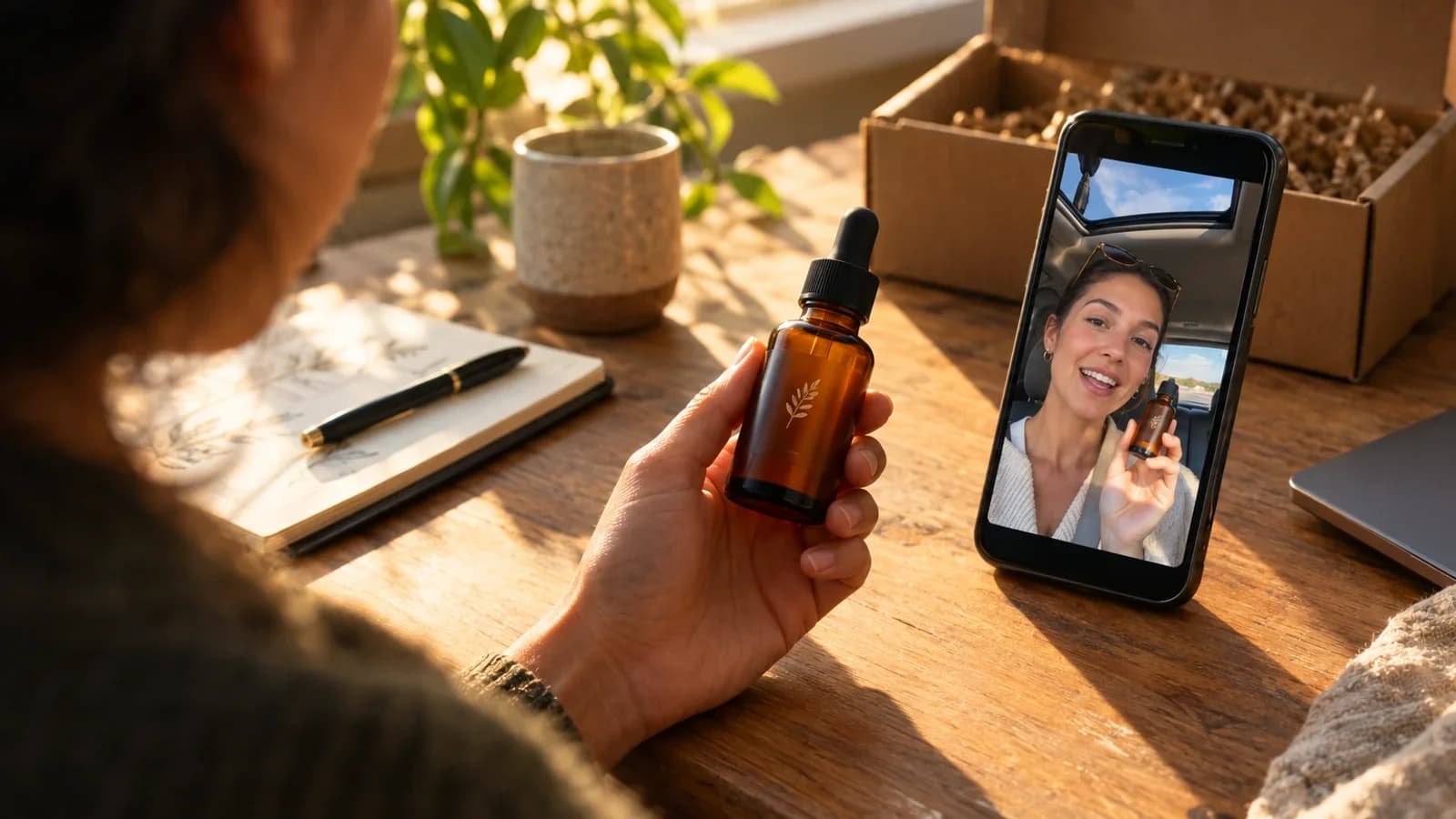
UGC-style ads are the highest-performing ad format on Meta, TikTok, and YouTube Shorts right now. Not polished brand commercials. Not stock footage slideshows. Ads that look like a real person picked up their phone, tried a product, and told their friends about it.
The data is hard to argue with. According to a 2025 Nielsen study, user-generated content ads outperform traditional branded content by 50% in click-through rate and 29% in conversion rate. TikTok's own research shows that UGC-style creative has a 65% higher view-through rate than studio-produced ads. Meta's Creative Shop reports that UGC ads deliver a 4x higher engagement rate and cost 33% less per acquisition than polished brand ads.
Brands know this. Agencies know this. Every performance marketer running paid social in 2025 knows that UGC-style creative is the path to lower CPAs and higher ROAS.
The problem is not understanding the format. The problem is producing it at a cost and pace that makes sense.
The Influencer UGC Cost Problem
The traditional path to UGC-style ads is hiring creators -- influencers, micro-influencers, or dedicated UGC creators -- to film short-form content featuring your product. On paper, it sounds simple. In practice, it is expensive, slow, and difficult to scale.
What UGC Creators Actually Charge
UGC creator rates have exploded. A 2025 survey from Later found that the average rate for a single 30-60 second UGC video from a mid-tier creator is $250-$500. Premium UGC creators with proven ad performance charge $500-$1,500 per video. Even nano-creators (under 10K followers) now charge $100-$300 per clip.
And that is for one video. One angle. One hook. One creator.
Effective paid social requires testing multiple creative angles simultaneously. Most performance marketers test 5-15 ad variations per campaign per week. At $250-$500 per variation, you are looking at $1,250-$7,500 per week just for creative -- before a single dollar of ad spend.
The Timeline Problem
Beyond cost, there is the timeline. Hiring a UGC creator involves outreach (1-3 days), negotiation and briefing (1-2 days), filming (1-5 days depending on their schedule), revisions (2-5 days), and final delivery (1-2 days). Best case: 7 days from brief to delivered asset. Typical case: 10-14 days.
When a hook works and you need five variations by tomorrow morning, the influencer pipeline cannot deliver.
Quality Inconsistency
Even when you find good creators at reasonable rates on time, quality varies wildly. One creator nails the brief; the next delivers something unusable. Lighting is off. Audio is bad. The delivery feels scripted and stiff. Revision rounds eat up time, and some creators cap revisions or charge extra for them.
| Factor | Influencer/UGC Creator | In-House Production | AI UGC Generation |
|---|---|---|---|
| Cost per video | $250 - $1,500 | $50 - $200 (staff time) | $0.10 - $1.00 |
| Turnaround time | 7 - 14 days | 1 - 3 days | 5 - 30 minutes |
| Variations per week | 3 - 5 (budget limited) | 5 - 10 (capacity limited) | 50 - 200+ |
| Consistency | Variable | Moderate | High |
| Revision cost | $50 - $200 per round | Staff time | Regenerate for pennies |
| Multilingual | Requires new creator per language | Requires bilingual staff | Instant (29+ languages) |
| Scale ceiling | Budget-constrained | Team-constrained | Nearly unlimited |
What Makes UGC Ads Work (The Psychology)
Before exploring the AI alternative, it is worth understanding exactly why UGC-style ads outperform polished creative. The answer lies in three psychological principles.
Perceived Authenticity
Consumers have developed ad blindness to anything that looks produced. A 2024 Stackla study found that 86% of consumers say authenticity is important when deciding what brands they support, and 79% say UGC highly impacts their purchasing decisions. When an ad looks like a friend's Instagram story rather than a brand commercial, it bypasses the mental filter that says "this is an ad, ignore it."
Social Proof
UGC-style ads trigger social proof -- the psychological tendency to follow the actions of others. When viewers see someone who looks like them using and recommending a product, it feels like a peer endorsement rather than a brand claim. This is why UGC ads convert better even when viewers know it is an ad.
The Selfie-Camera Aesthetic
The specific visual language of UGC -- slightly shaky handheld footage, front-facing camera angle, casual lighting, natural audio -- signals "real person, real experience." This aesthetic can be replicated without a real creator. The viewer's brain responds to the format, not to whether the person on screen was actually paid $500.
Research from the University of Pennsylvania's Wharton School found that ad format and visual style influence perceived authenticity more than actual source. A professionally scripted ad filmed in UGC style was rated as more authentic than genuine user content filmed in a polished style. The implication: you can achieve UGC ad performance without actual user-generated content.
The AI UGC Alternative
AI-powered creative tools now make it possible to produce UGC-style ad content that matches the aesthetic, tone, and performance of influencer-created content -- at a fraction of the cost and turnaround time.
Here is how each component works.
AI Avatars for "Creator" Segments
The most effective UGC ads feature a person speaking directly to camera. Oakgen's talking avatar tool generates photorealistic AI presenters who deliver your script with natural lip-sync, gestures, and expressions. The result looks like someone recording a selfie-style video testimonial.
You write the script. You choose an avatar that fits your target demographic. The AI generates a video of that avatar delivering your message in a natural, conversational tone. No creator outreach, no scheduling, no revision rounds.
For brands that want variety -- which is essential for testing -- you can generate the same script with different avatars, different voices, different delivery styles. Ten variations in an hour instead of coordinating with ten separate creators over two weeks.
AI Voice Generation for Authentic Delivery
The voice is critical. Overly polished, "radio announcer" voices kill the UGC feel instantly. Oakgen's voice generator offers 30+ natural-sounding voices with varied tones, ages, and styles. Select a voice that sounds conversational and relatable -- not broadcast-quality.
For brands that want to maintain a consistent "creator" voice across a campaign, Oakgen's voice cloning feature can establish a brand-specific voice persona. Clone a voice from a short sample and use it across all your UGC-style ads for continuity.
AI Image and Video Generation for Product Shots
UGC ads typically intercut between the "creator" speaking to camera and product shots, lifestyle imagery, or demonstrations. Instead of sourcing these from photoshoots, generate them with Oakgen's image generator or video generator.
Need a close-up of your skincare product on a bathroom counter with morning sunlight? Generate it. Need a lifestyle shot of someone wearing your apparel while walking downtown? Generate it. Need five variations with different settings, lighting, and compositions for A/B testing? Generate all five in two minutes.
Structure your AI UGC ads using the proven Hook-Body-CTA framework. Generate 5-10 different hooks (the first 3 seconds) as separate clips using different avatars and opening lines. Pair each hook with the same body content and CTA. This lets you test what grabs attention without reproducing the entire ad each time. On Oakgen, generating 10 hook variations costs roughly 50-80 credits -- less than $0.50 on the Pro plan.
Step-by-Step: Producing a UGC Ad With AI
Here is the complete workflow for creating a UGC-style ad that performs on paid social.
Step 1: Write the Script (15-30 Minutes)
The script is the most important part. No amount of production quality -- AI or otherwise -- saves a bad script. Follow these principles for UGC ad scripts:
Open with a hook. The first 3 seconds determine whether someone watches or scrolls. Effective UGC hooks: "I was so skeptical about this but...", "OK I need to talk about this because...", "Stop scrolling if you [pain point]...", "I've been using this for 2 weeks and..."
Use conversational language. Write how people talk, not how brands talk. Contractions, incomplete sentences, casual phrasing. Read the script out loud; if it sounds like a marketing email, rewrite it.
One benefit, one proof point. UGC ads are not product pages. Focus on a single benefit and back it with one specific claim, result, or experience.
End with a soft CTA. "Link in bio," "I'll put the link below," or "Go check them out" -- not "Shop now and save 20% with code CREATOR."
Step 2: Select Your Avatar and Voice (5 Minutes)
Choose an avatar from Oakgen's talking avatar library that matches your target customer demographic. If you sell to millennial women, choose an avatar that looks like a millennial woman. If you sell to Gen Z men, choose accordingly.
Select a voice that matches the avatar's appearance and your brand tone. Casual, warm, and slightly enthusiastic works for most DTC brands. Avoid overly energetic voices -- they read as fake.
Step 3: Generate the Presenter Segments (10-15 Minutes)
Input your script into the talking avatar tool. Generate the video. Review it for pacing and delivery. If anything feels off, adjust the script (a shorter sentence here, a pause there) and regenerate. Unlike a real creator who charges for revisions, regeneration costs only the credits for another generation.
Step 4: Generate Supporting Visuals (10-20 Minutes)
Create the product shots, lifestyle imagery, and any B-roll you need using the image generator and video generator. For UGC-style ads, generate visuals that look natural and candid -- not polished studio shots.
Prompt tips for UGC-style visuals:
- Include "handheld," "casual," "natural lighting" in your prompts
- Specify "phone camera quality" or "iPhone photo" for authentic feel
- Avoid "professional," "studio," or "commercial" descriptors
Step 5: Assemble and Export (15-30 Minutes)
Combine the avatar segments and generated visuals in any video editor (CapCut, DaVinci Resolve, or even Canva's video editor). Add captions -- 80% of social video is watched without sound, and captions increase view time by 40%. Export in 9:16 for TikTok/Reels/Shorts, 1:1 for feed placements.
Total time: 55-100 minutes for a complete UGC-style ad. Total cost: 50-150 Oakgen credits depending on avatar length and visual complexity -- roughly $0.25-$0.75 on the Pro plan.
Scaling to Dozens of Variations
The real power of AI UGC production is not making one ad. It is making fifty. Performance marketing runs on creative volume. The more variations you test, the faster you find winners, and the longer you can sustain performance before creative fatigue sets in.
The Testing Matrix Approach
Structure your creative testing as a matrix:
- 5 hooks (different opening lines and angles)
- 3 avatars (different demographics/personas)
- 2 body scripts (different benefit angles)
- 2 CTAs (different closing approaches)
That is 5 x 3 x 2 x 2 = 60 unique ad variations. With traditional UGC creators, producing 60 variations would cost $15,000-$90,000 and take weeks. With AI, you can produce them in a single day for under $50 in credits.
Iteration Speed
When your ad platform data shows that Hook #3 outperforms the others, immediately generate 10 new variations of that hook with different wording, pacing, and avatars. You go from insight to new creative in an hour, not a week. This iteration speed compounds over time -- every testing cycle gets you closer to your optimal creative.
| Creative Testing Scale | Traditional UGC Cost | AI UGC Cost | Time to Produce |
|---|---|---|---|
| 5 ad variations | $1,250 - $7,500 | $1.25 - $3.75 | 2-3 hours |
| 20 ad variations | $5,000 - $30,000 | $5 - $15 | 1 day |
| 60 ad variations (full matrix) | $15,000 - $90,000 | $15 - $45 | 1-2 days |
| Weekly refresh (10 new ads) | $2,500 - $15,000/week | $2.50 - $7.50/week | 3-4 hours |
| Monthly creative budget | $10,000 - $60,000 | $10 - $30 | 2-3 days total |
Best Practices for AI UGC That Converts
Match the Platform
Each platform has its own UGC aesthetic. TikTok UGC is fast-paced, jump-cut heavy, and uses trending audio. Instagram Reels UGC is slightly more polished but still casual. YouTube Shorts UGC tends to be more informational. Adjust your scripts and editing style accordingly.
Rotate Frequently
Creative fatigue is real. Even the best-performing UGC ad declines after 7-14 days of heavy spend. AI production economics mean you can rotate creative weekly instead of monthly. Budget for 10-20 new variations per week and retire underperformers aggressively.
Test Hooks Obsessively
The hook is 80% of the ad's performance. Generate 10 hook variations for every body script and let your ad platform's algorithm find the winner. With AI, the marginal cost of an additional hook variation is under $0.10.
Use Captions and Text Overlays
Add bold text overlays highlighting key claims and benefits. This increases accessibility, improves muted autoplay performance, and adds visual interest. Use your video editor's text tools or Oakgen's image generator to create branded text overlay templates.
Even AI-generated UGC-style ads are still ads. Follow each platform's advertising disclosure requirements. On Meta, use the Paid Partnership label when running as sponsored content. On TikTok, comply with their Branded Content policies. AI-generated ad content does not exempt you from standard advertising disclosure obligations in your jurisdiction.
FAQ
Do AI UGC ads actually perform as well as real influencer UGC?
In split tests, AI UGC-style ads regularly match and sometimes outperform traditional influencer UGC on click-through rate and conversion rate. The performance gap has closed significantly as AI avatar and voice quality have improved. The key factor is script quality -- a well-written AI ad outperforms a poorly briefed influencer ad every time. The visual format triggers the same psychological responses regardless of whether the presenter is human or AI.
Will platforms penalize AI-generated ad content?
No. Meta, TikTok, and Google do not penalize AI-generated ad creative in their auction algorithms. Ad performance is determined by engagement signals (click-through rate, conversion rate, watch time), not by how the creative was produced. As long as your ads comply with each platform's advertising policies and disclosure requirements, AI-generated content is treated identically to any other creative.
Can I use AI UGC for organic social content too?
Absolutely. While this guide focuses on paid ads, AI UGC works equally well for organic social content. Generate "customer story" style content, product demonstration videos, and educational content for your brand's organic channels. The same cost and speed advantages apply.
How do I make AI UGC look less "AI" and more authentic?
Three things make the biggest difference: (1) Write scripts that sound like natural speech, not marketing copy -- read them aloud and rewrite anything that sounds stiff. (2) Choose avatars and voices that match your target customer, not a "professional spokesperson" look. (3) In editing, add slight imperfections: jump cuts, casual transitions, and text overlays that match the platform's native style. The goal is not to hide that it is AI; the goal is to match the format and feel that drives engagement.
What is the minimum budget to start testing AI UGC ads?
Oakgen plans start at $9/month. For serious testing, the Pro plan at $19/month provides 5,000 credits for UGC ad variations across the creative workflow. Compare the displayed cost for your chosen models before estimating campaign volume.
Create UGC Ads Without the Creator Fees
AI avatars, natural voices, and product visuals. Produce dozens of UGC-style ads in hours, not weeks.