Sora 2 had every advantage: the brand, the compute, the hype. It still lost.
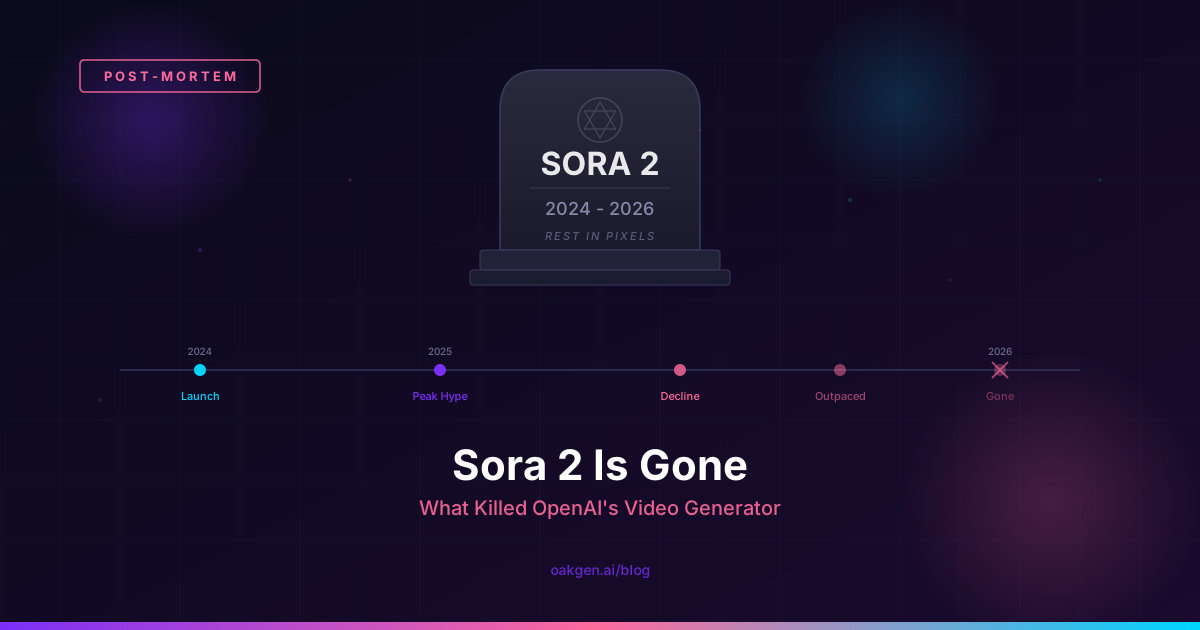
On April 26, 2026, the sora.com app went dark. OpenAI's standalone video generator -- the product that defined an entire category when its first demos went viral in February 2024 -- is gone. The API deprecates on September 24, 2026. What remains is a residual video generation feature buried inside ChatGPT and a successor model called Spud that Sam Altman describes as "more commercially oriented."
This is not an obituary. Sora 2 was not a beloved product that died too soon. It was a technically impressive research demo that never figured out how to be a business. The gap between "this looks amazing in a curated demo reel" and "this is something people will pay for every month" turned out to be vast, and OpenAI never closed it.
Here is the full story: what went wrong, when it went wrong, and what the shutdown means for anyone making AI video today.
- March 24, 2026: OpenAI announced Sora shutdown.
- April 26, 2026: Sora app (sora.com) closed permanently. All projects inaccessible.
- September 24, 2026: Sora API fully deprecated. Integrations will stop working.
- Now: ChatGPT Plus retains limited video generation. Sora Pro subscribers received ChatGPT Plus credits as compensation.
The Numbers That Killed Sora
The Wall Street Journal's reporting on Sora's economics told the story more clearly than any product review could.
$15 million per day at peak compute costs. $2.1 million in total revenue over its entire commercial lifetime. That is not a rounding error or a growing pain. That is a product burning through its lifetime revenue every three hours and twenty minutes of peak operation.
For context, Sora Pro cost $200/month per user. To break even on $15 million/day in compute, OpenAI would have needed 2.25 million paying subscribers. At its peak, Sora had roughly 500,000 total users -- most of them on the free tier.
The unit economics were underwater from day one and never improved. Every generation cost OpenAI more than the user paid. Every new subscriber deepened the loss. The product was functionally a subsidy, funded by OpenAI's broader ChatGPT revenue and investor capital.
This is the fundamental answer to "what killed Sora 2." Not the competition. Not the deepfakes. Not the Disney deal collapsing. Those accelerated the timeline, but the core problem was simpler: it cost too much to run and not enough people wanted to pay for it.
A Timeline of Decline
Understanding how Sora went from "the future of video" to shutdown in under two years requires tracking the key moments.
February 2024: The demo that changed everything. OpenAI released Sora's first demo videos -- a woman walking through Tokyo, a woolly mammoth in snow, a cat on a bed. The quality shocked the industry. Nothing else could produce video that coherent. Sora defined what AI video should look like.
December 2024: Public launch. After months of limited access, Sora launched publicly as a standalone product. The free tier was limited, and Sora Pro cost $200/month -- a price point that immediately narrowed the addressable market.
February 2025: Kling 2.0 arrives. Kuaishou's Kling 2.0 matched Sora's output quality at a fraction of the price, with a generous free tier. For the first time, Sora's quality was not unique.
Mid-2025: The competitor wave. Seedance, Veo 2, Runway Gen-4, Hailuo, and Wan 2.2 (14B) all shipped major updates. The gap between Sora and the field closed, then vanished, then inverted. Sora was no longer the best -- it was one of many, and an expensive one.
Late 2025: The deepfake crisis. Sora was flooded with unauthorized deepfakes of celebrities -- Robin Williams, Martin Luther King Jr., Sam Altman himself. Content moderation could not keep up. The reputational damage was significant, and the moderation costs added to an already unsustainable burn rate.
January 2026: The Disney deal collapses. Disney's $1 billion investment partnership with OpenAI, which included licensing characters for Sora-powered content, fell apart. Reports indicated Disney learned of internal concerns about Sora's viability less than an hour before the news became public. Losing a potential anchor customer of that magnitude removed one of the last plausible paths to Sora's commercial sustainability.
March 24, 2026: Shutdown announced. OpenAI confirmed Sora would close. The announcement cited "shifting focus to more integrated video capabilities" -- corporate language for "this product does not work as a standalone business."
Five Specific Reasons Sora Lost
The timeline tells what happened. Here is why.
1. Pricing That Could Not Compete
Sora Pro at $200/month was expensive when it launched. By mid-2025, it was indefensible. Kling offered comparable quality with a free tier of 66 credits per day. Seedance undercut Sora on price while offering features Sora lacked. Wan delivered usable output at $0.05 per second via API.
OpenAI's cost structure made competitive pricing impossible. The model's compute requirements were disproportionate to its output quality -- not because the quality was low, but because rival models achieved similar quality at dramatically lower inference costs. Sora was architected for demo-reel impressiveness, not for cost-efficient production use.
2. Speed That Frustrated Creators
Sora's generation times were consistently among the slowest in the market. A typical 10-second clip at 1080p took 3-5 minutes. Kling 3.0 generates comparable output in 60-90 seconds. Hailuo is faster still. For professional workflows where iteration speed directly affects productivity, Sora's latency was a constant friction point.
Speed matters more than most technical discussions acknowledge. A creator iterating on a prompt will run 10-20 generations before landing on a usable output. At 4 minutes per generation versus 90 seconds, that is the difference between a 40-minute session and a 15-minute session. Professionals chose the faster tool.
3. Quality Gaps on the Metrics That Matter
Sora's visual quality was competitive on cinematic wide shots and atmospheric scenes -- the categories that look best in demo reels. On the metrics that matter for production use, it fell behind.
- Character consistency across shots: Kling 3.0's multi-shot storyboarding maintained character identity across 6+ cuts. Sora could not reliably maintain consistency across 2.
- Text rendering in video: Sora rendered text poorly. Kling led this category.
- Motion accuracy on complex prompts: Seedance 2.0's multi-modal reference system and Wan 2.7's thinking mode both outperformed Sora on prompts with three or more sequential actions.
- Audio: Veo 3.1 shipped native synchronized audio -- dialogue, sound effects, ambient sound in a single generation. Sora was silent-only until the end.
The Artificial Analysis Video Arena, a crowdsourced Elo-based quality benchmark, told the story quantitatively. By April 2026, multiple models scored above Sora's peak Elo. The quality advantage that justified Sora's premium pricing had evaporated.
4. No Ecosystem, No Lock-In
Sora existed as an island. It had no meaningful integration with other tools, no plugin ecosystem, no API-first developer community. Runway had years of creative-tool integrations and an editing suite. Google's Veo 3.1 plugged into Gemini, YouTube, and Google Vids. Seedance and Kling offered solid API access at competitive rates, enabling developers to build pipelines.
Sora's storyboard feature was proprietary and could not export in editable formats. Creators who built workflows around Sora's unique features found themselves locked in to a platform with no portability. When the shutdown was announced, those workflows broke with no migration path.
5. The Moderation Burden
OpenAI's brand and public profile made Sora a magnet for misuse. Every deepfake scandal generated headlines that directly mentioned OpenAI. The company invested heavily in content moderation -- automated classifiers, human review teams, watermarking -- but could not stem the volume.
The moderation costs compounded the compute costs. Sora was simultaneously the most expensive model to run and the most expensive model to police. For a product already hemorrhaging money, the moderation burden made the economics even more impossible.
Where Sora Stood at Shutdown: A Comparison
At the time of its closure, here is how Sora 2 compared to the models that outlasted it.
| Spec | Sora 2 (at shutdown) | Kling 3.0 Pro | Seedance 2.0 | Veo 3.1 |
|---|---|---|---|---|
| Max Resolution | 1080p | 4K (3840x2160) | 1080p | 4K (3840x2160) |
| Max FPS | 30fps | 60fps | 30fps | 60fps |
| Max Duration | 20 seconds | 15 seconds | 10 seconds | 8 seconds (extendable) |
| Native Audio | No | No | Yes | Yes (dialogue + SFX) |
| Multi-Shot Consistency | Weak (2 shots) | Strong (6 cuts) | Strong (@ references) | Moderate |
| Text Rendering | Poor | Industry-leading | Good | Good |
| Generation Speed (10s clip) | 3-5 minutes | 60-90 seconds | 45-90 seconds | 60-120 seconds |
| Pricing | $200/month (Pro) | From $6.99/month | Credit-based | API from $0.05/sec |
| Video Arena Elo (April 2026) | Below top 10 | #3 (1242) | #1 (1273) | #6 (1221) |
| Status | Shut down | Active | Active | Active |
The table makes the competitive position clear. At $200/month, Sora 2 offered lower resolution, slower generation, no audio, weaker consistency, and lower benchmark scores than models costing a tenth of the price or less. The market did not kill Sora. The market simply made Sora's value proposition untenable.
Two of these competitors, Kling 3.0 Pro and Seedance 2.0, are available on Oakgen's AI video generator under a single credit balance. Veo 3.1 is not offered on Oakgen.
What Happens to OpenAI's Video Ambitions
Sora is dead, but OpenAI has not abandoned video generation.
Spud is real. Sam Altman confirmed that OpenAI completed pre-training on a model internally called Spud, described as "less of a research model and more of a directly commercially oriented tool." The phrasing is telling -- it acknowledges that Sora's failure was commercial, not technical, and signals that the replacement prioritizes economics over spectacle.
ChatGPT retains video. Video generation remains available within ChatGPT Plus and Team plans. This is likely the distribution vector for Spud -- video as a feature inside a product people already pay for, not a standalone $200/month subscription competing for its own user base.
The standalone model is dead; the capability is not. OpenAI learned an expensive lesson: a video generation model needs either a self-sustaining business model or an existing distribution channel. Sora had neither. Spud, presumably, will have ChatGPT's 200+ million users as its distribution channel from day one.
The Sora API deprecates on September 24, 2026. If you have integrations built on it, you need to migrate before that date. Most Sora API use cases can be replicated with Kling, Seedance, Veo, or Wan APIs directly from their providers. Kling and Seedance models are also available on Oakgen.
What This Means for AI Video in 2026
Sora's shutdown is not a setback for AI video generation. It is a market correction. The category is healthier now than at any point in its history, precisely because the unsustainable player exited.
The market is now genuinely competitive. No single company dominates AI video. Kling leads on photorealism and resolution. Seedance leads on controllability. Veo leads on audio integration. Wan leads on cost efficiency and open-source flexibility. This competition drives faster improvement and lower prices for everyone.
Pricing has rationalized. Sora's $200/month price point was an artifact of its cost structure, not a reflection of market value. With Sora gone, the market consensus has settled around $7-30/month for consumer plans and $0.05-0.40/second for API access. Creators get more for less.
Multi-model workflows are the new default. The era of picking one AI video tool and committing to it is over. Professional workflows in 2026 use different models for different tasks -- Kling for hero shots, Wan for rapid iteration, Seedance for controlled references, Veo for audio-integrated content. Platforms like Oakgen that put several major models, including Kling and Seedance, under one account are built for exactly this approach.
Open source is a real contender. Wan 2.7 ships under Apache 2.0. Open-Sora 2.0 is community-maintained. Self-hosted AI video is viable for technical teams. This was not the case when Sora launched -- the category was defined by closed, proprietary models. Now there is a genuine open-source alternative at competitive quality levels.
Earn 25% recurring on every referral.
Share Oakgen, get paid every month they stay.
The Lesson
Sora's failure is a case study in how a first-mover advantage can evaporate. OpenAI demonstrated that AI video generation was possible. Then faster, cheaper, more focused competitors built better products. Sora's brand recognition -- the thing that made every article about AI video mention it first -- was not enough to overcome a $200/month price tag, 4-minute generation times, and a quality gap that widened with every competitor update.
The creators and studios who built on Sora learned a harder lesson: building workflows around a single provider with no portability is a risk. The 6-month API deprecation window is generous by industry standards, but for teams with deep integrations, migration is still a significant lift.
For anyone starting fresh with AI video today, the advice is straightforward: use the best tool for each job, keep your workflows portable, and do not bet your pipeline on any single provider. The Sora alternatives are not just alternatives anymore. They are the new standard.
Kling and Seedance on One Platform
FAQ
Why did OpenAI shut down Sora 2?
The primary reason was unsustainable economics. Sora cost up to $15 million per day in peak compute while generating only $2.1 million in total lifetime revenue. The model was too expensive to run relative to what users would pay, and the competitive landscape made it impossible to justify the pricing premium. The deepfake moderation burden and the collapse of the Disney partnership accelerated the decision.
Can I still use Sora 2 after the shutdown?
The standalone Sora app at sora.com closed on April 26, 2026. Video generation is still available within ChatGPT Plus and Team plans, but without the dedicated interface, storyboarding features, or Sora-specific controls. The Sora API remains active until September 24, 2026, after which all API integrations will stop working.
What are the best replacements for Sora 2?
The top replacements depend on your priorities. Kling 3.0 Pro leads on photorealism and 4K output. Seedance 2.0 leads on controllability with its multi-modal reference system. Veo 3 leads on native audio generation. Wan 2.7 is the best budget option. Kling and Seedance are available on Oakgen's AI video generator; Veo and Wan 2.7 are not. For a detailed comparison, see our Sora shutdown replacement guide.
Is OpenAI making a new video model to replace Sora?
Yes. Sam Altman confirmed that OpenAI completed pre-training on a model called Spud, described as "more commercially oriented" than Sora. It is expected to be integrated into ChatGPT rather than launched as a standalone product. No public release date has been announced.
What should I do if my workflow depends on the Sora API?
Migrate before September 24, 2026. Most Sora API use cases can be replicated using Kling, Seedance, Veo, or Wan APIs. Oakgen puts Kling and Seedance video models under a single credit balance, which can simplify migration. See our pricing page for plan details and our free Sora 2 alternatives guide for options that include free tiers.
What to Read Next
- Sora is Shutting Down: 9 Best Alternatives in 2026 -- The comprehensive guide to every viable Sora replacement, ranked by quality, price, and use case.
- Sora 2 Shutdown: Best Replacements for Every Workflow -- Workflow-specific migration guide for creators, studios, and developers moving off Sora.
- 8 Free Sora 2 Alternatives (Skip the Waitlist) in 2026 -- Free-tier options for creators who do not want to pay for AI video after Sora's closure.