The Grok 4.5 vs Claude Opus 4.7 question is really a tradeoff between cost-efficient engineering work and careful judgment. Grok 4.5 launched with coding, agents, and token efficiency as the headline. Claude Opus 4.7 remains the model many power users trust for writing, nuanced review, and careful reasoning.
If you are choosing for a team, do not ask "which model is smarter?" Ask "which model wins this workflow at this price?"
Open Grok 4.5 in Oakgen, test your real coding or writing prompt, then switch to Claude from the same workspace. The model that wins your actual task is the one that matters.
Quick comparison
| Category | Grok 4.5 | Claude Opus 4.7 | Practical winner |
|---|---|---|---|
| Coding agents | Launch focus; built around agentic engineering | Very strong for review and architecture | Test both |
| Token pricing | $2 input / $6 output per 1M tokens | Higher Opus-class pricing | Grok 4.5 |
| Writing quality | Clear and useful | Usually stronger voice and nuance | Claude Opus |
| Long technical docs | 500K context | Strong long-document judgment | Depends |
| Marketing strategy | Good for analysis and competitive angles | Good for positioning and prose | Use both |
| Best workflow | First-pass engineering and cost-sensitive agents | Final review, prose, careful synthesis | Multi-model |
Where Grok 4.5 is the better first test
Start with Grok 4.5 when the work is technical, repetitive, or token-heavy.
Good fits:
- coding-agent loops
- bug triage
- codebase exploration
- technical documentation
- software design notes
- spreadsheet and Office-style knowledge work
- competitive research where cost matters
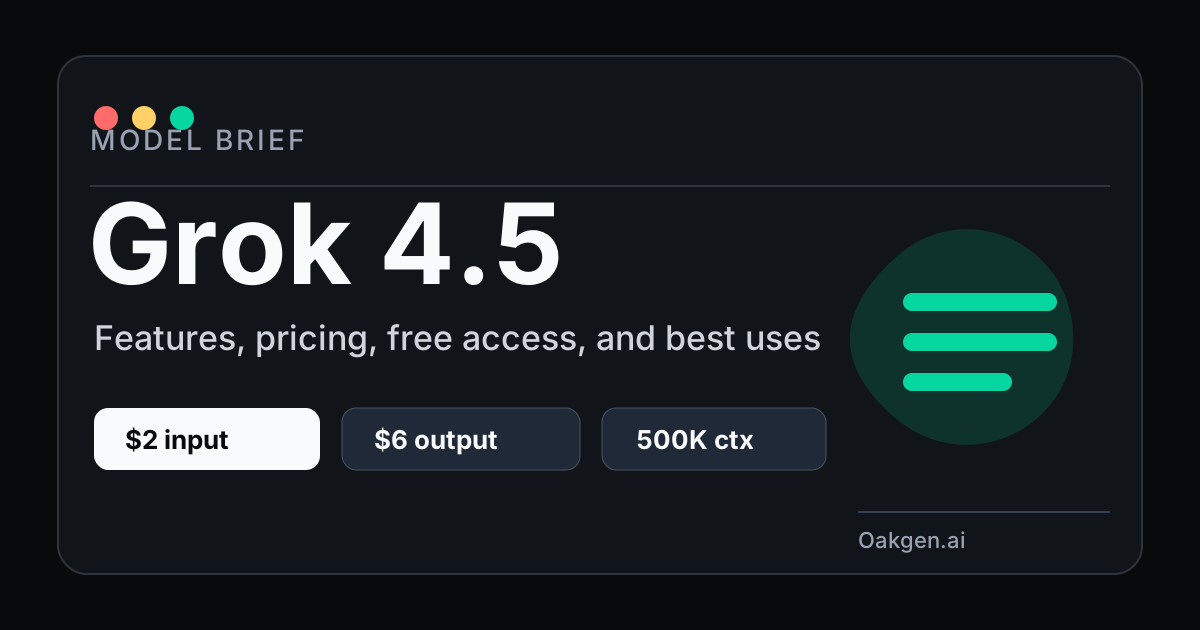
xAI's official docs list grok-4.5 at $2 input and $6 output per million tokens. That price changes the calculus. If a task needs many attempts, long outputs, or agent loops, cost can matter as much as raw quality.
Where Claude Opus 4.7 still earns its place
Use Claude Opus when the work needs judgment more than throughput.
Good fits:
- editing an important essay or announcement
- reviewing product positioning
- architecture tradeoff analysis
- legal-ish or policy-ish language where nuance matters
- turning raw notes into a coherent point of view
- final critique after another model drafts
Claude's advantage is not only "smartness." It is taste, caution, and prose control. If the output will be read by customers, investors, or a senior engineering team, a Claude pass is still worth testing.
The workflow I would use
For engineering:
- Start in Grok 4.5 for initial repo analysis or bug-fix planning.
- Ask it for the smallest patch and the test it would add.
- Switch to Claude for review: "Find flaws in this patch and tell me what could break."
- Use the cheaper model again for mechanical follow-up edits.
For marketing:
- Use Grok 4.5 to research competitors and extract sharp claims.
- Use Claude to turn the claims into readable copy.
- Use Oakgen's creative tools to turn the final message into ad variations, visuals, and scripts.
That is the point of multi-model work: each model gets the job it is best at.
Bottom line
Grok 4.5 is the model to test when cost, coding, and agentic throughput matter. Claude Opus 4.7 is the model to test when writing quality, careful judgment, and final review matter. The strongest users will use both, not argue about which brand deserves loyalty.
Sources
Frequently asked questions
Is Grok 4.5 better than Claude Opus 4.7? For some coding and cost-sensitive workflows, it may be. For writing and careful review, Claude is still a strong first test.
Can I use both in Oakgen? Yes. Start with Grok 4.5, then switch models from the picker.
Which model should agencies use? Agencies should use Grok 4.5 for research and campaign analysis, Claude for copy polish, and Oakgen's creative tools for production.