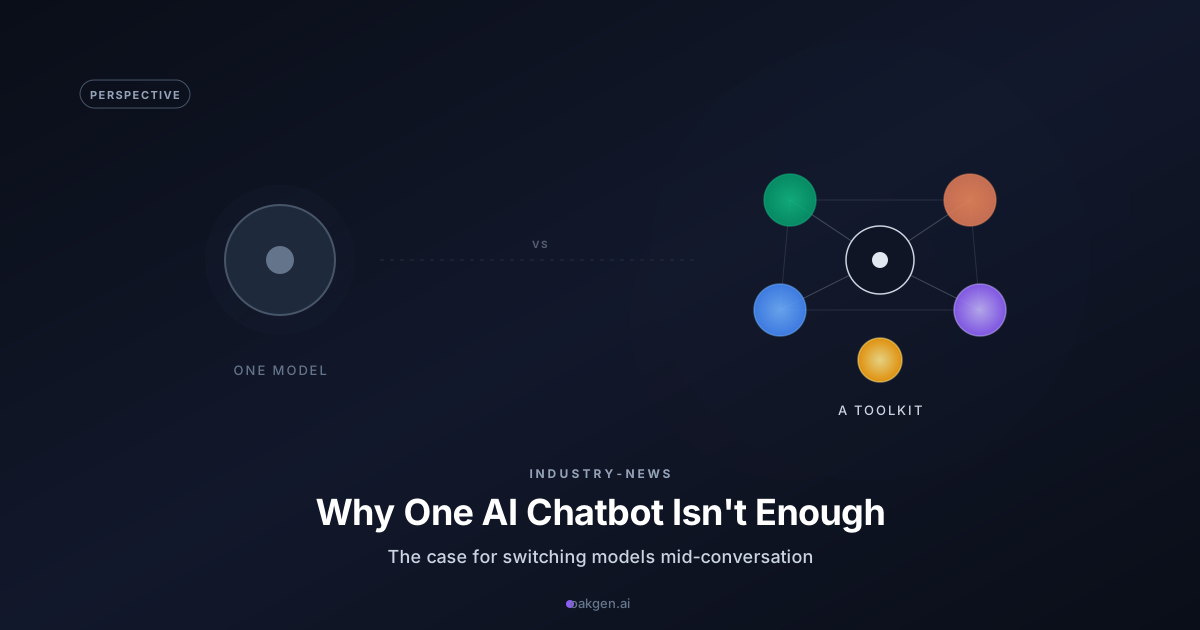
Most people pick an AI chatbot the same way they pick a coffee order. They try a few, they land on one, they stop thinking about it. "I'm a ChatGPT person." "I use Claude." "I swear by Gemini."
This made sense in 2023 when the models were still finding their voices and sticking with one felt like loyalty to a craft. It does not make sense in 2026.
The four leading chatbots have specialized. They are no longer competing to be the best at everything — they are competing to be the best at something. And if you are still using only one of them, you are doing the equivalent of writing every document in Notepad because you got used to it in 1998.
This piece is not a subtle ad for multi-model chat platforms. It is an argument that anyone serious about using AI for real work is already switching between models constantly, and that the single-model habit is the last thing holding back the average user from the productivity the power users have already unlocked.
The Specialization Has Already Happened
For most of 2023 and 2024, the top chatbots were close substitutes. Today they are not. Here is how they have pulled apart:
- ChatGPT (GPT-5.4) is the generalist and the mobile-first experience. Best voice, best image editing, best default behavior for people who do not want to think about which model they are talking to.
- Claude (Opus 4.7) is the writer's, coder's, and careful-reasoner's model. Best at long-form prose, architectural coding decisions, and pushing back on your ideas.
- Gemini (3.1 Pro) is the real-time researcher. Wired to Google Search, integrated into Workspace, best for questions whose answer changes every hour.
- Grok (4.5) is the coding, agentic-work, and knowledge-work model. Best for engineering tasks, Office-style workflows, X-aware research, and cost-sensitive frontier-model testing.
Under the big four, a second tier has gotten shockingly good at niches:
- Perplexity Sonar for anything that needs sources you can click
- DeepSeek V3.2 for cheap, high-quality reasoning and code
- Mistral Medium for European data residency and privacy-sensitive tasks
- Qwen3 Max for multilingual work, especially across Asian languages
- Kimi K2 for ultra-long documents at a lower price than Claude
No single chatbot is best at every one of these. And that means using only one of them is a choice — usually a choice you made in 2023 and never revisited.
The Hidden Cost of Single-Model Loyalty
Here is what sticking with one chatbot actually costs you.
You Get Worse Writing
Writers who switch between Claude and ChatGPT report noticeably better output than writers who use either alone. Claude produces the first draft with better voice. GPT tightens it up. Gemini checks it for dated facts. Each pass adds something. Using one model for all three passes loses most of that value.
You Get Slower Research
If you are using ChatGPT to research a breaking news story, you are fighting a tool that was trained on a frozen dataset and is reluctantly browsing the web. Gemini 3.1 Pro is pulling from live Google Search as you type. This is a minute-to-second speedup on current-events research, repeated every time you ask.
You Overpay
The hidden cost of single-model habit is that you pay for the expensive model even on cheap tasks. Claude Opus 4.7 is the smartest general model in the world. It is also unnecessary for 80% of what most people ask chatbots. A Gemini 2.5 Flash or DeepSeek V3.2 would have given the same output for one-tenth the cost. When you only have one tool, you use it on every job whether it fits or not.
You Get Stuck on Bad Answers
Every model has a "personality" — a set of assumptions it brings. When a model gives you a bad answer, asking the same model to try again usually produces a slightly-different bad answer. Asking a different model often unlocks the whole problem. This is not superstition — the training data and reward signals are genuinely different between Anthropic, OpenAI, Google, xAI, and DeepSeek. They disagree about things. That disagreement is useful.
The Power-User Pattern: Draft Cheap, Polish Smart
The workflow most power users have settled into looks something like this:
- Draft with a cheap fast model. Gemini 2.5 Flash, DeepSeek V3.2, or GPT-5.4 Mini. Produce a rough version in seconds. You are not trying to get quality — you are trying to get out of the blank page.
- Polish with the expensive careful model. Paste the draft into Claude Opus 4.7 and ask it to improve voice, tighten reasoning, and flag weak sections. You pay for premium reasoning only once per task, on the work that actually benefits.
- Fact-check with a search-wired model. Paste contested claims into Gemini 3.1 Pro or Perplexity Sonar Pro and ask for sources. Catches the hallucinations the first two models missed.
- Finalize with the model that owns the output format. For code: Claude or GPT Codex. For research papers: Perplexity. For social posts: Grok. For emails: Claude.
Each step costs pennies. Together they cost less than a single pass through Claude Opus 4.7 alone — and the output is dramatically better.
This pattern was not viable in 2024 because it required juggling four browser tabs and four subscriptions. It is viable now because multi-model chat tools have made the switching frictionless. Click a dropdown, change models, continue the same conversation. That single UX change — keeping the context, changing the model — is what unlocked the draft/polish/check/finalize workflow for mainstream users.
The writers, developers, researchers, and marketers getting the most out of AI in 2026 are almost all multi-model users. The single-model holdouts tend to be people who locked in their habit in 2023 and haven't revisited it.
The Old Argument Against Multi-Model Use Has Expired
For a long time, the argument for sticking with one chatbot made sense. It went like this:
"The switching cost is too high. Opening different tabs, juggling different paid accounts, copy-pasting context — it is more trouble than the quality gain is worth."
This was true. It is not true anymore. Multi-model chat platforms have collapsed the switching cost to a single dropdown change inside the same conversation, the same context window, the same billing. The argument for single-model loyalty was a workflow argument, and the workflow has changed.
What remains for single-model loyalty is mostly habit. "I know how to prompt Claude." "I trust ChatGPT's answers." "I'm used to the Gemini interface." These are real — they are the same kind of reasons someone kept using Internet Explorer long after everyone else had moved on. Habit is a feature and a bug. It saves cognitive cost in the short term and blocks improvement in the long term.
The Counter-Argument, Steel-Manned
The strongest case for sticking with one chatbot:
"Switching models disrupts the implicit context — the way a given model knows my work style, my past prompts, my preferences. A single deeply-familiar model outperforms four models I treat as strangers."
This would be true if chatbots had deep long-term memory of you. Most do not, or the memory is shallow enough that it does not survive serious task complexity. The relationship you have with "your" chatbot is, in most cases, one you are overestimating. The model does not remember you the way you think it does. It reads the last few turns of the conversation and produces a response. It does not have a stable model of "how this user works." Every new conversation starts roughly fresh.
Where the counter-argument is correct: if you maintain detailed memory instructions ("ChatGPT, here is a summary of my work, my role, my preferences"), that memory does not automatically port to another model. The practical fix is to keep your "about me" prompt as a snippet you paste into whichever model you are using for a given task. It takes thirty seconds and the output quality from a pasted-context model beats a familiar-but-context-free one almost every time.
The Argument from Model Bias
There is also an ethical argument that most people skip: no AI chatbot is neutral. Each one reflects the training choices, the safety tuning, and the reinforcement signals of the company that built it. Anthropic's Claude has a distinctly different "worldview" than xAI's Grok. OpenAI's GPT sits somewhere else. Google's Gemini somewhere else again.
If you rely on one chatbot for everything — especially for tasks where judgment matters — you are quietly outsourcing your epistemics to one company's set of choices. Multi-model use is partly an anti-capture mechanism. When three different models with three different training regimes agree on an answer, the answer is probably more reliable than when any one model asserts it alone. When they disagree, that disagreement is often itself the most useful piece of information.
"But I Don't Want to Think About Which Model"
Some users — probably most users — do not want to evaluate models per task. They want to open a chat, type a question, and get an answer. That is reasonable.
The solution for those users is not "pick one model and stick with it." It is "use a chat platform that automatically routes your prompt to the right model." Several of these now exist and the routing quality has gotten genuinely good. You type, the platform picks the model, you get the answer.
Either way — manual switching or auto-routing — the answer is not single-model loyalty. It is multi-model access with more or less visibility depending on how much control you want.
What Actually Changes When You Go Multi-Model
Users who switch from single-model to multi-model report the same pattern of changes, almost regardless of what they use AI for:
- Prompts get shorter. You stop over-prompting to work around a specific model's weaknesses because you can just switch to one that does not have that weakness.
- You ask harder questions. Knowing you can stress-test an answer across models makes you bolder about asking questions you previously did not trust any single chatbot to answer well.
- You spend less per task. Cheap models on cheap work, expensive models on hard work, which you could not confidently do when you only had one option.
- Your output gets better. Because each piece of work passes through the model best suited to it.
- You stop being "brand loyal" to AI. Which is a sane relationship to a piece of software. Your loyalty belongs to your work, not to your tools.
The Uncomfortable Conclusion
If you are reading this and you mostly use one chatbot, there is a decent chance you are producing lower-quality work, paying more per task, and accepting more hallucinations than a comparable person with a multi-model workflow. That is not a personal failing — it is a default that was set before the landscape specialized.
But the landscape has specialized. The four leading chatbots are no longer close substitutes. The supporting cast is no longer trivial. The switching cost has been engineered out. The single-model habit is a 2023 habit hanging on in a 2026 world.
The question is not "which chatbot is best?" It is "what is your setup for reaching the right model when you need it?" If your answer is still "I open ChatGPT," your workflow is two years out of date.