You have spent months developing a product. The prototype works. Early testers love it. You have decided to crowdfund the first production run. Now you are staring at a blank Kickstarter or Indiegogo campaign editor, and the gap between what you have built and what a funded campaign looks like feels enormous.
That gap is real. Only 38% of Kickstarter campaigns reach their funding goal. On Indiegogo, the success rate is lower. The campaigns that fail are not necessarily bad products -- they are campaigns that failed to convince strangers to spend money on something that does not exist yet, from a company they have never heard of, based entirely on what they see on a single page.
The campaigns that succeed -- the ones that raise 200%, 500%, 1000% of their goal -- do so because their campaign page does five things exceptionally well: it establishes immediate credibility, communicates the product's value clearly, uses visuals that make the product feel real and desirable, creates urgency without desperation, and reduces every friction point between interest and backing.
This guide breaks down how to build a campaign page that does all five. Not in theory -- in the specific, structural, visual, and psychological details that separate funded campaigns from abandoned ones.
The Anatomy of a High-Converting Campaign Page
Before diving into tactics, understand that backers follow a predictable scroll pattern. They do not read your page top-to-bottom like a book. They scan, evaluate, and make micro-decisions at each section about whether to keep reading or leave.
The backer's decision journey:
- Hero section (0-5 seconds): "Do I understand what this is? Does it look real? Am I interested?"
- Video (30-90 seconds): "Does this product solve a problem I care about? Do I trust these people?"
- Product details (1-3 minutes): "How does it work? Is it well-designed? What makes it different?"
- Social proof (30 seconds): "Have credible people validated this? Is there momentum?"
- Rewards/pricing (30 seconds): "Is the price fair? Is there a clear choice for me?"
- Risk assessment (30 seconds): "Will this actually ship? What is the timeline? What are the risks?"
Your page must answer each question at the right moment. Miss any one, and the backer leaves.
Section 1: The Hero Image and Headline
The hero section -- the image, headline, and subheadline visible before any scrolling -- is the single most important real estate on your campaign page. It determines whether 80% of visitors even start reading.
What the Hero Image Must Communicate
In one image, backers need to understand:
- What the product is (recognizable form factor)
- That it is real (not a rough concept sketch)
- That it is desirable (professional, polished, aspirational)
The most effective hero images show the product in a lifestyle context. Not a product on a white background (that is for Amazon, not Kickstarter). Not a 3D render floating in space (that signals "we have not built this"). A product in use, in a real-world setting, looking like something you could buy at a premium retailer today.
This creates a fundamental challenge for crowdfunding: you are selling a product that often does not exist in final form yet. How do you create a professional lifestyle hero image of a product that has not been manufactured?
Traditional options:
- Commission a 3D rendering firm: $500-$3,000 per scene. Professional quality but expensive and slow (2-4 weeks).
- Photograph a prototype: Free but often underwhelming. Prototypes rarely look like final products.
- Use mockup templates: $10-$50 but generic and shared with other campaigns.
The modern option: AI image generation. Describe your product in a lifestyle context and generate a hero image that looks like a professional product shoot.
Using Oakgen's image generator, you can produce hero images like:
- "Professional product photography of a sleek matte black wireless charger on a modern oak desk, next to an iPhone and a small plant, soft natural window light, shallow depth of field, editorial style"
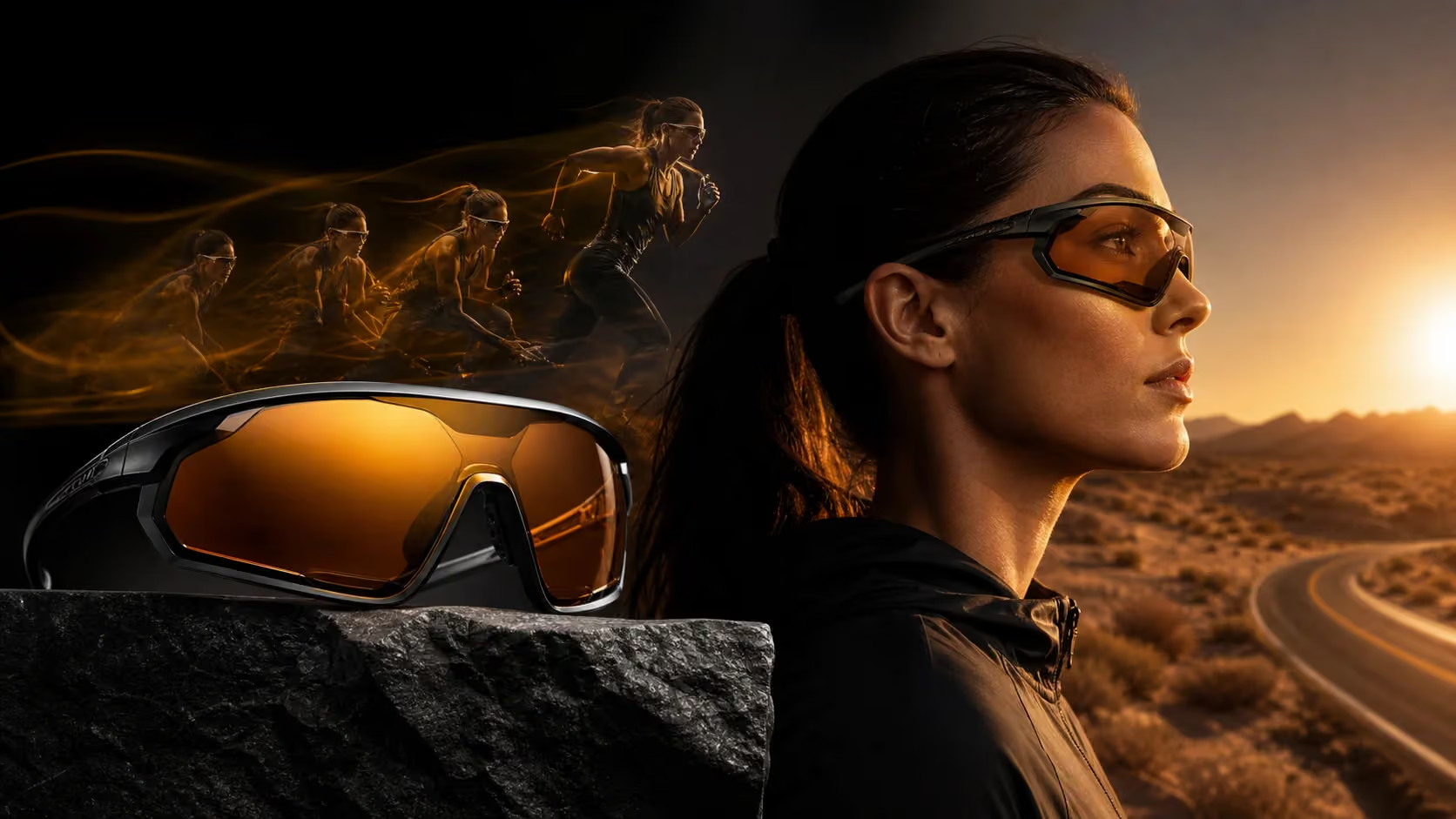
- "A person wearing minimalist titanium-frame sunglasses at an outdoor cafe, golden hour lighting, lifestyle photography, shallow depth of field, warm tones"
- "Close-up of a premium stainless steel travel mug being held in one hand, urban background blurred, morning light, condensation on the mug surface, commercial photography style"
Cost: pennies per image. Turnaround: under 60 seconds. Variations: unlimited.
Campaigns that exceed their funding goal by 200% or more share a common trait: their visuals look like they belong to an established brand, not a crowdfunding project. The imagery quality signals that the team is professional, the product is real, and the execution will be competent. Investing in professional-quality visuals -- whether through traditional photography, 3D rendering, or AI generation -- is the highest-ROI activity for any campaign.
The Headline Formula
Your headline has one job: make the backer understand and want the product in one sentence.
Formula: [Product category] + [key differentiator] + [emotional benefit]
Examples:
- "The World's Lightest Carry-On Suitcase -- Travel Without the Weight"
- "A Standing Desk That Adjusts With Your Voice -- Work the Way You Move"
- "Noise-Canceling Earbuds With 72-Hour Battery -- Your Silence, Your Schedule"
Avoid:
- Clever wordplay that obscures what the product is
- Technical specifications in the headline (save those for the body)
- Hyperbolic claims ("revolutionary," "game-changing") without proof
Section 2: The Campaign Video
The video is where conversion happens. Kickstarter reports that campaigns with videos raise 105% more than campaigns without. But not all videos convert equally.
The Optimal Video Structure (2-3 Minutes)
0:00-0:15 -- The hook. Show the problem your product solves or the moment of delight your product creates. Do not start with your company name, team introduction, or origin story. Start with something the viewer cares about.
0:15-0:45 -- The product reveal. Show the product. What it looks like, what it does, how it works. Use the best visuals you have -- lifestyle shots, product close-ups, demonstration footage.
0:45-1:30 -- Features and benefits. Walk through 3-5 key features, each tied to a benefit. "The titanium frame weighs 12 grams" (feature) "so you forget you are wearing them" (benefit).
1:30-2:00 -- Social proof and credentials. Press mentions, expert endorsements, prototype test results, team credentials. Why should the backer trust that this team can deliver?
2:00-2:30 -- The ask. Explicitly ask for their support. Summarize the offer. Create urgency around early-bird pricing or limited rewards.
Production tip: You do not need a $10,000 video production. A well-lit video shot on a smartphone with good audio quality, clean b-roll of the product, and text overlays for key points outperforms a professionally shot video with poor structure and unclear messaging. Structure and clarity beat production value.
For b-roll footage and supplementary visuals within your video, AI-generated product shots can fill gaps where you lack professional footage. Generate lifestyle and context images on Oakgen and use them as Ken Burns-style motion stills in your edit.
For narration, Oakgen's voice generator produces professional voiceover from text in seconds, eliminating the need for a recording studio session.
Section 3: The Product Story
Below the fold, your page needs to tell the complete product story. This is where you convert interested visitors into committed backers.
The Problem-Solution Framework
Start with the problem. Describe the frustration, inconvenience, or unmet need your product addresses. Use specific, relatable scenarios. "You are at the airport with a rolling suitcase that weighs 9 pounds empty, leaving you 13 pounds for a week's worth of clothes" is better than "Traditional suitcases are too heavy."
Then introduce the solution. Show how your product specifically addresses each aspect of the problem. This is where detailed product imagery becomes essential.
Product Detail Images
Each feature needs its own dedicated image. Not a bullet list with a single product photo -- a visual for every major claim.
Types of product detail images your campaign needs:
- Exploded view or cross-section: Shows internal components and build quality
- Material close-ups: Shows texture, finish, and premium materials
- Size comparison: Product next to everyday objects for scale
- Feature callouts: Product image with labeled annotations pointing to specific features
- Before/after or comparison: Your product versus the existing solution
- Color/variant options: Every available option shown in the same setting
For pre-manufacturing campaigns, AI image generation produces all of these. Generate your product from multiple angles, in close-up, showing materials and details, at different scales. Use Oakgen's image editor to add feature callout text and annotations.
| Campaign Visual | Without AI | With AI Generation | Impact on Conversions |
|---|---|---|---|
| Hero lifestyle image | $500-3,000 (3D render) or prototype photo | $0.03-$0.50 per image | Highest impact -- determines 80% bounce rate |
| Product detail images (10+) | $2,500-10,000 (renders) or CAD screenshots | $0.30-$5.00 total | High -- builds product understanding and desire |
| Lifestyle context shots (5+) | $1,000-5,000 (photographer + props) or N/A | $0.15-$2.50 total | High -- triggers ownership imagination |
| Color/variant previews | $500-2,000 per variant (re-render) | $0.03-$0.50 per variant | Moderate -- increases average pledge amount |
| Size comparison images | $200-500 per setup | $0.03-$0.50 per image | Moderate -- reduces purchase uncertainty |
| Video b-roll stills | Included in video budget or separate shoot | $0.15-$2.50 total | Moderate -- improves video production quality |
Section 4: Social Proof and Credibility
Backers are taking a risk. They are paying for a product that might not ship for 6-18 months from a company with no track record of delivery. Every credibility signal reduces that perceived risk.
Types of Social Proof That Convert
Press and media mentions. Even a brief mention in a relevant publication adds legitimacy. Display publication logos prominently. If you do not have press coverage yet, reach out to relevant bloggers and niche publications before launch with a press kit that includes your AI-generated product visuals.
Expert endorsements. A quote from someone with relevant expertise ("As a physical therapist, I see the potential of this product for patient recovery" for a health product) carries more weight than general praise.
Prototype testing results. "We tested the battery through 500 charge cycles with less than 3% capacity loss" is specific, verifiable, and confidence-building.
Team credentials. Where the team has worked before, relevant expertise, previous successful campaigns. Backers are betting on the team as much as the product.
Backer count and funding progress. Kickstarter displays these automatically, and they create powerful social proof. This is why a strong launch day matters -- early momentum attracts more backers.
The most successful campaigns fund in the first 48 hours because the creator spent months building an email list of interested backers before launch. A list of 1,000-5,000 highly interested people who are primed to back on day one creates the social proof momentum that attracts organic backers. Your campaign page should be designed, written, and visually complete weeks before launch so your pre-launch marketing drives traffic to a page that converts immediately.
Section 5: Reward Tiers and Pricing Psychology
Your reward structure is a pricing page, and it should be designed with the same attention to pricing psychology that SaaS companies use.
The Three-Tier Structure
Most successful campaigns follow a pattern:
- Early Bird (limited quantity): 20-30% off the eventual retail price. Creates urgency. Limited to 100-500 backers.
- Standard Backer: 10-15% off retail. The primary tier where most pledges land.
- Premium Bundle: Product plus accessories, cases, extra units, or exclusive colors. 10-25% higher than the standard tier. Increases average pledge amount.
Anchor pricing: Display the planned retail price prominently next to each reward tier. "Retail $149 / Early Bird $99" makes the discount tangible and creates urgency.
The decoy tier: Include one tier that is intentionally less attractive to make your target tier look better by comparison. A "$79 product only" next to a "$99 product + case + charger" makes the $99 tier feel like an obvious better deal.
Reward Images
Each reward tier needs a dedicated image showing exactly what the backer receives. A photo or AI-generated image of every item in the tier, arranged together, labeled clearly. This reduces confusion and increases pledge confidence.
Generate reward tier images on Oakgen showing product bundles, accessory kits, and exclusive color variants -- all items arranged in an attractive flat-lay or lifestyle composition.
Section 6: Risk Mitigation
The final section of your page should address backer concerns head-on. Campaigns that acknowledge risks and explain mitigation plans convert better than campaigns that pretend risks do not exist.
What to Include
- Timeline with milestones. A visual timeline showing prototyping, tooling, manufacturing, QA, and shipping dates. Include buffer time.
- Manufacturing status. "We have completed tooling and our first 500-unit production run is scheduled for March" is far more reassuring than no manufacturing information.
- Shipping plan. Which countries, which carriers, estimated duties for international backers.
- Risk acknowledgment. "Manufacturing delays are possible. If our timeline shifts, we will communicate proactively through monthly updates." Honesty builds trust.
- Refund policy. Kickstarter does not require refunds, but offering them dramatically increases backer confidence.
The single most common cause of backer frustration is missed delivery dates. Add 2-3 months of buffer to your most optimistic timeline. Backers would rather see a realistic date and receive the product on time than see an aggressive date and wait through months of delay updates. Under-promise and over-deliver.
The Campaign Page Visual Checklist
A fully optimized campaign page needs these visual assets at minimum:
- 1 hero lifestyle image (product in context, professional quality)
- 1 campaign video (2-3 minutes, structured as outlined above)
- 3-5 feature detail images with callouts
- 2-3 lifestyle/context images showing the product in use
- 1-2 size/scale reference images
- 1 exploded view or materials detail image
- 1 image per color/variant option
- 1 image per reward tier showing all included items
- 1 team photo
- 1 timeline/roadmap graphic
- Press logos (if applicable)
That is 15-25 images minimum. At traditional production costs, this visual package would cost $5,000-$25,000. With AI generation for lifestyle, detail, and variant images, the visual production cost drops to under $10 for the AI-generated assets.
| Campaign Stage | Visual Need | Traditional Solution | AI-Assisted Solution |
|---|---|---|---|
| Pre-launch (building hype) | Teaser images, landing page visuals | $1,000-3,000 (concept renders) | AI lifestyle + product shots ($0.10-$2) |
| Launch day | Full campaign page (15-25 images) | $5,000-25,000 (photography + renders) | AI generation + basic video ($5-$50) |
| Mid-campaign updates | Progress photos, new angle shots | $500-2,000 per update | AI variations ($0.05-$1 per update) |
| Stretch goal reveals | New color/variant visualizations | $500-2,000 per variant | AI generation ($0.03-$0.50 per variant) |
| Post-campaign marketing | Social media content, ad creatives | $2,000-5,000 ongoing | Unlimited AI-generated variants |
Optimizing After Launch
Your campaign page is not static. The most successful campaigns iterate on their page throughout the funding period based on backer feedback and conversion data.
Track and optimize:
- Conversion rate by traffic source. If Facebook ads convert at 2% but newsletter traffic converts at 8%, your page may need adjustments for cold-audience visitors.
- Video completion rate. If most viewers drop off at the 45-second mark, the middle section of your video needs work.
- Pledge tier distribution. If 90% of backers choose the cheapest tier, your premium tier pricing or value proposition needs adjustment.
- Common backer questions. If multiple backers ask about the same thing, add a FAQ section addressing it directly with supporting visuals.
You can update your campaign page at any time during the funding period. Use this to your advantage. Add new product images, update lifestyle shots, add comparison visuals that address common concerns, and refresh the hero image if the original is not converting.
FAQ
What funding goal should I set?
Set the minimum amount you need to deliver the product to backers, not your aspirational target. A campaign that funds at 100% of a conservative goal creates momentum and credibility. A campaign sitting at 30% of an ambitious goal looks like it is failing, which discourages new backers. Use stretch goals to capture the upside once your base goal is met.
How long should my campaign run?
30 days is the standard and optimal duration for most campaigns. Shorter campaigns (14-21 days) can work if you have a large pre-launch audience because they create urgency. Longer campaigns (45-60 days) almost always perform worse because the urgency dissipates. Most pledges come in the first 48 hours and the last 48 hours -- the middle is a plateau regardless of campaign length.
Should I use a video production company for my campaign video?
Not necessarily. The most important elements are clear audio, good lighting, a tight script, and professional product visuals. Many successful campaigns use self-shot video with AI-generated product b-roll, text overlays, and background music. Oakgen's music generator can create background tracks for your video, and the voice generator can produce professional narration. Invest your budget in the product visuals shown in the video rather than cinematic production techniques.
Can I use AI-generated images for a Kickstarter campaign?
Yes. Kickstarter requires that you accurately represent your product and project status. AI-generated lifestyle and concept images are acceptable as long as they represent what you are actually building. You should not use AI imagery to misrepresent the product's features, materials, or capabilities. Be transparent in your campaign about the product's current development stage and what backers can expect in the final product.
What is the biggest mistake first-time campaign creators make?
Launching without a pre-built audience. The campaign page can be perfect, but if no one sees it in the first 48 hours, it will not fund. Spend 2-3 months before launch building an email list through landing pages, social media, content marketing, and outreach. Use your AI-generated product visuals for pre-launch marketing content -- social media posts, landing page imagery, and email headers. The campaign page converts visitors. Your job is to drive visitors there.