You have a product ready to sell. Maybe it is a physical product sitting on your desk, a digital product that needs a visual representation, or a product concept that does not physically exist yet. In every case, you need professional-looking visuals to sell it. And in every case, the traditional answer -- hire a product photographer -- is expensive, slow, and often overkill for what you actually need.
Professional product photography costs $25 to $75 per image for simple white-background shots. Lifestyle photography -- your product in a styled scene with props, models, and professional lighting -- runs $100 to $500 per image. A full product shoot for a 20-SKU ecommerce store with lifestyle and white-background variants costs $2,000 to $15,000. Add the logistics: shipping samples to the photographer, 1-2 week turnaround, revision rounds, and re-shoots when you update packaging.
For an Amazon seller testing a new product, a Shopify store owner with 50 SKUs, or a Kickstarter creator who needs campaign visuals before the product is manufactured, those numbers are a barrier. And the timeline kills momentum. You want to launch Tuesday. The photographer can fit you in next month.
This is not a minor problem. Product imagery is the single largest conversion factor in ecommerce. Shopify reports that 75% of online shoppers rely on product photos when making purchase decisions. Amazon sellers with professional-quality lifestyle images see 25-40% higher conversion rates than those with basic white-background photos. For Etsy sellers, listings with styled mockups receive 3-5 times more favorites than listings with flat-lay photos.
The question is not whether you need professional product visuals. It is how you get them without the photographer, the studio, and the $5,000 invoice.
Understanding Product Mockup Types
Before exploring methods, it helps to understand what "product mockup" actually means and which types drive the most sales.
White-Background Product Photos
The standard ecommerce product image: your product isolated on a pure white background. Amazon requires these as the main listing image. They serve a functional purpose -- showing the product clearly without distractions. Every product needs these, but they do not sell by themselves.
Lifestyle Mockups
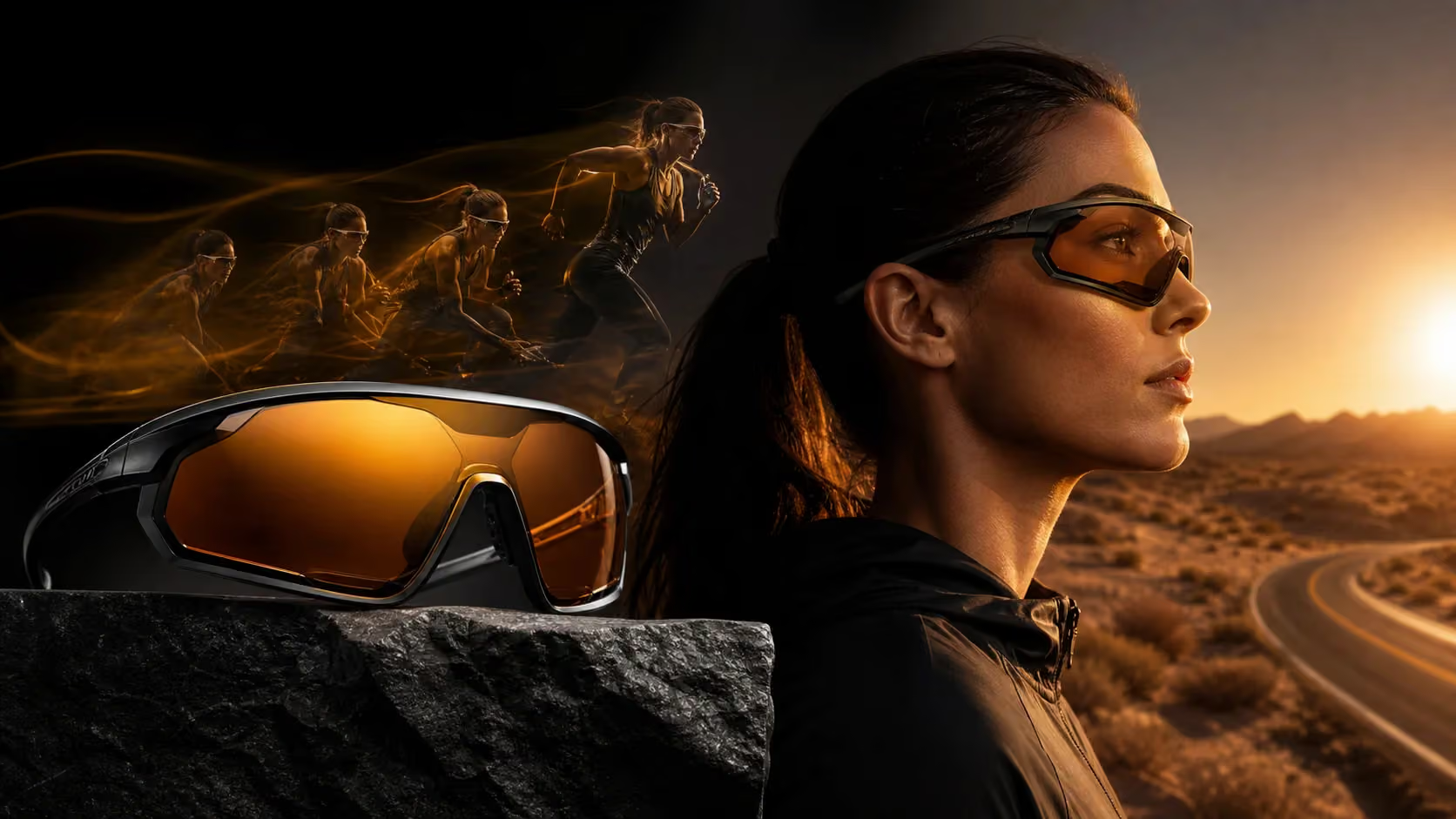
Your product in a real-world context. A coffee mug on a wooden desk next to a laptop. A skincare bottle on a marble bathroom counter with eucalyptus sprigs. A phone case held by someone walking through a city. These images help buyers visualize owning the product. They are the images that drive emotional purchase decisions.
Scene Mockups
A broader environmental shot that tells a story. A workspace setup featuring your product. A kitchen scene where your product is in use. A holiday gift spread with your product as the centerpiece. These work for marketing materials, social media, and brand storytelling.
Device Mockups
For digital products, apps, or SaaS: your interface displayed on realistic device screens. A MacBook showing your dashboard, an iPhone showing your app, a tablet showing your ebook. These are essential for software products, digital downloads, and tech businesses.
Packaging Mockups
Your label, design, or branding applied to a realistic 3D product shape. A label on a wine bottle, a design on a t-shirt, a brand on a box. Useful before manufacturing (Kickstarter campaigns, pre-orders) and for testing design variations.
Data from multiple ecommerce studies shows a consistent hierarchy: lifestyle mockups convert highest (showing the product in context triggers ownership imagination), followed by white-background images (showing the product clearly builds confidence), followed by size/scale references (reducing uncertainty about dimensions). The most effective listings combine all three types. The least effective use only white-background shots.
Method 1: DIY Photography With a Smartphone (Free)
If you have the physical product in hand, you can create surprisingly good product photos with a smartphone and a few household items.
The Basic White-Background Setup
You need:
- A smartphone with a decent camera (anything from the last 3-4 years)
- A large sheet of white poster board or foam core ($2 at a dollar store)
- A window for natural light
- A second piece of white board or paper for bounce lighting
Setup: Curve the poster board so the bottom rests flat on a table and the top leans against a wall, creating a seamless "infinity" background with no visible edge. Place your product on the flat portion. Position the table next to a large window so light comes from one side. Hold a second piece of white board on the opposite side to bounce light into the shadows.
Camera settings: Use portrait mode if your phone has it. Tap to focus on the product. Lock exposure by long-pressing. Avoid using the flash -- natural window light looks dramatically better.
Post-processing: Use Snapseed (free) or Lightroom Mobile (free tier) to increase exposure until the background is pure white, boost contrast slightly, and ensure colors are accurate.
The DIY Lifestyle Shot
Creating lifestyle mockups with a phone is harder because you need props, surfaces, and scenes that feel curated and intentional.
Tips that work:
- Use textured surfaces: a wooden cutting board, a marble tile from a home improvement store ($3), a piece of linen fabric
- Keep props minimal and relevant: 2-3 items that relate to your product's use case
- Shoot from a 45-degree angle looking down (the most flattering angle for most products)
- Ensure consistent color temperature -- do not mix natural light with lamp light
The limitation: DIY lifestyle shots require styling skill. The difference between "products scattered on a table" and "a curated lifestyle scene" is subtle but immediately recognizable to buyers. This is where professional photographers earn their fee -- not in camera work, but in styling.
Method 2: Digital Mockup Templates ($0 to $50)
Mockup templates are pre-photographed scenes with a smart object layer where you drop in your product image, label, or screen. The result looks like your product was professionally photographed in that scene.
Where to find them:
- Placeit by Envato ($7.47/month or $14.95 per download): Thousands of mockups across categories. The largest selection. Online editor, no Photoshop needed.
- Smartmockups (free tier available, $9/month for pro): Clean interface, good apparel and device mockups.
- Mockup World (free): Curated collection of free PSD mockups.
- Creative Market ($2-$30 per template): High-quality individual mockups purchased once.
Limitations of templates:
- Every mockup is shared with thousands of other businesses using the same service
- Your product must fit the template's perspective and dimensions
- Limited to the scenes and contexts the template creator photographed
- Customization is usually restricted to swapping the product image
Templates work well for device mockups (showing your app on an iPhone) and apparel mockups (showing your design on a t-shirt). They work less well for unique physical products that do not fit standard template shapes.
| Method | Cost | Time Per Image | Realism | Customization | Best For |
|---|---|---|---|---|---|
| DIY smartphone photo | $0 - $5 | 15 - 45 min | Moderate (with effort) | Unlimited (physical product) | White-background, simple lifestyle |
| Mockup templates | $0 - $15/mo | 2 - 10 min | High (pre-photographed) | Low (fixed scenes) | Device mockups, apparel, packaging |
| 3D rendering software | $0 - $50/mo | 1 - 4 hours (learning curve) | Very high | Very high | Technical products, CAD models |
| AI image generation | $0.03 - $0.50 | Under 60 seconds | High to very high | Unlimited (any scene describable) | Lifestyle, scenes, conceptual |
| Professional photographer | $25 - $500/image | 1 - 3 weeks | Very high | High (within physical constraints) | Catalog, luxury, food |
Method 3: 3D Mockup Software ($0 to $50/month)
For products with 3D models (common in manufacturing, consumer electronics, and packaging), 3D rendering software creates photorealistic mockups without any physical photography.
Accessible options:
- Blender (free, open-source): Professional-quality 3D rendering. Steep learning curve but unlimited capability.
- Vectary (free tier): Browser-based 3D design and mockup tool. Easier learning curve than Blender.
- Keyshot ($995 one-time or $99/year): Industry-standard product visualization. Used by major brands.
The limitation is obvious: you need a 3D model of your product. If you manufactured the product using CAD files, those files can often be imported directly. If you do not have a 3D model, creating one from scratch is its own significant skill and time investment.
Method 4: AI-Generated Product Mockups
This is where the economics and speed equation changes fundamentally. AI image generation produces custom product mockup scenes -- any product, in any context, with any styling -- in seconds.
Unlike templates, every AI-generated image is unique to your product. Unlike DIY photography, you are not limited by physical props, surfaces, or locations. Unlike 3D rendering, there is no learning curve or 3D model requirement.
How It Works in Practice
Using Oakgen's image generator, you describe the scene you want, and the AI produces it:
Lifestyle mockup prompts that work:
- "Professional product photography of a matte black water bottle on a granite kitchen counter, morning light streaming through a window, blurred coffee maker in the background, shallow depth of field"
- "Flat lay photography of a skincare set including three amber glass bottles on a white marble surface, eucalyptus leaves and a small towel as props, top-down perspective, soft shadows"
- "A person holding a leather journal in a cozy coffee shop, natural window light, blurred cafe background, warm tones, lifestyle photography style"
White-background prompts:
- "Commercial product photography of a minimalist ceramic vase on a pure white background, soft even lighting, no shadows, centered composition"
Scene/environmental prompts:
- "A modern home office desk setup featuring a sleek laptop stand, organized workspace, monstera plant in the background, soft daylight from a window, editorial style photography"
Models like Flux 2 Pro on Oakgen excel at photorealistic product scenes with natural lighting and depth of field. For products that need precise text rendering on labels or packaging, GPT Image 1.5 handles typography within images better than most models.
If you have a white-background photo of your actual product, you can use Oakgen's image editor to place it into AI-generated scenes. This gives you the best of both worlds: your real product (accurate colors, exact dimensions, real materials) in a styled context that would have required a photographer, a studio, and a prop stylist. Generate the background scene with AI, then composite your real product into it.
AI Mockups for Products That Do Not Exist Yet
This is where AI generation is uniquely powerful and has no traditional equivalent at any price point.
If you are running a Kickstarter campaign, the product is not yet manufactured. You cannot photograph something that does not exist. Traditionally, this meant commissioning 3D renders (expensive) or creating crude prototypes for photography (time-consuming and often unrepresentative of the final product).
AI generation lets you describe the product you are going to make and visualize it in any context:
- Product concept images for your campaign hero section
- Lifestyle shots showing the product in use before it is manufactured
- Size reference images placing the product next to common objects
- Color variant previews showing every option in the same scene
- Packaging mockups showing your branding on the final product
For pre-launch products, this capability is transformative. You can build an entire visual marketing campaign before spending a dollar on manufacturing.
The Cost of AI-Generated Product Mockups
The math speaks for itself.
A typical ecommerce product listing needs:
- 5-7 white-background images (different angles)
- 3-5 lifestyle images (different contexts)
- 1-2 size/scale reference images
- 2-3 feature highlight images
That is 11-17 images per product. At 3 credits per image on Oakgen (typical for Flux 2 Pro), that is 33-51 credits, or roughly $0.13-$0.20 per product. For a 50-SKU store, the total image generation cost would be approximately $6.50-$10.
Compare that to professional photography at $25-$75 per image: the same 50-SKU store would cost $13,750-$63,750.
| Ecommerce Need | Professional Photography | AI Generation (Oakgen) | Savings |
|---|---|---|---|
| Single product listing (15 images) | $375 - $1,125 | $0.13 - $0.60 | 99%+ |
| 10-product store | $3,750 - $11,250 | $1.30 - $6.00 | 99%+ |
| 50-product store | $18,750 - $56,250 | $6.50 - $30.00 | 99%+ |
| Seasonal refresh (all images) | Full re-shoot cost | Regenerate in an afternoon | 99%+ cost, weeks of time |
| A/B testing 3 hero variants | $225 - $1,500 (3x shoot) | $0.03 - $0.12 | 99%+ |
Optimizing Product Mockups for Each Sales Channel
Different platforms have different requirements and best practices. Your mockups need to be optimized for where they will appear.
Amazon
- Main image: Product on pure white background (RGB 255, 255, 255). Product must fill 85% of the frame. No props, no text, no borders.
- Additional images (up to 8): Lifestyle scenes, feature callouts, size charts, and comparison images. This is where AI-generated lifestyle mockups shine.
- Infographic images: Product with overlaid text highlighting features. Generate the base image with AI, add text overlays in Canva.
Shopify / Direct-to-Consumer
More creative freedom than Amazon. Lifestyle images should match your brand aesthetic. Consistency across all product pages matters more than individual image quality. Use the same AI generation style and prompt structure across your catalog for visual cohesion.
Etsy
Lifestyle mockups dramatically outperform white-background images on Etsy. The platform's audience responds to styled, aspirational imagery. Flat-lay photography, in-context lifestyle shots, and seasonal styling all perform well. AI generation lets you create seasonal variants (holiday gifting scenes, summer outdoor settings, cozy winter interiors) without re-shooting.
Social Media / Ads
Product images for social media and advertising need to stop the scroll. This means bold compositions, saturated colors, and unexpected contexts. AI generation excels here because you are unconstrained by physical reality -- you can place your product in any setting, at any scale, in any creative context.
AI-generated product mockups should represent your product accurately. Do not generate images that misrepresent the product's size, color, materials, or capabilities. Customers who receive a product that does not match the listing images will leave negative reviews, request returns, and damage your seller metrics. Use AI to make your product look its best in appropriate contexts -- not to make it look like something it is not.
The Workflow: From Product to Published Listing
Here is a practical, step-by-step workflow for creating a complete set of product mockups without a photographer.
Step 1: Capture Your Product (If Physical)
If you have the physical product, take 10-15 reference photos with your phone using the DIY white-background setup described above. These serve as your product reference and can also be used as your main Amazon image.
Step 2: Define Your Mockup Shot List
List every image you need:
- Main product image (white background, front view)
- 2-3 additional angles (side, back, detail)
- 3-5 lifestyle contexts (where and how the product is used)
- 1-2 scale/size reference images
- Feature highlight images (close-ups of key features)
- Seasonal or promotional variants (if applicable)
Step 3: Generate Lifestyle Mockups
Use Oakgen's image generator to create each lifestyle and scene mockup on your shot list. Generate 3-5 variations of each shot and select the strongest.
Step 4: Enhance and Upscale
Use the image editor to refine any images that need adjustment -- color correction, background tweaks, or detail enhancement. Use the upscaler to ensure all images meet the resolution requirements for your platform (minimum 1000x1000 for Amazon, 2048x2048 recommended).
Step 5: Add Text Overlays and Infographics
For infographic-style images (common on Amazon), add text callouts, dimension labels, and feature highlights using Canva or Figma. Use your AI-generated lifestyle images as the base.
Step 6: Optimize and Upload
Compress images for web (TinyPNG or Squoosh.app) without visible quality loss. Upload to your platform in the correct order -- hero image first, lifestyle images next, detail shots last.
FAQ
Are AI-generated product mockups allowed on Amazon?
Amazon's image policies require that the main product image accurately represent the product you are selling. AI-generated lifestyle images for supplementary image slots are widely used and accepted. The main image should be a real photograph of your actual product on a white background when possible. For supplementary lifestyle and infographic images, AI-generated content is standard practice.
How do I maintain visual consistency across my product catalog?
Use the same AI model, the same prompt structure, and the same style descriptors across all products. For example, if your brand has a warm, natural aesthetic, use prompts that consistently include "warm natural light, wooden surfaces, earth tones, shallow depth of field" for every product. Save your prompt templates and modify only the product-specific details for each SKU.
Can AI generate mockups of my specific product?
AI image generation works from text descriptions, so it generates products that match your description rather than your exact product. For generic products (bottles, boxes, mugs, apparel), AI produces highly accurate representations. For unique or highly detailed products, the best approach is to photograph your real product against a white background and use Oakgen's image editor to composite it into AI-generated lifestyle scenes.
What resolution should my product mockups be?
For Amazon, the recommended minimum is 1000x1000 pixels, with 2000x2000 preferred for zoom functionality. For Shopify and direct-to-consumer stores, 2000x2000 or higher is standard. For social media, 1080x1080 (square) or 1080x1350 (portrait) are optimal. Oakgen's AI models generate images up to 1024x1024 or 1344x768 natively, and the upscaler can increase resolution to 4x for print and high-resolution display needs.
How often should I update my product mockups?
Refresh your lifestyle mockups seasonally (every 3-4 months) to keep listings feeling current. Update immediately when you change packaging, materials, or product design. A/B test new mockup styles quarterly -- even small improvements in imagery can produce meaningful conversion rate increases over time. With AI generation, the marginal cost of creating new images is essentially zero, so there is no reason to let your mockups go stale.