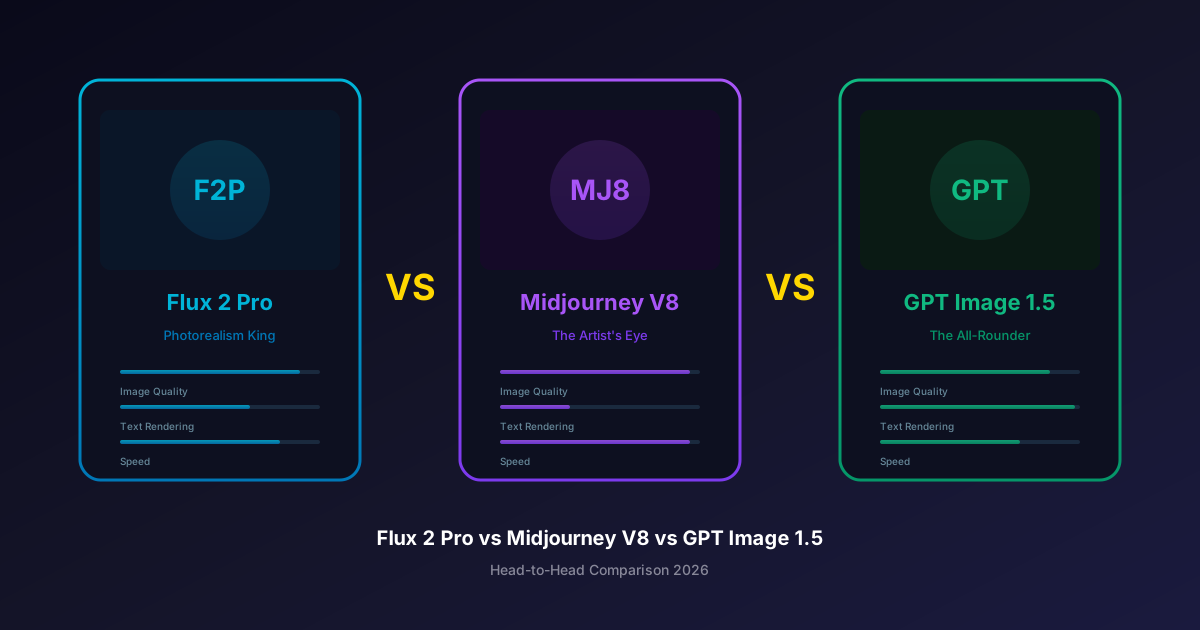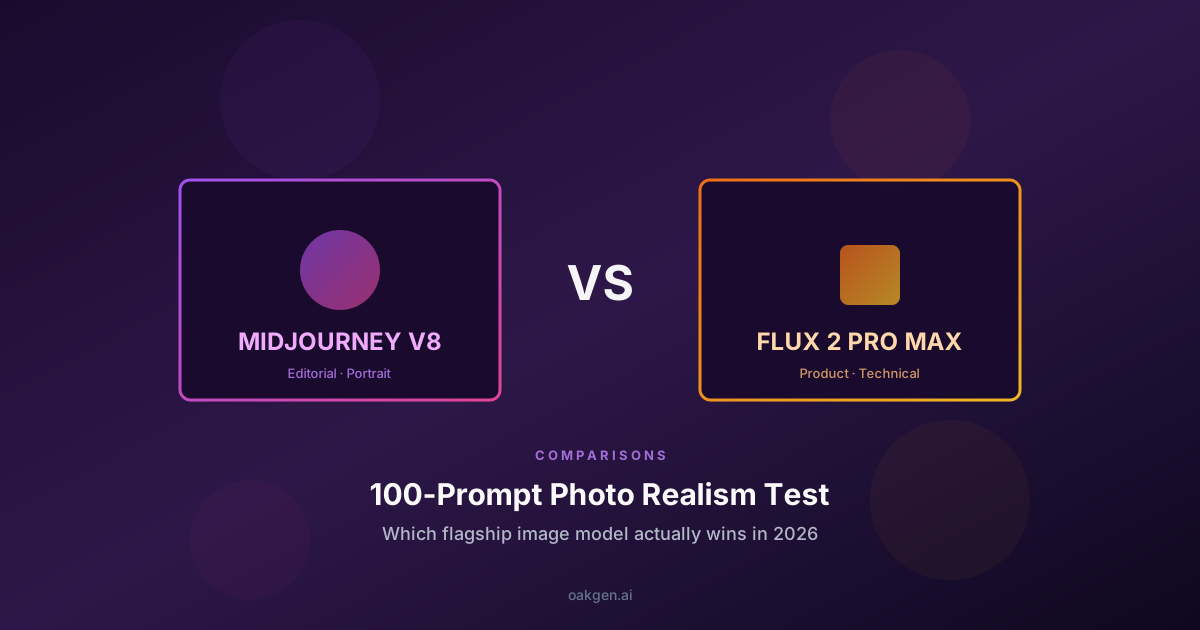
Midjourney V8 dropped earlier this year with a focus on photographic realism and emotional weight. Flux 2 Pro Max has held the top of the photoreal leaderboard since launch. They are now the two models any serious image workflow has to choose between.
We ran 100 paired prompts through both models, scored the outputs blind, and pulled out where each one wins. Here is what we found.
The Setup
Same prompts, same aspect ratios, default settings on both models. We tested four categories of 25 prompts each:
- Portraits -- single subjects, varied ages and ethnicities, varied lighting
- Products -- e-commerce style, cosmetics, electronics, food
- Environments -- interiors, exteriors, architectural, natural landscapes
- Editorial -- multi-subject scenes, narrative compositions, magazine-style
Three reviewers scored each pair on photorealism, prompt adherence, and aesthetic appeal. Winners were called by majority vote with ties recorded as draws.
Portraits: Midjourney V8 Wins, But Closer Than Expected
Midjourney has historically owned portrait work, and V8 extends that lead in a specific way. Skin texture in V8 outputs has more nuance -- pores, micro-shadowing, subsurface scattering that reads as real skin rather than rendered skin. Hair has more individual strand definition. Eyes catch light more naturally.
V8 won 16 of 25 portraits. Flux won 6. Three were draws.
Where Flux 2 Pro Max won was in technically demanding scenarios: high-contrast lighting, multi-source mixed color temperature, and shots where physical accuracy mattered more than emotional impact. A Flux portrait under harsh window light reads as a photograph; a V8 portrait under the same prompt reads as a cinematic still. Both are excellent, but they answer different questions.
For headshots, fashion, beauty, and any portrait work where the emotional weight of the image matters, V8 is now the default. For documentary-style portraits, journalistic work, or anything that needs to read as captured rather than crafted, Flux holds.
Products: Flux 2 Pro Max Wins Cleanly
Product photography is about material accuracy. Glass needs to refract correctly. Metal needs to reflect cleanly. Plastic needs to look like plastic, not metal. Liquids need surface tension. This is Flux territory.
Flux won 19 of 25 product shots. V8 won 4. Two draws.
The Flux outputs were more useful for e-commerce work. Cleaner backgrounds, more accurate material rendering, better edge handling for cutouts, and more predictable lighting that matched the prompt. V8 produced more visually striking product shots but introduced creative interpretation -- adding mood, atmosphere, and lighting choices that were not in the prompt.
For catalog work, product detail pages, and any commercial photography use case, Flux is the right tool. For lifestyle product shots where atmosphere matters, V8 can be the better choice.
Environments: Split
Architectural and landscape shots produced the closest result.
Flux won 12 of 25. V8 won 10. Three draws.
Flux dominated interior architectural visualization, where accurate light falloff and material rendering decide the shot. V8 dominated exterior landscapes where mood, atmosphere, and weather feeling carried the image. Neither model had a clear edge across the full category.
The deciding factor was the prompt itself. Prompts with specific material and lighting language ("brushed aluminum at 11am sun") favored Flux. Prompts with emotional or narrative direction ("a lonely cabin at the edge of an autumn forest") favored V8.
Editorial: Midjourney V8 Wins
Editorial scenes -- multi-subject, narrative, magazine-aesthetic -- are where V8 pulls ahead the most.
V8 won 18 of 25. Flux won 5. Two draws.
V8 understands composition, narrative weight, and emotional balance in ways that Flux does not. Flux can produce a technically perfect multi-subject scene that feels staged. V8 produces the same scene with the implied story Flux misses.
For brand campaigns, editorial illustration, magazine work, and any image where the viewer needs to feel something, V8 is now the model to use.
Prompt Adherence
Outside of pure aesthetics, prompt adherence matters because it determines how many iterations you need.
Flux 2 Pro Max hit all major prompt elements on 21 of 25 prompts per category (84%). V8 hit all major prompt elements on 18 of 25 (72%). V8's misses were usually creative reinterpretations -- the model executed its own version of the prompt rather than the literal request.
For workflows where you need exactly what you asked for, Flux is more predictable. For workflows where you want the model to bring something, V8 brings more.
Speed and Cost
Flux 2 Pro Max runs about 15-25 seconds per generation at 2048x2048. V8 runs about 30-50 seconds at comparable resolution.
On Oakgen, Flux 2 Pro Max costs roughly 25 credits per image, V8 costs roughly 35 credits. For high-volume work, Flux is meaningfully cheaper and faster.
For hero campaign images, run both models on the same prompt and pick the winner. The extra 60 credits is rounding error compared to the upside of the better shot. For volume work, pick one and stick with it.
Honest Recommendations
After 100 prompts, the picture is clearer than the marketing copy suggests.
Use Flux 2 Pro Max when:
- Product photography or commercial work
- Architectural and interior visualization
- The prompt is technical and specific
- You need predictable, exact output
- Volume work where cost matters
Use Midjourney V8 when:
- Portraits where emotional weight matters
- Editorial, magazine, and narrative imagery
- Outdoor landscapes with mood
- Brand campaign visuals
- The prompt is creative and open-ended
The honest answer is that most serious workflows benefit from having both models available. They are not competing tools -- they are different tools that happen to share a category. Picking one and forcing every prompt through it leaves quality on the table.
What About Other Models?
GPT Image 2 still leads on text rendering and instruction following but trails both on pure photorealism. Imagen 4 Ultra is faster and better at typography but produces a glossier aesthetic that reads less photographic. Nano-banana Pro is the editing champion but is not a from-scratch generation tool. None of these compete directly with V8 or Flux 2 Pro Max for flagship photorealistic image generation.
The Bottom Line
Midjourney V8 and Flux 2 Pro Max are now the two best general-purpose photographic AI image models available. V8 is the emotional, editorial, portrait tool. Flux 2 Pro Max is the technical, commercial, product tool. The right choice is the one that matches your output -- and for most professional workflows, the right answer is to use both.