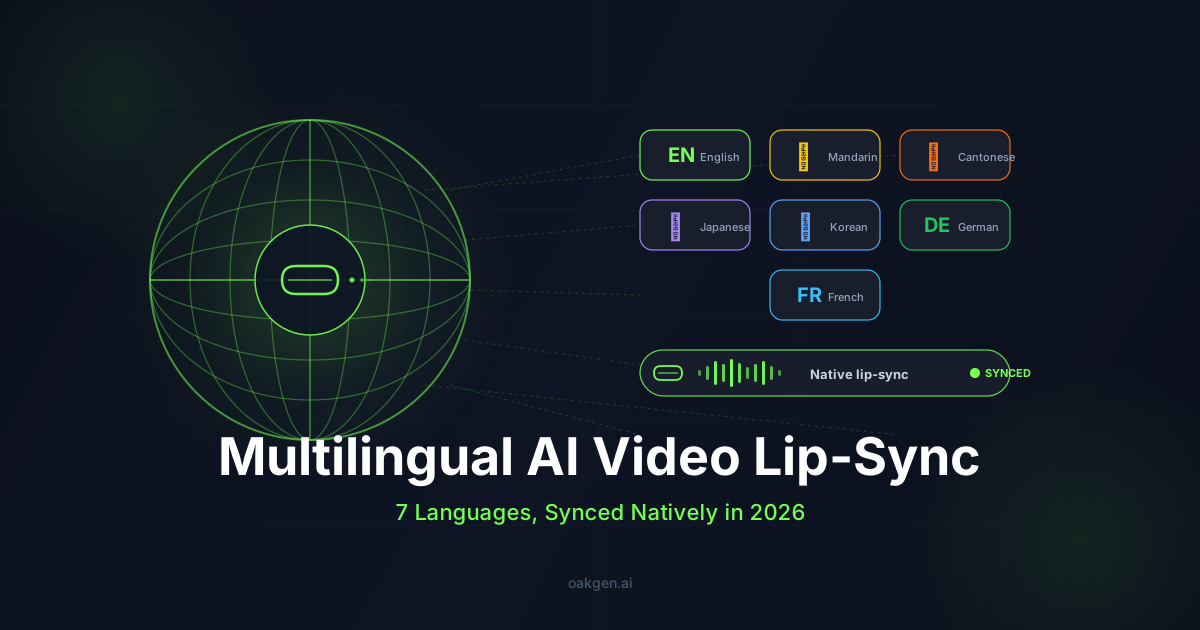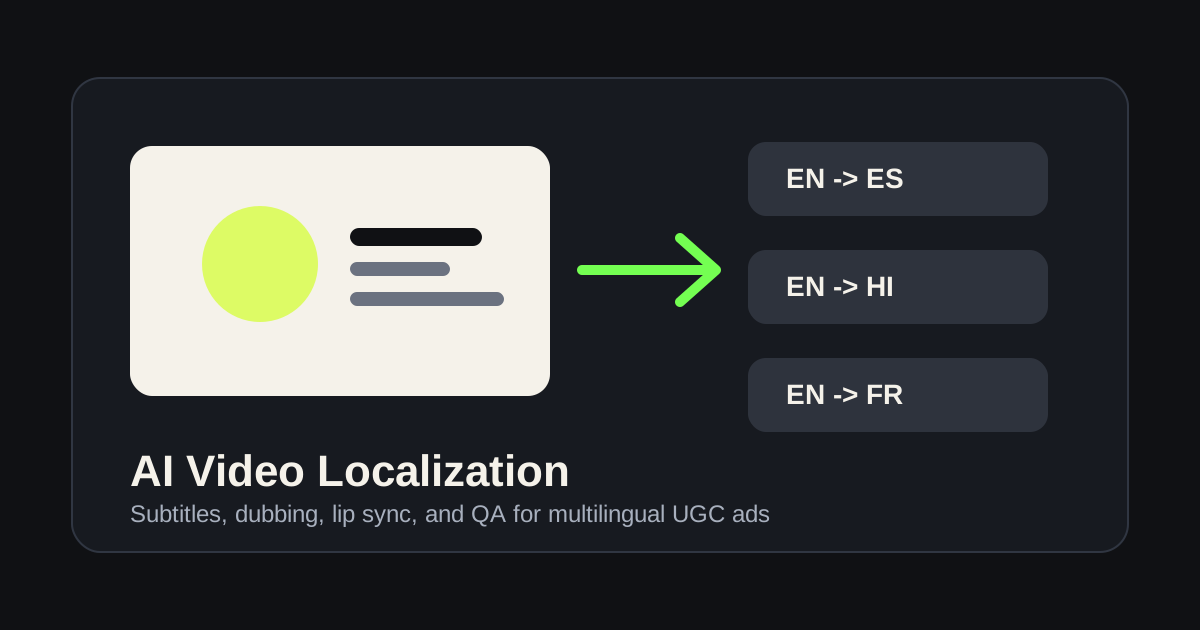
AI video localization means turning one working ad into market-specific versions without reshooting the entire campaign. For UGC ads, that usually means translation, subtitles, AI dubbing, lip sync, localized captions, and a human QA pass before publishing.
The important word is localization, not translation. A Spanish, Hindi, French, Arabic, or Japanese ad should not feel like an English ad wearing subtitles. The hook, pacing, claim, CTA, and disclosure need to make sense in the target market.
Use Oakgen for the production pass before localization: create the original UGC ad, generate AI video, produce talking-photo clips, and add audio variations before the final versions go through native review.
Turn One UGC Concept Into Localized Variations
Use Oakgen to create UGC-style ads, AI video, talking-photo clips, and audio variations before adapting them for each market.
Subtitles vs Dubbing vs Lip Sync
Start with the cheapest format that can answer the business question. If the ad does not work in the original language, a perfect dub will not save it.
| Method | Best For | Watch-Out |
|---|---|---|
| Subtitles | Fast testing, low budget, silent-feed platforms | Does not solve voice trust or local speaking style |
| AI dubbing | Voice-led explainers, product demos, creator-style ads | Needs review for tone, names, numbers, and claims |
| AI lip sync | Face-centric UGC, talking-head ads, founder-style videos | Costs more and can look uncanny if overused |
| Full localization | Winning ads entering serious spend in a new market | Requires local copy, compliance, creative, and QA review |
My default recommendation: test subtitles first, dub winners second, lip-sync the highest-confidence presenter ads third. Lip sync is powerful, but it is not a default requirement for every cutdown, B-roll clip, or product montage.
The 10-Language Localization Workflow
Here is a practical workflow for taking one UGC ad into ten languages.
- Pick the source ad
- Use a proven or promising ad, not a random asset.
- Confirm the hook, claim, and CTA are worth adapting.
- Create the localization brief
- Target markets:
- Languages:
- Platform:
- Offer:
- Words that must not change:
- Claims that require legal review:
- Disclosure text:
- Prepare the script
- Extract source transcript.
- Remove idioms that will not travel.
- Mark brand names, product names, numbers, and claims.
- Translate for meaning
- Translate the message, not just the words.
- Keep line length and spoken pacing realistic.
- Choose format by market
- Subtitle only.
- Dubbed audio.
- Dubbed plus lip sync.
- Fully localized creative.
- Generate variations
- Voice, captions, overlays, CTA, end card.
- QA with native review
- Accuracy, tone, compliance, timing, visual fit.
- Publish and compare
- Track by market, language, hook, and format.
This workflow creates enough control to scale without losing the message.
What Changes In A Localized UGC Ad
The script is only one layer. A localized ad may need changes across the whole asset.
| Layer | What To Localize | Example |
|---|---|---|
| Hook | Problem language and cultural context | A price-saving hook may beat a speed hook in one market |
| Voice | Accent, pace, formality, energy | A casual US creator tone may feel too familiar elsewhere |
| Captions | Length, line breaks, reading speed | German captions may need shorter on-screen phrases |
| Visuals | Currency, packaging, backgrounds, hands, UI | Replace USD offer with local price or remove price |
| Compliance | Claims, disclosures, platform rules | Health or finance claims may need local review |
| CTA | Action language and destination | Try now, book a demo, shop, install, or create may vary by market |
The best localized ad preserves the strategic spine while changing the surface. Same promise, local wording. Same proof, local clarity. Same creative format, local trust signals.
Build A Market Brief Before You Translate
Before generating ten versions, write a one-page brief for each market. It does not need to be complicated, but it should stop the team from treating every language like a word swap.
Include the local buyer problem, the offer, the CTA, the product names that must stay unchanged, the claims that require review, the level of formality, and any phrases to avoid. Add platform notes too. A TikTok Shop ad, Meta prospecting ad, YouTube Short, and landing-page explainer may all use the same source creative, but they should not use the exact same caption structure.
This is also where you decide whether the ad needs a local proof point. If the English ad says "ships in two days" but that is only true in the United States, the localized version needs a different claim. Translation without offer review is how localized ads become inaccurate.
When To Use Subtitles
Subtitles are the fastest way to learn whether a market responds to the creative idea.
Use subtitles when:
- the platform is often watched muted
- the visual demo carries the message
- the budget is small
- the source ad is still being validated
- you need a fast market test
- the presenter is not central to trust
Subtitles are weak when the ad depends on the speaker's credibility. If the person is selling through personality, tone, or emotional rhythm, a subtitle-only version may underperform even if the translation is accurate.
When To Use AI Dubbing
AI dubbing is useful when the spoken message matters. You can preserve the ad structure while making it easier to consume in the viewer's language.
Use AI dubbing when:
- the ad is voice-led
- the original voice is not the main brand asset
- the viewer needs to understand quickly
- the video is longer than a few seconds
- the CTA depends on spoken explanation
Watch out for numbers, brand names, ingredients, feature names, and legal disclaimers. AI dubbing tools are good, but they still need a glossary and review. You do not want your product name pronounced three ways across ten languages.
When To Use AI Lip Sync
Lip sync is best when the face is the ad.
Use it for:
- UGC talking-head ads
- founder-style explainers
- synthetic presenters
- educational product walkthroughs
- high-performing ads that deserve localization spend
Do not use it blindly. If a video is mostly product B-roll, screen capture, or text overlay, lip sync is unnecessary. Spend the effort on captions, local hooks, and product-page fit.
Translate broad tests cheaply. Dub promising ads. Lip-sync proven talking-head winners. This keeps localization spend tied to signal instead of novelty.
AI Video Localization QA Checklist
Use this before publishing each localized version.
Language: Market: Reviewer: Version:
Transcript accuracy:
- Brand names correct?
- Product names correct?
- Numbers correct?
- Offer correct?
- Claims unchanged or legally approved?
Voice:
- Natural accent?
- Appropriate pace?
- Emotion matches the ad?
- No robotic emphasis?
Captions:
- No overflow?
- Correct line breaks?
- Readable on mobile?
- Matches spoken audio?
Lip sync:
- Mouth movement plausible?
- No distracting face warping?
- No identity drift?
Visuals:
- Currency/local context correct?
- UI screenshots relevant?
- Product packaging accurate?
- Cultural tone appropriate?
Compliance:
- AI disclosure included if needed?
- Synthetic performer label included if needed?
- Platform AI-content toggle used?
- Local disclaimer present?
Decision:
- Approve
- Revise
- Reject
Native review is not optional for serious campaigns. AI can translate text. It cannot reliably tell you whether the line sounds natural, too pushy, oddly formal, or legally risky in a specific market.
Rollout Cadence For Ten Markets
Do not localize every asset at the same depth on day one. Use a staged rollout so budget follows signal.
Stage one: subtitle exploration. Take two or three promising source ads and create subtitle versions for the target markets. The goal is not perfect localization. The goal is to see which market, hook, and product angle deserves deeper production.
Stage two: dubbed winners. Pick the strongest source ad and dub it for the markets that showed promise. Keep the same visual structure, but review the spoken script carefully. This is where brand pronunciation, offer accuracy, and claim safety matter most.
Stage three: localized creative. For markets that show real signal, change more than the language. Adjust the hook, CTA, price framing, proof, captions, and even the scene if needed. A localized winner may keep only the skeleton of the original ad.
Stage four: market-native variants. Once the market is worth ongoing spend, use the winning local learning to create new source ads for that market. At that point, the original English ad is a reference, not the master asset.
This cadence protects the team from two expensive mistakes: overproducing localization before there is signal, and under-localizing winners that deserve a market-specific version.
Market Decision Rubric
Use this rubric when deciding whether a market needs subtitles, dubbing, lip sync, or a fully localized ad.
| Question | If Yes | If No |
|---|---|---|
| Does the visual demo explain most of the value? | Start with subtitles | Consider dubbing |
| Is the presenter central to trust? | Dub or lip-sync the winner | Use voiceover or captions |
| Does the source offer apply locally? | Keep the CTA with local wording | Rewrite offer before translating |
| Are there regulated or sensitive claims? | Use native and legal review | Standard native review may be enough |
| Is the market showing paid signal? | Invest in full localization | Keep tests lightweight |
The best choice is usually obvious after this review. A product montage may only need captions and local currency. A face-led founder ad may need dubbing, lip sync, and a more careful disclosure. A regulated category may need local counsel before the first paid test.
Where Oakgen Fits
Oakgen is not a replacement for native-language review. It is the place to build the source assets before review.
Use Oakgen to create the source ad with UGC ads, build visual scenes with the AI video generator, create presenter-style cuts with talking photo, and produce voice or audio assets with audio tools. Then localize and QA the versions that matter.
This is especially useful for agencies. You can show a client five localized directions before spending on a full production workflow. The goal is not to avoid humans. The goal is to use humans where they add the most value: local judgment, compliance, offer nuance, and final approval.
Create The Source UGC Ad Before Localizing
Start with one strong Oakgen UGC ad, then adapt the winning script, visuals, voice, and CTA for each language.
Common Mistakes
The first mistake is localizing a weak ad. If the original hook does not work, translation gives you ten versions of the same problem.
The second mistake is translating captions but leaving the visual world untouched. A product screen, price, shipping promise, or disclaimer can make the ad feel foreign even when the language is correct.
The third mistake is skipping review. AI dubbing can sound fluent and still change a claim. That is dangerous for health, finance, legal, supplement, and performance claims.
The fourth mistake is using lip sync as decoration. Lip sync should increase trust. If it makes the presenter look strange, use a dubbed voiceover over B-roll instead.
What I Would Do
For a DTC product entering ten markets, I would pick three winning English UGC ads, subtitle all three, then dub the top one in five priority languages. I would lip-sync only the best face-centric variant after performance signal. I would keep a glossary for product names, claims, ingredients, and disclaimers.
That gives you speed without pretending AI localization is magic. The system works when the creative idea is strong and the review process is strict.
The Localization Glossary
Every multilingual UGC workflow needs a small glossary before generation starts.
Include:
- product name
- brand name pronunciation
- ingredient names
- feature names
- claim phrases
- forbidden translations
- discount language
- shipping language
- disclaimer language
- CTA language
This is especially important when the source ad uses casual speech. A phrase like "this saved my routine" may translate into something too literal, too dramatic, or too claim-heavy. The glossary keeps the ad inside the same strategic and compliance boundaries across markets.
For regulated or claim-sensitive categories, the glossary should separate three things: approved phrases, phrases that need legal review, and phrases that are banned. Give the translator or reviewer that list before generating audio. Otherwise the AI may produce fluent language that changes the meaning.
Market Review Before Scaling
Do not scale a localized ad just because the dubbing sounds good to a non-native speaker.
Have a native reviewer check:
- Is the translation natural?
- Does the voice sound local or generically international?
- Does the CTA feel normal for the market?
- Are numbers, dates, currency, shipping, and discounts correct?
- Does the visual context fit the market?
- Does the ad accidentally imply a stronger claim than the original?
Localization is not translation plus lip sync. It is making the ad feel like it was meant for that buyer.
FAQ
What is AI video localization? AI video localization is the process of adapting a video for another language or market using AI translation, subtitles, dubbing, lip sync, localized captions, and sometimes localized visuals or offers.
Should I use subtitles, dubbing, or lip sync for UGC ads? Use subtitles for fast low-cost testing, dubbing when audio drives persuasion, and lip sync when the presenter is central to trust. Do not pay for lip sync on every ad before you know the creative works.
Can one UGC ad become ten localized ads? Yes, but it should not be a blind translation. Keep the winning hook and structure, then localize idioms, claims, captions, offers, disclaimers, and pacing for each market.
What should be QA checked in AI-dubbed ads? Check brand names, product names, legal claims, numbers, cultural tone, subtitle timing, lip sync, voice emotion, platform disclosures, and whether the CTA makes sense in the target market.
Where does Oakgen fit in AI video localization? Use Oakgen to create the source UGC ad, AI video, talking-photo clips, audio, and variation set before native speakers review the final market versions.