When a model quietly takes the #1 position on the most trusted AI video leaderboard, the first question everyone asks isn't "how good is it?" — it's "who built it?"
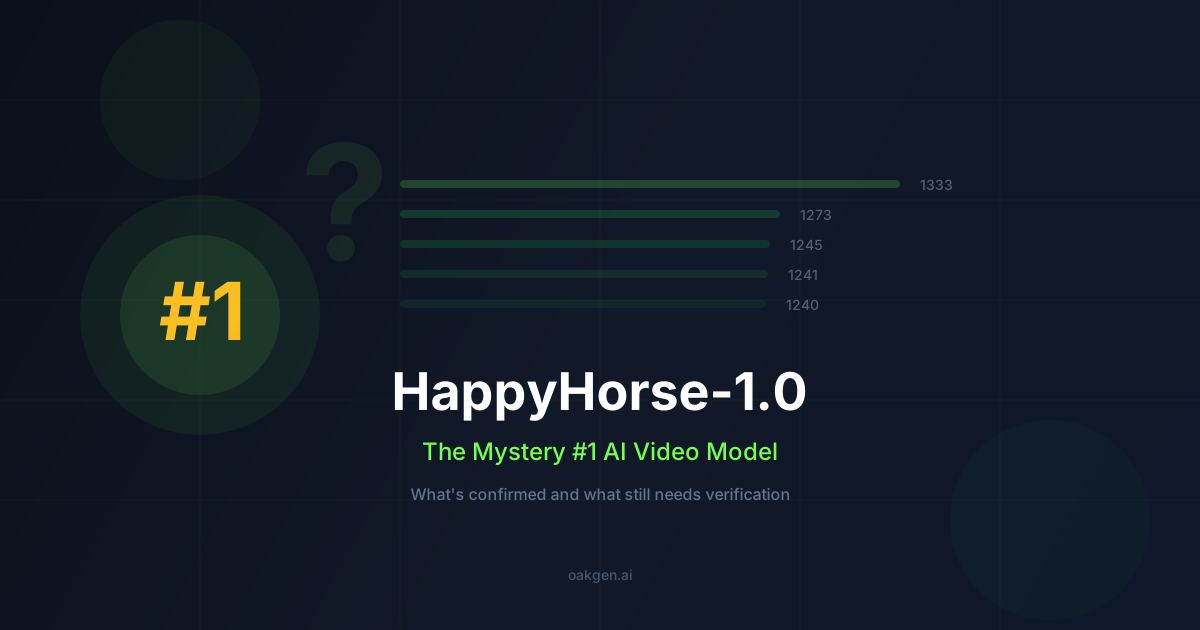
HappyHorse-1.0 has held the top spot on the Artificial Analysis Video Arena since early April 2026. Elo 1333 in text-to-video. Elo 1392 in image-to-video. Ahead of Seedance 2.0, ahead of Kling 3.0, ahead of every model from every major lab.
And nobody has publicly taken credit.
Here's every piece of evidence, every theory, and every dead end I've found while trying to answer the question: who made HappyHorse-1.0?
What Artificial Analysis Has Said
Artificial Analysis — the organization running the video arena — used one specific word when announcing HappyHorse-1.0's addition: "pseudonymous."
That's a precise choice. It means the model was submitted to the arena by someone who did not attach a verifiable real-world identity or organization to the submission. The arena accepted it anyway because the quality evaluation is blind — it doesn't matter who submits if the outputs are compared fairly.
This isn't unprecedented for Artificial Analysis. They've accepted submissions from known labs and independent researchers before. But a pseudonymous model reaching #1 across multiple categories is new territory.
The Official Sites: What They Reveal (and Don't)
Two websites are associated with HappyHorse-1.0:
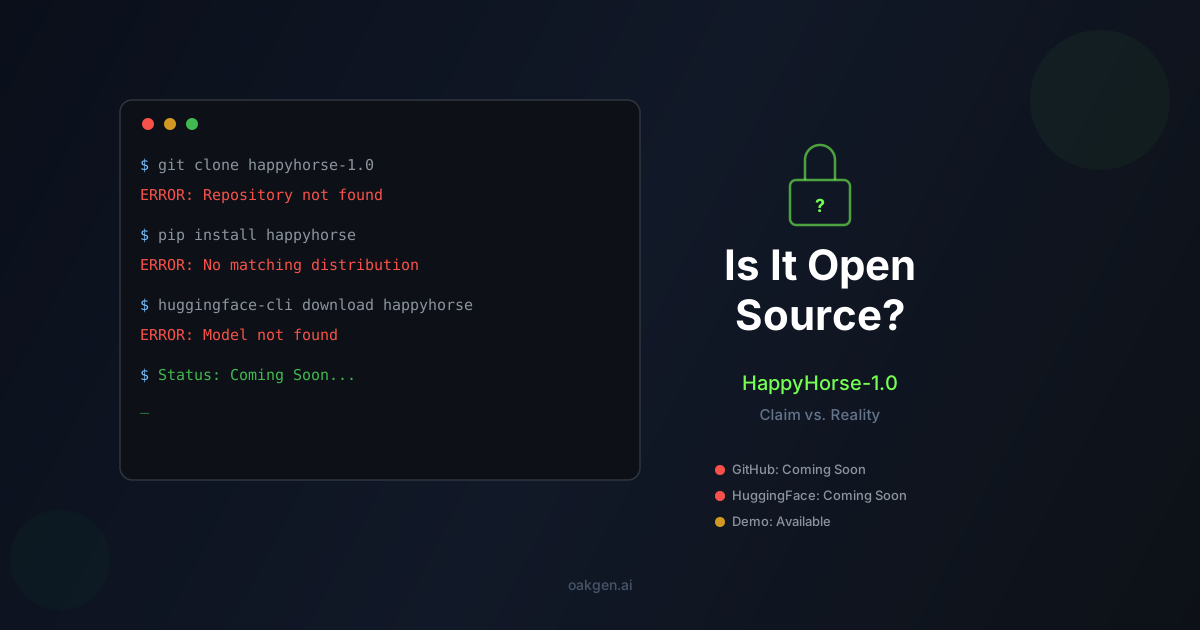
happyhorses.io — The primary technical site. It contains architecture descriptions (40-layer Transformer, single self-attention, no cross-attention), capability claims (multilingual, joint audio-video), and links to GitHub and Model Hub that both say "coming soon." No team page. No company name. No individual names. No "About" section.
happy-horse.art — A secondary marketing-focused site. More polished visuals, vaguer technical claims. It mentions "15 billion parameters" and "commercial usage rights." One version of this page referenced infrastructure from a major cloud provider, but I couldn't independently verify whether that indicates the builder's identity or just their hosting choice.
Neither site has a footer with a company registration, a privacy policy with a legal entity name, or any social media links to an identifiable organization.
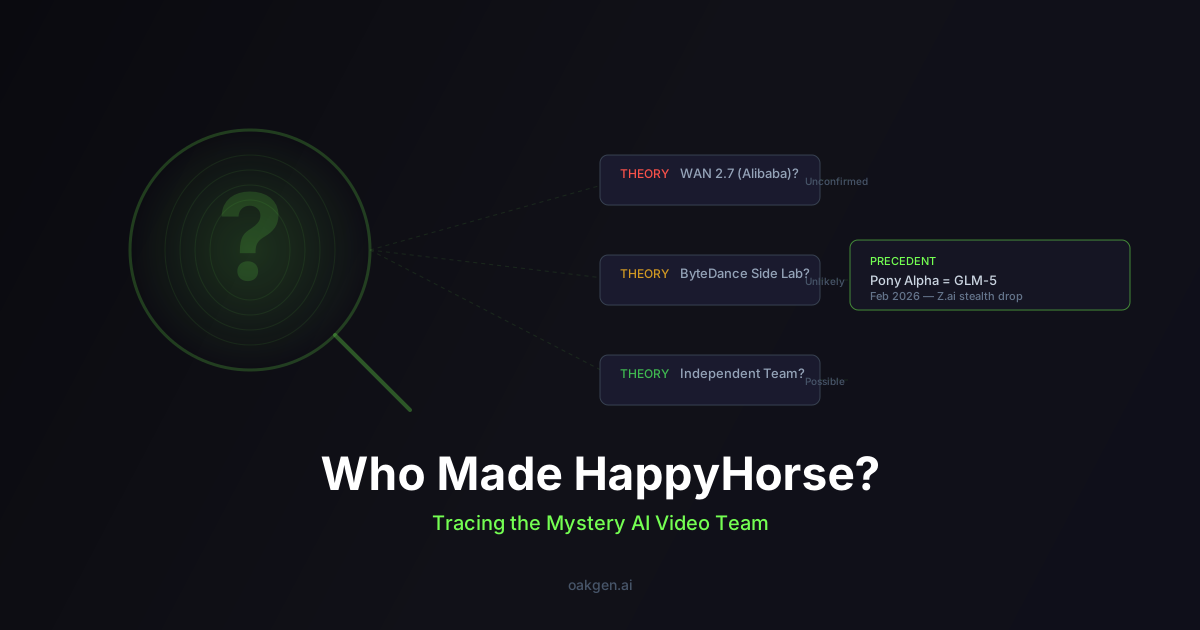
The WAN 2.7 Theory
The most persistent speculation connects HappyHorse-1.0 to Alibaba's WAN model family. Here's the argument and its limitations.
Evidence Supporting the Theory
Performance jump pattern: previous WAN generation sits on the Artificial Analysis leaderboard at Elo 1189 for T2V. A hypothetical WAN 2.7 with a major architecture revision could plausibly reach the 1333 range — that's a ~144-point jump, which is large but not without precedent across model generations.
Stealth drop pattern: Anonymous model drops before official launches have become a recognized strategy in the Chinese AI ecosystem. Labs test models under pseudonyms to gather independent quality data without the noise of brand expectations.
Multilingual capabilities: HappyHorse claims native support for Chinese, English, Japanese, Korean, German, and French. The CJK language emphasis is consistent with a team operating in the Chinese AI ecosystem, where multilingual CJK support is a natural priority.
Infrastructure hints: Some community members noted similarities between the demo's serving infrastructure and patterns seen in other Alibaba-affiliated projects. This is weak evidence — infrastructure choices don't identify builders.
Evidence Against the Theory
Architecture mismatch: The publicly known WAN architecture uses a different approach than what HappyHorse describes. previous WAN generation uses a dual-stream design. HappyHorse claims a single unified self-attention Transformer. These are architecturally distinct — unless Alibaba made a complete design departure for 2.7, which is possible but would represent a major pivot.
Naming convention break: Alibaba has consistently used the "WAN" brand across all their video model releases. Launching under a completely different name would break years of brand equity and the continuity that helps researchers track progress across versions.
No insider confirmation: In previous anonymous drops (like the Pony Alpha / GLM-5 situation), insider leaks or API fingerprinting eventually confirmed the connection. As of mid-April 2026, no such confirmation has emerged for HappyHorse.
Timeline: If this were WAN 2.7, Alibaba would typically have a coordinated release plan. The extended "coming soon" status for weights and code doesn't match Alibaba's usual pace — their WAN releases have historically moved quickly from announcement to availability.
Verdict on the WAN Theory
Plausible but unconfirmed. The pattern match is there. The direct evidence is not.
The Pony Alpha Precedent
To understand why the WAN 2.7 theory has traction, you need to know the Pony Alpha story.
In February 2026, a model called "Pony Alpha" appeared on OpenRouter with no team identification. It quickly climbed language model leaderboards with impressive benchmark scores. The AI community spent roughly two weeks speculating about its origin.
It turned out to be Z.ai's GLM-5, running a stealth stress test before official launch. The team wanted unbiased quality feedback and load testing without the expectations that come with a known brand name.
The playbook: submit anonymously, gather data, reveal identity once the results validate the model.
This precedent is why every mystery model now triggers a guessing game. The strategy worked for Z.ai — they got clean benchmark data and a PR boost from the reveal. Other labs noticed.
Other Theories Worth Noting
Independent Research Team
Not every top model comes from a major lab. Reve Image 1.0 reached #1 on the Artificial Analysis Image Arena and came from a small Palo Alto startup. The video generation space could have a similar emergence — a small, well-funded team with strong researchers who prefer to let the work speak before the brand.
ByteDance Side Project
Some speculation has pointed toward ByteDance — but this conflicts with the fact that ByteDance's Dreamina team already has Seedance 2.0, which competes directly with HappyHorse. Running two competing entries in the same arena under different brands would be unusual, though not impossible in a large organization.
Academic Lab Stealth Release
University-affiliated AI labs occasionally publish competitive models without commercial backing. A well-resourced academic group could produce a top-tier model, especially if they secured significant compute through grants or partnerships. The lack of a company entity would explain the pseudonymous submission.
What the Domain Registration Reveals
I checked the WHOIS records for both associated domains. Both use privacy protection services — no registrant name, organization, or contact information is exposed. The registration dates are recent (March 2026), consistent with a pre-launch setup rather than a long-running project.
Domain registration with privacy protection is standard practice and reveals nothing about identity. But the absence of any public information is itself a data point — whoever built HappyHorse-1.0 has deliberately chosen not to be identifiable.
What Would Confirm the Builder's Identity
Three scenarios would settle this:
-
Weight release: Once weights are public, researchers can analyze the architecture, check for training artifacts, and compare against known model families. If HappyHorse shares significant architectural DNA with WAN models, that would strongly suggest an Alibaba connection. If the architecture is genuinely novel, it points to an independent team.
-
API launch: A commercial API requires a legal entity for billing, terms of service, and data processing. The company behind the API would become publicly identifiable.
-
Direct announcement: The simplest resolution — someone holds a press conference or publishes a blog post. If this follows the Pony Alpha playbook, the reveal would come once the team is satisfied with the arena validation.
Why Anonymous Drops Are Becoming More Common
HappyHorse isn't an anomaly — it's a trend. Anonymous or pseudonymous model submissions have increased across multiple AI leaderboards in 2026. The reasons are straightforward:
- Bias-free evaluation: Known brands carry expectations. A model from Google gets scrutinized differently than a model from an unknown team. Anonymous submission removes that variable.
- Competitive intelligence: Revealing a model publicly before launch gives competitors time to respond. Anonymous testing buys time.
- Stress testing: Running a model under real-world conditions without managing public expectations about availability or performance.
- Regulatory navigation: Some jurisdictions have emerging AI disclosure requirements. Anonymous testing might operate in a regulatory gray zone before official launch.
This trend means we'll see more HappyHorse-style appearances in the future. Getting comfortable with evaluating models on their outputs rather than their pedigree is a skill worth developing.
FAQ
Who made HappyHorse-1.0?
Unknown as of April 2026. Artificial Analysis describes the submission as "pseudonymous." No organization or individual has publicly claimed the model.
Is HappyHorse-1.0 made by Alibaba?
Unconfirmed. The WAN 2.7 speculation exists because anonymous pre-launch drops are common in the Chinese AI ecosystem, but no direct evidence connects HappyHorse to Alibaba. Architecture descriptions don't obviously match known WAN designs.
What was Pony Alpha?
A model that appeared anonymously on OpenRouter in February 2026. It turned out to be Z.ai's GLM-5 running a stealth stress test. This precedent is why HappyHorse has triggered similar speculation.
Does it matter who made HappyHorse-1.0?
For quality evaluation: no. The Elo scores come from blind comparisons and don't depend on team identity. For practical use: yes. Team identity affects trust, licensing expectations, support availability, and long-term viability.
When will we know who made HappyHorse-1.0?
Likely when weights are released (architecture analysis would reveal connections to known model families) or when an API launches (requiring a legal entity). Following the Pony Alpha timeline, reveals typically happen within 2-4 weeks of the anonymous debut.
We'll Break the News When the Team Reveals Itself
Our daily AI newsletter covers every major model drop and team reveal. When HappyHorse's builder goes public, you'll hear about it the same morning.