The average person scrolls through 300 feet of social media content per day. That is roughly the height of the Statue of Liberty. In that torrent of images, videos, and text, your ad gets approximately 1.7 seconds of attention before the thumb decides to keep scrolling or stop. Meta's own research puts the window even shorter for younger demographics -- Gen Z users make the stop-or-scroll decision in under 1.3 seconds.
This is the 3-second rule of social media advertising: if your visual does not arrest attention within the first 3 seconds of entering the viewport, it functionally does not exist. It does not matter how good your offer is, how compelling your copy is, or how much you spent on targeting. If the thumb does not stop, nothing else matters.
The good news is that thumb-stopping visuals are not random. They follow predictable patterns rooted in neuroscience and visual perception research. This guide breaks down exactly what makes a visual stop the scroll, provides data-backed frameworks for creating attention-capturing content, and shows you how to use AI to produce and test thumb-stopping visuals at the speed social media demands.
The Attention Economy: Why 3 Seconds Is All You Get
The human attention system evolved to prioritize novel, high-contrast, and potentially threatening stimuli. In a social media feed, your content competes against every other post for the same limited attentional resource. Understanding how the brain allocates attention is the first step to winning the competition.
Pre-Attentive Processing
Before conscious awareness kicks in, the brain's visual system performs what neuroscientists call pre-attentive processing. In 100-250 milliseconds -- less than a quarter of a second -- the brain scans for four specific features: color, orientation, size, and motion. Anything that differs sharply from its surroundings on any of these dimensions triggers an involuntary attention shift.
This is why a bright red image in a feed of muted pastels stops the scroll. It is not a conscious decision. The brain's visual system flags the anomaly and redirects attention before the viewer even realizes they have stopped scrolling.
The Dwell Time Cascade
Once the thumb stops, attention follows a cascade:
- 0-0.5 seconds: Pre-attentive features register (color, contrast, motion)
- 0.5-1.5 seconds: The brain identifies the subject (face, product, scene)
- 1.5-3 seconds: The viewer decides whether to engage or resume scrolling
- 3-7 seconds: If still engaged, the viewer processes text, details, and meaning
- 7+ seconds: Deep engagement -- the viewer is likely to interact (like, comment, click)
Your creative must win at each stage of this cascade. Fail at any stage and you lose the viewer permanently. There is no second chance in a social feed.
- TikTok: 0.8-1.3 seconds to stop the scroll. Motion and audio are critical. Static images underperform by 73% compared to video.
- Instagram Feed: 1.3-1.7 seconds. High-contrast visuals and faces perform best. Carousel posts get 3x more engagement than single images.
- Facebook Feed: 1.5-2.1 seconds. Slightly longer window due to older demographic. Text overlays perform better here than on other platforms.
- LinkedIn Feed: 2.0-3.0 seconds. Professional audience scrolls more deliberately. Data visualizations and charts stop scrolls effectively.
- X (Twitter): 1.0-1.5 seconds. Images with bold text overlays outperform standalone images by 41%.
The 7 Visual Triggers That Stop the Scroll
Research in visual attention and advertising effectiveness has identified specific visual elements that consistently trigger the brain's involuntary attention response. These are not subjective design preferences. They are neurological triggers.
1. Human Faces (Especially Eyes)
The fusiform face area (FFA) in the brain is a dedicated neural module for face detection. It operates faster than almost any other visual processing pathway. A face in your ad triggers automatic attention allocation that no landscape, product shot, or abstract design can match.
The data backs this up. Ads featuring human faces generate 38% higher engagement on Instagram and 27% higher click-through rates on Facebook compared to ads without faces. Eye contact multiplies the effect -- faces looking directly at the camera create a sense of personal connection that stops scrollers mid-swipe.
Use the Image Generator to create diverse, high-quality face-forward visuals tailored to your target demographic. Generate variations with different expressions, angles, and demographics to test which face resonates most with your audience.
2. High Color Contrast
The brain's pre-attentive processing system is essentially a contrast detector. Elements that differ sharply from their surroundings in color, brightness, or saturation are flagged for attention before conscious processing begins.
In a social feed dominated by similar-toned content, a high-contrast visual is an anomaly that the brain cannot ignore. The most effective approach is not to make everything bold -- it is to create a strong contrast ratio between the focal point and the background.
Practical application: dark subject on bright background, or bright subject on dark background. Avoid middle-gray, middle-saturation visuals that blend into the feed.
3. Pattern Interruption
The brain becomes habituated to repeated patterns. When every post in a feed looks roughly similar -- same aspect ratio, same color range, same layout -- the brain enters autopilot mode and scrolling speed increases.
Pattern interruption breaks this autopilot. Anything visually unexpected forces the brain to re-engage: an unusual aspect ratio, an asymmetric layout, an unexpected color combination, or a visual that seems out of place in the platform's aesthetic.
The uglier your ad, the better it performs is an exaggeration, but it captures a real insight. Ads that look too polished, too "designed," blend into the feed. Ads with a raw, slightly imperfect, almost accidental quality interrupt the pattern and stop the scroll.
4. Motion and Implied Motion
The human visual system is hard-wired to detect motion. In evolutionary terms, movement could signal a predator or prey, making it critical for survival. This ancient wiring means that any movement in a social feed -- even a subtle animation -- triggers automatic attention.
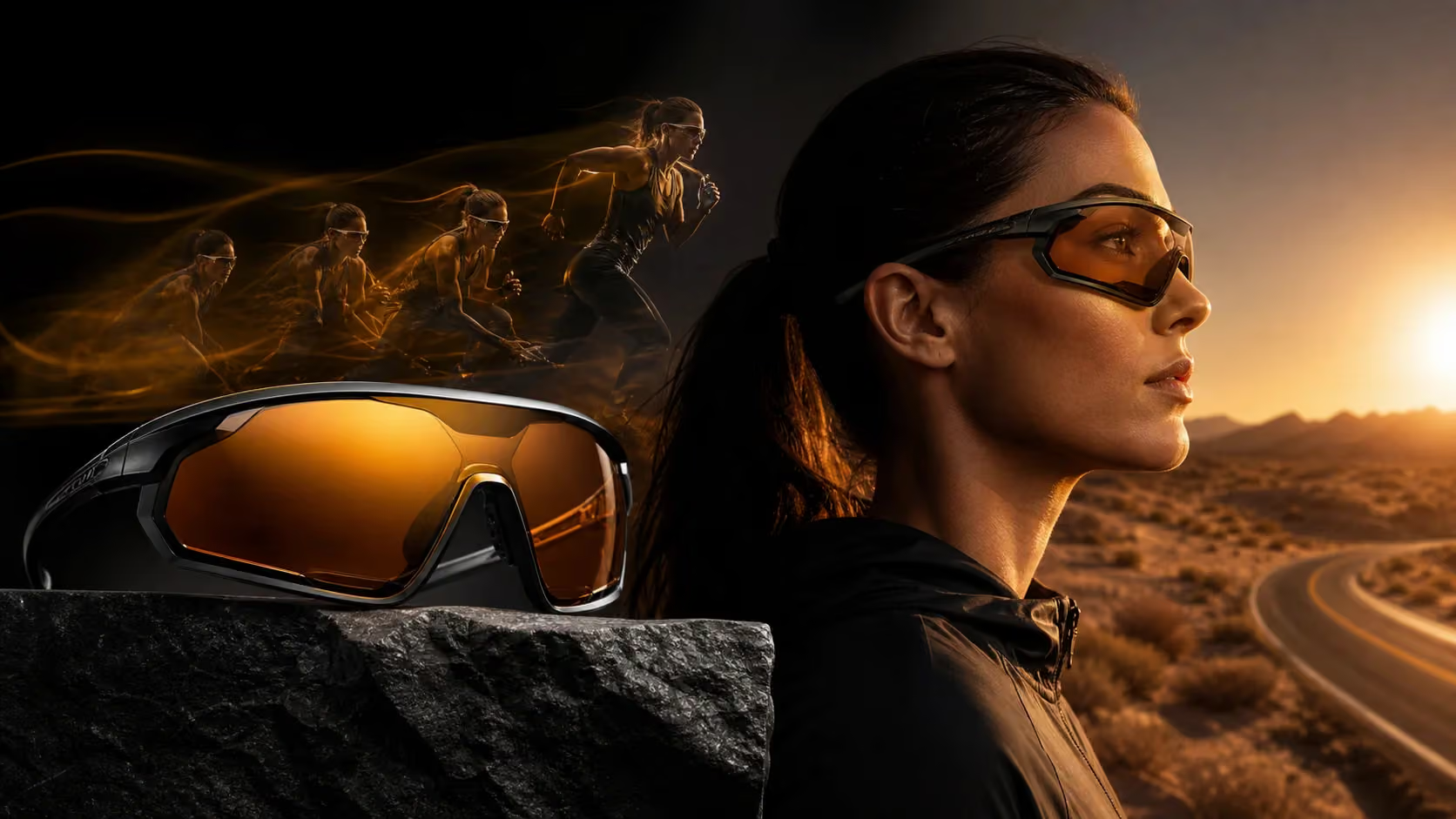
For static posts, you can exploit this by using implied motion: diagonal lines, blur effects, action poses, and compositions that suggest movement. These activate the brain's motion-detection pathways even in a still image.
For video ads, the first frame is everything. The Video Generator lets you create short video clips with immediate motion from frame one. No logo animations, no slow fades. Start with movement.
5. Text-Image Tension
A provocative text overlay on an unexpected image creates cognitive tension that the brain needs to resolve. This tension keeps the viewer engaged past the initial scroll-stop moment and into the deeper engagement phase.
The key word is tension, not harmony. Text that simply describes the image ("Beautiful sunset") adds nothing. Text that creates a question or contradiction ("This sunset cost $47M") forces the brain to keep looking to resolve the mismatch.
6. Scale Anomaly
Objects shown at unexpected scales trigger attention. An extreme close-up of a texture, an impossibly large product dominating a landscape, or a tiny figure in a vast space all create visual anomalies that the brain flags for closer inspection.
AI image generators excel at scale anomalies because they are not constrained by physical reality. Use the Image Generator to create surreal, attention-grabbing scale compositions that would be impossible or prohibitively expensive to photograph.
7. Negative Space
In a feed packed with busy, detailed visuals, an image with generous negative space is itself a pattern interruption. The brain expects complexity and encounters simplicity, which forces a pause.
Apple has mastered this principle. Their ads feature a product floating in empty space, and they consistently outperform visually busy competitors. The product becomes the only thing to look at, which means it gets 100% of the viewer's attention.
| Visual Trigger | Avg. Scroll-Stop Increase | Best Platform |
|---|---|---|
| Human face (eye contact) | +38% | Instagram, Facebook |
| High color contrast | +29% | All platforms |
| Pattern interruption | +43% | TikTok, Instagram Reels |
| Motion (first 0.5s) | +67% | TikTok, Reels, Shorts |
| Text-image tension | +34% | X, LinkedIn, Facebook |
| Scale anomaly | +31% | Instagram, Pinterest |
| Negative space | +22% | LinkedIn, Instagram |
The First-Frame Framework
For video ads, the first frame is the only frame that matters for scroll-stopping. If your video starts with a logo, a fade-in, or a slow pan, you have already lost. The viewer will never see frame two.
Here is a framework for engineering first frames that stop scrolls:
The Hook Frame Formula
Element 1: Visual anchor. A face, a product, or a bold graphic that fills at least 40% of the frame. Small, distant subjects fail because they do not register in pre-attentive processing.
Element 2: Color pop. At least one element in the frame must be a highly saturated color that contrasts with the platform's background (dark mode and light mode both). Test your first frame against both backgrounds.
Element 3: Immediate motion. Something must be moving from frame one. A hand gesture, a product being revealed, a text animation. The motion does not need to be dramatic -- even subtle movement triggers the brain's motion-detection system.
Element 4: Information gap. The first frame should contain just enough information to create curiosity but not enough to satisfy it. A partial product reveal, a provocative question, or an unexpected situation all create an information gap that pulls the viewer into the next few seconds.
85% of Facebook videos and 70% of Instagram feed videos are watched without sound initially. Your first frame must work in complete silence. If your scroll-stopping strategy relies on audio (a shout, music, a sound effect), you are ignoring the majority of your potential audience. Design every first frame as if it will be viewed on mute. Add captions or bold text overlays to compensate. The Video Generator creates visually compelling video content that grabs attention even with the sound off.
Platform-Specific Scroll-Stopping Strategies
Each platform has a different visual environment, which means different strategies for breaking through.
Instagram and Reels: Bold, saturated colors and faces with direct eye contact perform best. Carousel posts where the first slide creates curiosity outperform singles by 3x. Use the UGC Ads tool to create authentic-feeling content native to the feed.
TikTok and YouTube Shorts: Immediate action in the first frame is non-negotiable. Text hooks, faces close to camera, and bright high-contrast lighting work. Slow introductions and anything that looks corporate will be swiped away instantly.
LinkedIn: Data visualizations, bold statistics as text overlays, and before/after comparisons stop the professional scroll. Lifestyle imagery feels out of place here.
Facebook: Conversation-provoking visuals that invite comments and shares win the algorithm. UGC-style content and before/after transformations outperform polished corporate creative.
Building a Thumb-Stopping Visual Testing System
The difference between brands that consistently produce scroll-stopping content and those that struggle is not creative talent. It is testing volume. The more visual variants you test, the faster you learn what resonates with your specific audience.
The 10x Testing Framework
Traditional creative production limits most brands to testing 2-3 visual variants per campaign. AI tools enable 20-30 variants per campaign at the same cost. Here is how to structure that volume:
Wave 1: Broad hypothesis testing (10 variants) Generate 10 fundamentally different visual approaches for the same message. Different styles, different compositions, different color palettes, different subjects. Run each with minimal budget to identify the top 2-3 performers.
Wave 2: Winner iteration (10 variants) Take your top 3 performers from Wave 1 and generate 3-4 variations of each. Adjust one variable at a time: color temperature, facial expression, text placement, background complexity.
Wave 3: Optimization (5-10 variants) Fine-tune the top performer from Wave 2. Test subtle variations: slightly different crop, adjusted brightness, alternative text color, different face angle.
This three-wave process, powered by AI-generated visuals from the Image Generator, takes 2-3 weeks and produces a scroll-stopping visual that has been validated against 20-30 alternatives. Traditional production could not accomplish Wave 1 in the same time frame.
| Testing Approach | Traditional Creative | AI-Powered (Oakgen) |
|---|---|---|
| Variants per wave | 2-3 | 10-30 |
| Cost per variant | $50-200 | $0.05-0.30 |
| Time per wave | 5-10 days | 1-2 hours |
| Total testing budget | $500-2,000 | $5-20 |
| Iterations before winner | 1-2 waves | 3 waves (30+ variants) |
| Statistical confidence | Low (small sample) | High (large variant pool) |
AI-Powered Visual Hook Generation
The fastest way to produce thumb-stopping social media visuals in 2025 is to combine AI image and video generation with the psychological triggers outlined above. Here is a practical workflow.
For Static Posts and Ads
-
Define your trigger combination. Choose 2-3 of the 7 visual triggers that fit your brand and message. For example: face + high contrast + text-image tension.
-
Write trigger-specific prompts. Use the Image Generator with prompts that explicitly encode your chosen triggers. Instead of "product photo of our shoes," write "extreme close-up portrait of a woman's face lit with dramatic split lighting, half red half blue, looking directly at camera, wearing athletic headband, bold minimalist composition, magazine ad style."
-
Generate 10 variations. Produce 10 images with the same trigger combination but different executions. Vary the subject, the color scheme, the angle, and the composition while keeping the core triggers consistent.
-
Screen with the 2-second test. Open each image as a thumbnail on your phone. Whichever ones your eye gravitates to first pass the test. If you have to look for the good ones, they failed.
-
Publish the top 3. Run them simultaneously with identical copy and targeting. Let the data choose the winner.
For Video Ads
-
Storyboard the first 3 seconds. This is 90% of the creative work for a scroll-stopping video. Use the first-frame framework above.
-
Generate the hook clip. Use the Video Generator to create a 3-5 second opening clip that embodies your chosen visual triggers. Focus entirely on those first seconds -- the rest of the video can be simpler.
-
Add voice and music. Layer in a voiceover with the Voice Generator and background music from the AI Music Generator to create a complete sensory experience. Remember to design for sound-off viewing first, then add audio as a bonus layer.
-
Test multiple hooks, same body. Generate 5 different opening clips and attach each to the same video body and CTA. This isolates the hook as the only variable and gives you clean data on which visual approach stops the scroll most effectively.
Track these metrics to measure scroll-stopping effectiveness: Thumb-stop rate (% of viewers who watched at least 3 seconds), Hook rate (% who watched past 3 seconds out of those who stopped), and Hold rate (% who watched 50%+ of the video). A strong scroll-stopping visual should produce a thumb-stop rate above 30%, a hook rate above 50%, and a hold rate above 25%. If your thumb-stop rate is high but your hook rate is low, your visual stops attention but your opening message fails to sustain it.
Frequently Asked Questions
What is the 3-second rule in social media marketing?
The 3-second rule states that a social media ad or post has approximately 3 seconds (often less) to capture a viewer's attention before they scroll past. Research from Meta shows the actual decision window is 1.3-2.1 seconds depending on the platform and demographic. Your visual must trigger an involuntary attention response within this window through contrast, faces, motion, or pattern interruption.
What makes a social media visual "thumb-stopping"?
A thumb-stopping visual exploits the brain's pre-attentive processing system by featuring high color contrast, human faces (especially with eye contact), unexpected scale or composition, immediate motion (for video), or pattern interruption that breaks from the surrounding feed's visual rhythm. The most effective visuals combine 2-3 of these triggers simultaneously.
How many visual variants should I test for social media ads?
Aim for 10-30 variants across three testing waves. Start with 10 fundamentally different approaches, identify the top 3, iterate on those with 10 more variants, then fine-tune the winner with 5-10 subtle variations. AI image generation tools make this volume feasible at minimal cost -- what would cost $2,000+ in designer time costs under $20 with the Image Generator.
Does video always outperform static images on social media?
Video generates 67% higher scroll-stop rates than static images on TikTok and Instagram Reels, but the gap narrows on feed-based placements. On LinkedIn, high-quality static images with data overlays can outperform video. On Pinterest, static images still dominate. The right format depends on the platform, but video is the overall winner for attention capture across most social platforms.
How do I create thumb-stopping content without a design background?
AI creative tools eliminate the need for design skills. The Image Generator produces professional-quality visuals from text descriptions. The Video Generator creates motion content from prompts or reference images. Focus on learning the psychological triggers that stop scrolls (faces, contrast, pattern interruption, motion) and encode those triggers into your AI prompts. The AI handles the execution -- you handle the strategy.
Create Scroll-Stopping Visuals in Seconds
Generate dozens of thumb-stopping ad visuals and video hooks with Oakgen's AI creative tools. Test more, learn faster, convert higher.