Oakgen AI Chat offers Oakgen Auto, Oakgen Max, and Oakgen Pro Max. The external models compared in this article are not available as named choices in that selector.
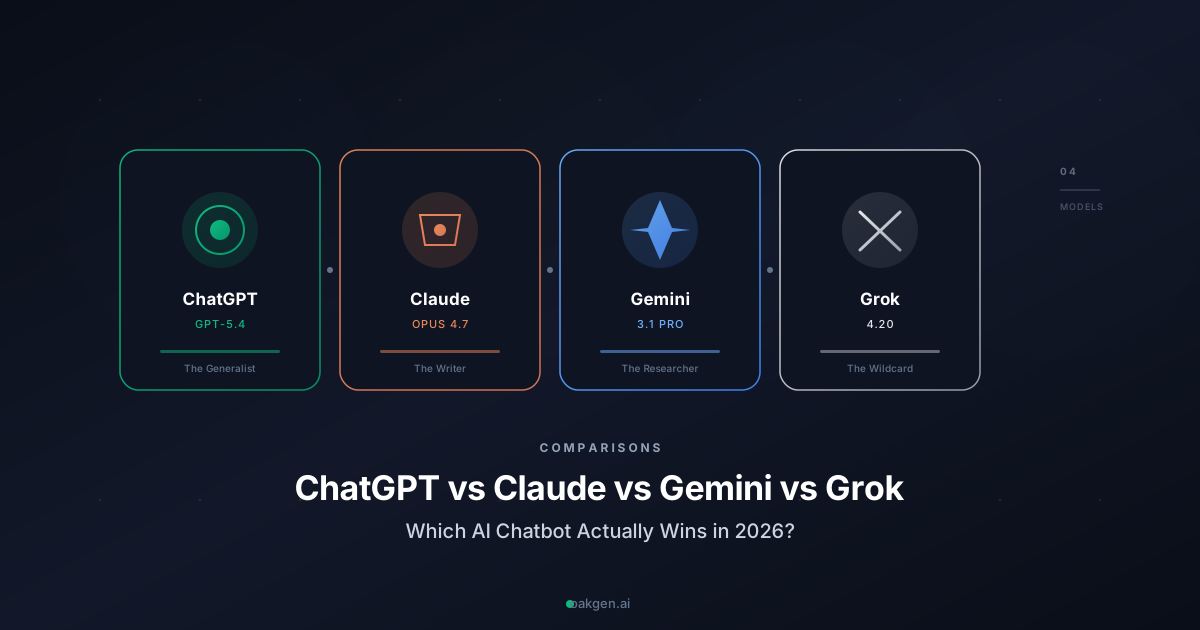
Four chatbots have pulled ahead of the pack in 2026: ChatGPT (now running on GPT-5.4), Claude (Opus 4.7 and Sonnet 4.6), Gemini (3.1 Pro), and Grok (4.20). Each has millions of daily users who swear it is the only one worth paying for. Each has a comfortable lead in at least one category. And the honest answer to "which is best?" is that it depends on what you are doing in the next five minutes.
This comparison is built from real-world use: what these models feel like when you actually work with them, not what they score on a benchmark. By the end you will know which chatbot to reach for when you need to ship an email at 8:58am, outline a 40-page document at midnight, or figure out whether your landlord is bluffing about the lease clause.
You do not have to. If this comparison convinces you that you need two of these models, price that against one workspace: Oakgen AI Chat is an alternative to all four that runs on Oakgen Auto, Max and Pro Max, with image, video and audio tools on the same credit balance.
The Four Contenders at a Glance
Here is the short version, for readers who just want a recommendation before they click away.
| Chatbot | Best For | Where It Loses | Context Window |
|---|---|---|---|
| ChatGPT (GPT-5.4) | General assistant, image understanding, tool use, voice | Long-document nuance, creative writing voice | 1M tokens |
| Claude (Opus 4.7) | Writing, reasoning, coding, long documents, careful judgment | Pricing, multimodal parity with GPT | 1M tokens |
| Gemini (3.1 Pro) | Research with fresh info, Google Docs/Gmail users, massive context | Personality, "feels corporate" at times | 1M tokens |
| Grok (4.5) | Coding, agentic tasks, X-aware research, cost-efficient frontier testing | Less proven than GPT/Claude for broad daily workflows | 500K tokens |
Now the long version.
ChatGPT (GPT-5.4): The Default Choice
GPT-5.4, released in early 2026, is what most people think of when they hear "AI chatbot." It is the safest recommendation for a first-time user and still the one that ships the most polished product: voice mode, image editing inside the chat, file uploads that actually work, tool use with live browsing, and a mobile app that feels like it was designed by people who use phones.
Where GPT-5.4 Is Genuinely Ahead
- Multimodal handling. You can drop in a screenshot of a spreadsheet, a photo of a handwritten note, a PDF, and a voice memo into the same conversation and GPT-5.4 will reason across all of them without losing the thread. No other model is quite this fluent across modalities yet.
- Tool use reliability. When you ask it to browse the web, write and run code, or generate an image, it picks the right tool and follows through without needing to be coached.
- The app. OpenAI's polish on the mobile and desktop apps is still a step ahead. Voice-to-voice latency feels closer to a phone call than any competitor.
Where GPT-5.4 Falls Short
- Long-document writing has a flat voice. When asked to write a 3,000-word essay, GPT-5.4 produces clean prose that all sounds slightly the same. Claude is a better stylist.
- Reasoning on hard problems. For truly difficult coding, legal, or logic tasks, GPT-5.4 is excellent but Claude Opus 4.7 still has a slight edge on "think carefully before answering" problems.
- Price. ChatGPT Plus is $20/month and Pro is $200/month. Both are reasonable, but you are paying for access to one company's models.
Use GPT-5.4 when: you want the general-purpose chatbot that works well for most tasks, you care about voice or image uploads, or you are new to AI and want the least friction.
Claude (Opus 4.7): The Writer's and Reasoner's Choice
Claude is the chatbot that power users quietly swear by. It does not have the biggest marketing budget or the voice mode with the most natural cadence, but if you actually write for a living, code for a living, or do work where being right matters more than responding instantly, Claude is often the better tool.
Where Claude Opus 4.7 Is Genuinely Ahead
- Writing voice. Claude writes prose that sounds like a person, not a chatbot. Give it the same essay brief as GPT-5.4 and Gemini and Claude's version will have more rhythm, cleaner transitions, and a point of view. This is not subjective — professional writers consistently prefer it in blind tests.
- Nuanced reasoning. On problems that require weighing multiple factors, spotting what is missing, or pushing back on the user's assumptions, Claude is the most reliable. It will tell you your idea has a flaw before it helps you build it.
- Long-context recall. Claude Opus 4.7 supports a 1M-token context window and, unlike some competitors, it actually uses the full context. Drop in a 200-page legal document and ask a question about page 147 — Claude will find it.
- Coding. For refactoring, architecture decisions, and code review, Claude Opus 4.7 is the developer favorite. It is less likely to hallucinate APIs and more likely to flag bugs before running the code.
Where Claude Opus 4.7 Falls Short
- Multimodal parity. Claude handles images and PDFs well, but it does not yet have native image generation, native audio, or tool use as seamless as GPT's.
- Pricing for heavy use. Opus 4.7 is expensive per token. If you are a power user, the Pro plan ($20/month with limits) can feel tight.
- Personality. Claude can feel a little cautious, sometimes to the point of hedging when a direct answer would be more useful.
Use Claude Opus 4.7 when: the output matters more than the speed. Writing, editing, long documents, careful coding, negotiating high-stakes language.
Gemini (3.1 Pro): The Google-Native Choice
Gemini 3.1 Pro is the smartest Gemini has ever been, and for the first time the "it's a Google product" argument actually helps. If you live in Google Docs, Gmail, Drive, and Calendar, Gemini 3.1 is the chatbot with the deepest integration into the tools you already use — and the freshest real-world information, because it is hooked directly into Google Search.
Where Gemini 3.1 Is Genuinely Ahead
- Fresh information. Ask "who won the Champions League last night?" or "what is the current exchange rate between USD and JPY?" and Gemini will pull the answer from live search. ChatGPT and Claude can browse, but Gemini's integration is faster and cites better.
- Google Workspace. Gemini can read your Gmail, summarize a long email thread, draft replies in your voice, pull data from a Google Sheet, and schedule events directly. If you are a Workspace user this is a real productivity multiplier.
- Massive native context. 1M tokens natively, with strong recall. Gemini can ingest hundreds of pages of PDFs without breaking.
- Price-to-performance on the Flash tier. Gemini 2.5 Flash and 3.1 Flash Lite are extremely cheap to run, which matters if you are doing high-volume tasks.
Where Gemini 3.1 Falls Short
- Personality. Gemini is the most "corporate feeling" of the four. It is helpful and accurate, but it does not have the warmth of ChatGPT or the voice of Claude.
- Creative writing. Its prose is fine but workmanlike. Not the one you reach for if you want your piece to sing.
- Occasional refusal drift. It still sometimes refuses reasonable requests that the other three answer without comment.
Use Gemini 3.1 when: you need up-to-the-minute information, you work in Google Workspace, or you need to process enormous documents on a budget.
Grok (4.5): The Engineering Wildcard
Grok 4.5 is the newest of the four and the most aggressive on the coding-and-agents story. Built by xAI, it is positioned for software engineering, agentic tasks, knowledge work, and X-aware research. If Grok 4.20 was the personality-heavy wildcard, Grok 4.5 is the work-model version.
Where Grok 4.5 Is Genuinely Ahead
- Real-time X data. Ask "what is trending on X right now?" or "what did Sam Altman say today?" and Grok will pull directly from X. For anyone tracking news, culture, or sentiment, this is a real edge.
- Humor and personality. Grok has a voice — irreverent, a little bratty, willing to make jokes. If you find the other chatbots too sanitized, Grok feels more like a human.
- Willingness to answer. Grok refuses fewer questions than its competitors. This cuts both ways: more useful for edgy research, more risky if you want reliable guardrails.
- API price. xAI lists Grok 4.5 at $2 input and $6 output per million tokens, which makes it attractive for high-volume developer testing.
Where Grok 4.5 Falls Short
- Consistency. Grok's output quality varies more than the others. Sometimes it is sharp, sometimes it phones it in.
- Ecosystem. No serious mobile app polish, no image generation worth using, no voice mode. It is a chat interface first and not much else.
- Broad assistant polish. GPT and Claude still feel more mature for everyday writing, multimodal workflows, and careful final review.
Use Grok 4.5 when: you want to test coding, agentic workflows, technical research, or cost-sensitive frontier-model prompts. Explore Grok.
Head-to-Head: Five Tasks, Four Models
Abstract comparisons only go so far. Here is how the four models actually compare on specific tasks that normal people do every day.
Task 1: Write a Difficult Email
You need to push back on a client without burning the relationship. Who writes the best draft?
- Claude Opus 4.7 — Best. Tone-aware, finds the right "firm but kind" register on the first try.
- ChatGPT (GPT-5.4) — Good. Slightly more generic but usable.
- Gemini 3.1 — Fine. Feels like a template.
- Grok 4.5 — Better for technical rewrite tasks than delicate relationship tone.
Task 2: Summarize a 60-Page PDF
You have to read a long report by morning. Which model gives the best summary?
- Claude Opus 4.7 — Best. Actually retrieves specific facts from deep in the document.
- Gemini 3.1 Pro — Very close second. Strong recall, sometimes better citations.
- ChatGPT (GPT-5.4) — Good general summary, occasionally misses deep details.
- Grok 4.5 — Strong for technical documents, less proven for general long-form synthesis.
Task 3: Debug a Chunk of Code
Your app is throwing an error you cannot decipher.
- Claude Opus 4.7 — Best for architectural bugs and nuanced refactoring.
- ChatGPT (GPT-5.4 + Codex) — Best for iterative "try this, now try that" debugging with tool use.
- Gemini 3.1 Pro — Solid, especially for anything involving Google Cloud.
- Grok 4.5 — Strong contender, especially for cost-sensitive coding tests.
Task 4: Research a Current Event
The news broke two hours ago and you need to understand it.
- Gemini 3.1 Pro — Best. Live Google Search integration, good citations.
- Grok 4.5 — Best for X-aware social sentiment and technical context.
- ChatGPT (GPT-5.4) — Good with browsing, slightly slower.
- Claude Opus 4.7 — Weakest here unless given web search tools.
Task 5: Plan a Trip
You need a seven-day Japan itinerary that accounts for jet lag and budget.
- ChatGPT (GPT-5.4) — Best. Balanced, actionable, good pacing.
- Gemini 3.1 Pro — Close second, strong on maps and current info.
- Claude Opus 4.7 — Thoughtful but more prose than schedule.
- Grok 4.5 — Useful for research-heavy planning, less polished than ChatGPT for itinerary shape.
Pricing Compared
As of July 2026:
| Product | Free Tier | Pro Tier | Max Tier |
|---|---|---|---|
| ChatGPT | Limited GPT-5 Mini | $20/mo (Plus) | $200/mo (Pro) |
| Claude | Limited Sonnet 4.6 | $20/mo (Pro) | $100/mo (Max) |
| Gemini | Generous Flash | $20/mo (Advanced) | $200/mo (Ultra) |
| Grok | Limited free access | $30/mo (SuperGrok) | Enterprise/API usage |
The honest read: each of these costs between $20 and $40/month for serious use, and power users often pay for two. Over a year you are looking at $500 to $1,500 in subscriptions before you have rendered a single image or generated a video.
Open Oakgen AI Chat to research, draft, and plan with Oakgen Auto, Oakgen Max, and Oakgen Pro Max. Review the result before creating supporting assets.
So Which One Should You Pay For?
If you only want one subscription and the answer has to be absolute:
- Most people: ChatGPT Plus ($20/mo). It is the best generalist and the mobile app wins.
- Writers, coders, and anyone who cares about craft: Claude Pro ($20/mo).
- Researchers, analysts, Google Workspace users: Gemini Advanced ($20/mo).
- Power users and X-native people: X Premium+ to get Grok bundled with the rest of X.
If the answer does not have to be absolute — and it probably should not be — use a tool that aggregates all four. The truth of 2026 is that the four leading models each own a different corner of the task space. Using the same model for everything is like using a single kitchen knife for chopping, filleting, and bread.
The Case for Switching Models Mid-Task
One pattern that has quietly become best practice: use the cheapest fast model for the first draft, then pass the output to a more expensive careful model for the final pass. A cheap Gemini Flash draft polished by Claude Opus 4.7 is often better than an expensive Opus draft done alone — because the first model gets you out of a blank page and the second model has something concrete to react to.
This workflow only works when switching models is frictionless. If it means copy-pasting between four browser tabs and four separate paid accounts, most people will just stick with their one subscription. If it means clicking a dropdown in the same conversation, it changes how you work.
That is the quiet case for multi-model chat apps: the best model for a task is never the same across a full project, and most of the productivity gains are locked behind the friction of switching.
The Bottom Line
In 2026 there is no single best AI chatbot — there are four excellent ones and they are good at different things. ChatGPT is the default. Claude is the writer's and careful-thinker's pick. Gemini is the fresh-information and Workspace pick. Grok is the wildcard with real-time X data and personality.
Pick the one that matches the work you do most. Then find a way to reach the other three when you need them, because on any given week you will. Your writing will be better for it, your research will be sharper, and you will stop fighting a single model to do a task it was not meant for.