AI UGC Ads for Shopify: 30 Variants in an Hour
This playbook shows DTC operators how to ship 30 AI UGC ad variants for one Shopify product in a single 60-minute session. You paste a product URL, batch-generate hooks, render avatar reads, and export ad-library-ready 9:16 cuts. Average per-video cost lands near $5 versus roughly $247 for human UGC, per 2026 industry benchmarks.
AI UGC tools deliver finished ad videos at roughly $5 each in about 10 minutes, versus about $247 and a 7-10 day turnaround for traditional human UGC creators. That's a 98% cost reduction, per 2026 benchmarks reported by Cometly and Medium tool reviews.
The 2026 DTC ad reality is brutal. iOS attribution is still leaky, CAC keeps climbing, and Meta's algorithm punishes brands that ship the same three creatives all month. Buyers want creator-style hooks, not polished brand spots. You need volume, you need variety, and you need both before next Tuesday's ad-set refresh.
Why AI UGC Now Beats Hiring Creators on Fiverr
The case for AI UGC stopped being theoretical in late 2025. A reference fitness-supplement campaign cited in 2026 tool reviews paid $75 for 15 AI UGC variants and watched CPA drop 27.6% (from $58 to $42), with CTR jumping 57.5% (from 1.2% to 1.89%). The same brand priced human UGC at $741 for the equivalent volume.
The math holds across categories. UGC formats deliver about 400% higher click-through rates than polished brand content, and shoppers engaging with UGC convert at roughly 161% higher rates per the same 2026 benchmarks. AI doesn't make UGC work. UGC already works. AI just rips out the bottleneck that kept you shipping three videos a week instead of thirty.
The catch: AI UGC is mid by default. Generic avatars reading generic scripts in generic kitchens. The playbook below is the workflow that turns batch output into actual scroll-stoppers.
The 60-Minute Output Goal: 30 Ad-Library-Ready Variants
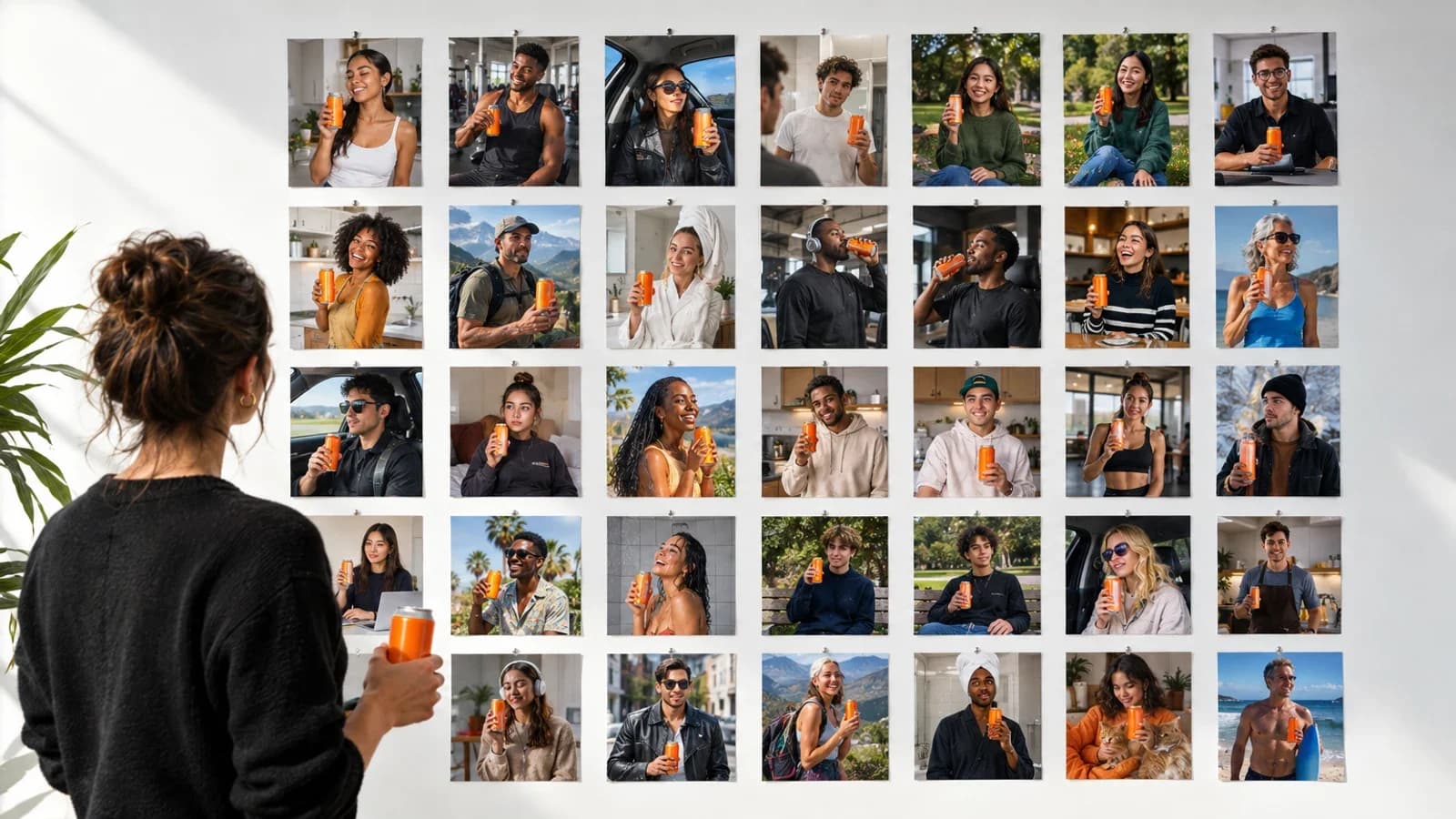
Thirty is the number because Meta's Advantage+ campaigns reward creative diversity. A 30-variant batch lets you test 5 hooks across 3 avatars across 2 endings without exhausting your daily ad spend on duplicates. At Oakgen credit pricing, a 30-clip batch with talking-avatar generation lands in the 9,000-15,000 credit range, well inside a single Pro or Ultimate monthly allocation (5,000 and 10,000 credits respectively).
For comparison, a human UGC studio quoting $247 per video charges $7,410 for the same 30 variants. The hourly economics get worse when you factor in brief writing, creator vetting, revision cycles, and shipping product samples. Most DTC operators top out at 8-12 human UGC videos per month per product. AI flips that ceiling into a floor.
The 60-minute clock breaks down roughly as: 8 minutes on product-page scrape and angle research, 12 minutes on hook batch generation, 25 minutes on avatar render queue, 10 minutes on B-roll cuts and captions, 5 minutes on export and ad-library upload. You'll feel the speed in the third batch, not the first.
Step-by-Step: Paste-URL to Render-Queue in One Hour
Here's the exact sequence. Run it on a single Shopify product the first time. Once you've shipped one batch, you can fork the workflow for every SKU in your catalog.
- Paste the product URL into a hook generator. Tools like Higgsfield Studio or Hermes Agent scrape the landing page, parse benefits and price points, and propose UGC formats (testimonial, unboxing, demo, problem-solution, trend hijack). MakeUGC and Creatify do the same for under $10 per finished video on $39-99/month plans.
- Pull 10 hooks per format. A hook is the first 1.5 seconds. "POV: I tried the [product] for 30 days" is one. "Why is no one talking about this?" is another. Don't write hooks yourself. Let the AI batch ten, then cut the bottom seven.
- Pick three avatars per hook. Different demographics, different rooms, different energy levels. Your buyer is not one person, and ad-library tests prove this in 48 hours.
- Generate voiceovers. Use a TTS model that handles emotional prosody. ElevenLabs v3 (available inside Oakgen via the voice generator) reads scripts with breath, pauses, and emphasis that match real creator delivery.
- Render avatar talking videos. Image-to-video with lip-sync, or talking-photo from a single avatar still. The AI talking photo tool takes one portrait plus a script and returns a 1080p clip in 3-5 minutes.
- Cut B-roll inserts. A 9-second shopping-cart shot, a 4-second "before" frame, a quick product close-up. Generate these with Oakgen's video generator using Seedance 2.0 or Kling v3 prompts.
- Stitch and caption. Burn captions in CapCut or any ad-editor. About 85% of Meta auto-played feed views run muted, so captions are non-negotiable.
- Export 9:16 master + 1:1 fallback. Upload masters to Meta Ad Library, TikTok Ads Manager, and Google Performance Max. Tag every variant with
hook-format-avatarso the dashboard tells you which combo wins.
Running all 30 variants on the same audience and same daily budget will not give you a fair test. You'll burn $400 in 48 hours and conclude "AI UGC doesn't work." Instead, ladder variants in groups of 5, kill bottom-quartile CTR after 1,000 impressions, and let winners scale. The variant volume is only valuable when you also use Meta's automated rules to retire losers fast.
AI UGC vs Human UGC: The 2026 Numbers
The cost gap is the headline, but the speed and volume gaps matter more for performance marketers running weekly creative refreshes.
| Metric | Human UGC Creator | AI UGC (2026) |
|---|---|---|
| Cost per finished video | ~$247 | ~$5 |
| Turnaround time | 7-10 days | ~10 minutes |
| Revisions included | 1-2 (extra fees apply) | Unlimited regenerations |
| Output ceiling per week | 3-5 videos | 50+ videos |
| Sample shipping required | Yes, adds 3-5 days | No, product image only |
| Demographic targeting | Limited to roster | Switch ethnicity, age, room in seconds |
| Reference campaign result | $741 for 15 videos | $75 for 15 videos, CPA -27.6% |
The "unlimited regenerations" row is the sleeper. With human UGC, every ask for a new hook, a different opening line, or a tighter cut is a negotiation. With AI, you regenerate the variant in 90 seconds and move on.
The 2026 Tool Stack: Higgsfield, MakeUGC, Creatify, Arcads
Most DTC operators pick one orchestrator and one generator. The orchestrator scrapes your product, writes scripts, and queues output. The generator renders avatars and voices. Sometimes one tool does both.
Higgsfield Studio + Hermes Agent. Hermes scans your product URL, picks a UGC format based on what's trending in the category, and "auto-generates a short script, tone, and structure," per the vo3ai 2026 walkthrough. Higgsfield handles the avatar render. Marketed at agencies running 50+ variants per launch.
MakeUGC. $39-99/month, sub-$10 per finished video. Strong avatar library, weaker on product-aware scripting. Pair with a separate hook tool for best output.
Creatify. $39-99/month, similar pricing to MakeUGC. Stronger templated workflows for Shopify product feeds. Good for catalog-style brands shipping 100+ SKUs.
Arcads. $49-199/month. Higher ceiling on avatar realism and emotional range, which matters when your category needs trust-style scripts (supplements, skincare, finance).
Oakgen. Build the same workflow with the AI video generator (Seedance 2.5, Kling O3 Pro, Kling v3) plus the talking photo tool plus the voice generator. One credit pool covers all three. Talking-avatar runs about 300-500 credits per minute ($1.20-$2/min) and TTS runs about 1 credit per 30 characters ($0.004), so a 30-second UGC ad with cloned voice lands near $0.80-$1.20 in raw generation cost.
The right pick depends on whether you want a closed pipeline (Higgsfield, MakeUGC) or a model-shopping approach where you swap in Seedance 2.5 for cinematic shots and Kling v3 for natural human motion. Operators who already split image and video tools across providers usually save 30-40% by consolidating on a multi-model platform like the Oakgen alternatives to HeyGen or the Synthesia alternatives roundup.
Hook Frameworks That Survive the Algorithm
Tools generate hooks. You still have to pick the ones that don't sound like AI wrote them.
The five hook patterns that test well in 2026 ad-library data:
- Pattern interrupt: "Wait. This is illegal in [country]?" Drops the viewer into a question they need answered.
- Time-bound POV: "Day 14 of using [product] and I have to tell you something." Implies real testing, builds curiosity in 2 seconds.
- Comparison anchor: "I tried the $300 version and the $30 version. Here's what nobody tells you." Pre-frames the product as the smart choice.
- Confession: "I was about to return this until I tried it on [specific use case]." Uses friction to build credibility.
- Trend hijack: "Everyone's doing [trending challenge]. I tried it with [product]." Borrows organic reach for paid placement.
Run each hook through three avatars. The same script reads completely differently from a 24-year-old in a college dorm versus a 45-year-old in a suburban kitchen. That demographic spread is the variable human UGC can't deliver without 12 separate creator contracts.
For deeper hook research, the 2026 video generator roundup breaks down which models handle dialogue best and which produce wooden delivery you can spot from across the room.
Quality Floors: Don't Ship Anything That Looks Generated
The fastest way to torch your CPA is to ship AI UGC that screams AI UGC. Three quality floors stop that:
Lighting variation. Generic AI avatars get rendered in flat studio light. Real creators shoot in messy bedroom light, kitchen overhead, or harsh window glare. Prompt for "warm afternoon window light" or "fluorescent bathroom mirror" instead of accepting defaults.
Background motion. Static AI avatars in static rooms read as fake within 0.5 seconds. Add prompted motion: a roommate walking past, a dog on the couch, steam from a coffee mug. Text-to-video with models like Seedance 2.0 handles ambient motion better than most dedicated avatar tools.
Voice authenticity. Default TTS voices read like default TTS voices. Clone a real voice (yours, a friend's with consent, or a stock-licensed sample) and you cross into "could be real" territory. ElevenLabs v3 inside Oakgen captures pauses, breath, and emotional shifts that make scripts feel like talking, not reading.
Imperfection. Real UGC has uhms, restarts, and weird crops. Generated UGC is too clean. After render, trim the first 0.3 seconds (kills the eye-contact opening that screams "lookbook"), add a slight handheld jitter in the editor, and accept one minor mouth-shape glitch instead of regenerating five times.
Skip these floors and you ship 30 ads that all flop. Apply them and the same 30 variants beat your hand-shot baseline within a week.
Try This Workflow with Oakgen
Three tools cover the full pipeline. The AI image generator creates avatar reference shots, product mockups, and B-roll frames. The AI talking photo tool animates one portrait into a 60-second creator-style read. The AI video generator handles cinematic B-roll, product shots, and trend-style cuts using Seedance 2.5, Kling O3 Pro, and Kling v3.
If you're agency-side and shipping AI UGC for clients, Oakgen's referral program pays you for every paid signup you bring. The same platform works for the Runway alternatives shortlist if your team needs cinematic generation alongside avatar work.
FAQ
How many AI UGC ad variants should I run per product?
Aim for 30 in the first batch: 5 hook formats × 3 avatars × 2 endings. Run in groups of 5 with $20-30 daily budget per group. Kill any variant under 1.5% CTR after 1,000 impressions. Scale winners to $100+ daily. Most operators land 3-5 winners out of 30, which is about 10-15% better than human UGC hit rates because AI lets you test demographics and hooks you'd never brief a human creator on.
What's the actual per-video cost on Oakgen for a 30-second AI UGC ad?
A 30-second talking-avatar ad with cloned voice runs about 150-250 credits (roughly $0.60-$1 in raw cost). Add B-roll cuts and you're at $1.50-$2 per finished variant. Compared to ~$247 for human UGC and ~$5 for closed AI UGC platforms, the Oakgen multi-model approach lands near the bottom of the cost curve while letting you swap models per shot.
Will Meta or TikTok flag AI-generated ads?
Both platforms now require disclosure for AI-generated content depicting "real-looking" people in news, political, or social-issue contexts. Standard product UGC ads do not require disclosure as of early 2026, but TikTok recommends labeling synthetic media voluntarily. Check current platform policies before launch. The rules tightened twice in 2025 and may shift again.
Can I clone a real creator's voice for AI UGC?
Yes, with explicit written consent. Oakgen requires consent confirmation for voice cloning, and ElevenLabs v3 captures voice timbre from a clean 30-second sample. The legal floor is consent. The ethical floor is a creator agreement that covers commercial usage and allows the creator to opt out of specific campaigns.
How does this scale beyond one product?
Once your first batch ships, the workflow becomes a template. Save your hook prompts, your avatar selections, and your B-roll style as a reusable preset. New product launches go from 60 minutes of setup to about 20 minutes per SKU. DTC brands running 50+ SKUs typically spin up a creative-ops associate to run batches weekly, fed by the platform team's product calendar.
What if my product needs to be physically shown?
Generate a clean product mockup with the image generator, then composite it into the avatar shot or use it as a B-roll insert. For categories where seeing the product matters (food, fashion, hardware), you ship one real product photo plus 30 AI UGC variants. The avatar talks about the product, then the B-roll shows it. This is the workflow most beauty and supplement brands run in 2026.
Ship 30 AI UGC Variants This Week
For agencies running AI UGC at scale, the Oakgen partner program shares revenue on every paid client you onboard.